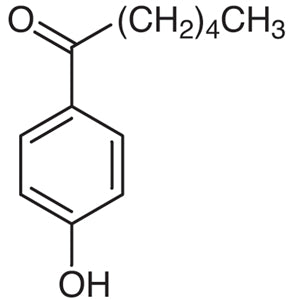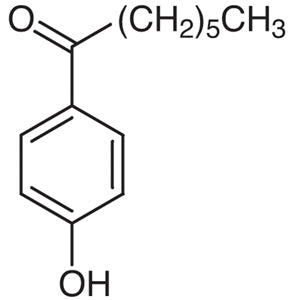
TCI H0864 4'-Hydroxyheptanophenone is an aromatic ketone built from a phenol ring joined to a seven-carbon alkyl chain through a carbonyl group at the para position. The combination of a polar phenolic hydroxyl group with a long hydrocarbon chain gives the molecule a mild amphiphilic character that is fairly distinctive among simple aromatic building blocks. In the laboratory, this compound serves as an intermediate in the synthesis of alkylphenols, liquid crystal materials, stabilizers, and long-chain molecules that require a hydroxylated aromatic core combined with a flexible aliphatic tail.
The properties that make it an attractive choice lie in three complementary working sites. The aryl ketone group can be reduced to a secondary alcohol, deoxygenated through Clemmensen or Wolff-Kishner reduction to give 4-heptylphenol, or reacted with organometallic nucleophiles to build tertiary alcohols. The free phenol group is ready for alkylation or acylation, or it may be protected first as the synthetic design requires. Meanwhile, the long heptanoyl chain improves solubility in non-polar organic solvents and contributes useful hydrophobic character to the resulting structures.
In Indonesian laboratories, materials of this type are typically drawn on by university and institutional research groups working on organic synthesis, materials chemistry, and surfactant or stabilizer development, as well as by industrial R&D teams preparing alkylphenol derivatives. It is usually ordered in research quantities for multi-step synthetic routes, method development, and the preparation of reference intermediates, where a well-defined bifunctional aromatic building block shortens the route to a target molecule.
- Alkylphenol synthesis: the para-substituted aryl ketone can be fully deoxygenated by Clemmensen or Wolff-Kishner reduction to give 4-heptylphenol directly, making this a short route to long-chain alkylphenols.
- Liquid crystal material preparation: the rigid hydroxylated aromatic core paired with a flexible seven-carbon aliphatic tail matches the structural motif commonly required in mesogenic molecular design work.
- Stabilizer intermediate chemistry: the free phenolic hydroxyl group is available for alkylation or acylation, allowing the molecule to be elaborated into phenol-based stabilizer structures.
- Secondary and tertiary alcohol synthesis: the aryl ketone can be reduced to a secondary alcohol or attacked by organometallic nucleophiles to construct tertiary alcohols bearing both aromatic and long-chain substituents.
- Amphiphilic and surfactant-oriented research: the polar phenolic head combined with a long hydrocarbon chain gives the mild amphiphilic character needed when studying interfacial behaviour of aromatic building blocks.
| Brand | TCI (Tokyo Chemical Industry) |
|---|---|
| CAS number | 14392-72-4 |
| Molecular formula | — |
| Purity | — |
| Category | Chemistry > Building Blocks > Non-Heterocyclic Building Blocks |
| Pack sizes | available in standard TCI research pack sizes; please confirm the currently listed packaging option when ordering |
| Physical form | — |
| Storage | store in a tightly closed original container in a cool, dry, well-ventilated place, following the storage statement on the manufacturer's label |
- Catalogue number: H0864
Keep the material in its original tightly closed container in a cool, dry and well-ventilated area, away from heat, direct sunlight, ignition sources and strong oxidising agents. Amber glass or the supplier's original packaging is suitable for storage, and containers should be resealed promptly after weighing to limit moisture uptake and contamination. Handle the compound in a fume hood using a lab coat, chemical-resistant gloves and safety glasses, and avoid generating or inhaling dust. Since phenolic compounds can irritate skin and eyes, wash thoroughly after handling, keep it separate from incompatible materials, and consult the manufacturer's Safety Data Sheet before use, including for waste disposal.
—
Produk Terkait
-
Heptanophenone TCI H0369
Regular price Rp 1.590.750,00Regular price -
4'-Hydroxyhexanophenone TCI H0884
Regular price Rp 2.306.850,00Regular price -
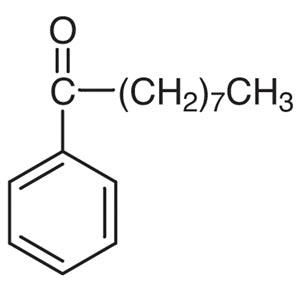
n-Octanophenone TCI O0149
Regular price From Rp 1.724.100,00Regular price -
Methyl6-Hydroxyhexanoate TCI H1938
Regular price From Rp 1.538.250,00Regular price -
Ethyl6-Hydroxyhexanoate TCI E1305
Regular price From Rp 3.100.650,00Regular price -
Ethyl3-Hydroxyhexanoate TCI E0788
Regular price From Rp 2.545.200,00Regular price -
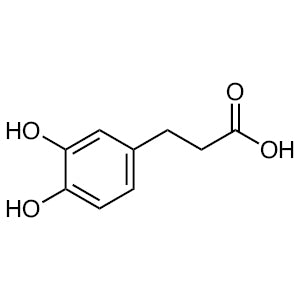
3,4-DihydroxyhydrocinnamicAcid TCI D5901
Regular price From Rp 1.538.250,00Regular price -
Nonanophenone TCI N0568
Regular price Rp 3.763.200,00Regular price