

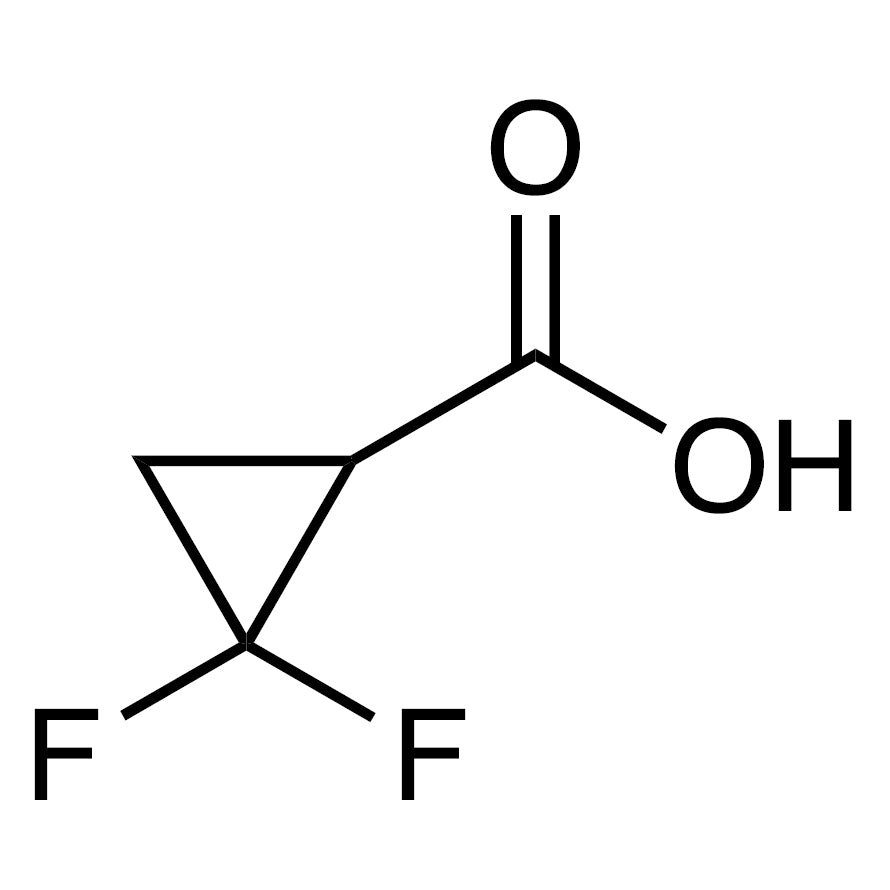
2,2-Difluorocyclopropanecarboxylic Acid is a chemical compound widely used as a foundational building block in organic synthesis. Its unique structure, featuring a cyclopropane ring with two fluorine atoms, makes it a valuable tool in the laboratory for creating complex organic molecules. This compound is particularly useful for researchers aiming to develop new pharmaceuticals or industrial chemicals, as its reactivity can be precisely controlled during synthesis. Due to its specialized properties, it is frequently sought after by chemists working on advanced synthetic routes.
The compound’s reactivity is enhanced by the presence of fluorine atoms, which influence its chemical behavior and stability. This makes it suitable for a variety of reactions where controlled reactivity is essential. Its molecular structure also allows for versatile functionalization, enabling the creation of a wide range of derivatives. These characteristics make it an ideal choice for applications requiring both specificity and adaptability in chemical synthesis.
In Indonesian laboratories, 2,2-Difluorocyclopropanecarboxylic Acid is commonly used in organic chemistry research, especially in projects related to drug development and industrial chemical synthesis. Its availability in the local market supports ongoing scientific investigations and ensures that researchers have access to the necessary materials without the need for international imports.
Related TCI products
- TCI T3765 277756-46-4 1-(Trifluoromethyl)cyclopropane-1-carboxylic Acid
- TCI F1254 137081-41-5 1-Fluorocyclopropanecarboxylic Acid
- TCI F1083 849217-48-7 1-[(4-Fluorophenyl)carbamoyl]cyclopropanecarboxylic Acid
- TCI D6473 509072-57-5 (2,2-Difluorocyclopropyl)methanol
- TCI D4330 122665-97-8 4,4-Difluorocyclohexanecarboxylic Acid
- TCI D5540 22419-35-8 4,4-Difluorocyclohexanol
- Organic synthesis projects benefit from this compound due to its reactivity and ability to form complex molecular structures.
- Drug development research utilizes it as a building block for creating novel pharmaceutical compounds with specific properties.
- Industrial chemical synthesis applications rely on its stability and functionalization potential for producing specialized materials.
- Research on fluorinated compounds uses it to explore the effects of fluorine substitution on molecular behavior.
- Academic laboratories incorporate it into teaching and experimental setups to demonstrate advanced synthetic techniques.
| Brand | TCI |
|---|---|
| CAS number | 107873-03-0 |
| Molecular formula | — |
| Purity | — |
| Category | Chemistry > Building Blocks > Fluorinated Building Blocks |
| Pack sizes | As per supplier specifications |
| Physical form | Solid (as per standard product description) |
| Storage | Store in a cool, dry place away from light and moisture |
This compound should be stored in a cool, dry environment, away from direct sunlight and sources of heat. It is recommended to use airtight containers to prevent moisture absorption and maintain its chemical integrity. Due to its reactivity, it should be handled in a well-ventilated area, and appropriate personal protective equipment should be worn. Avoid exposure to incompatible substances, and ensure that storage conditions are consistent with standard laboratory safety protocols. Proper labeling and secure storage are essential to prevent accidental use or contamination.
—
Produk Terkait
-
1-(Trifluoromethyl)cyclopropane-1-carboxylicAcid TCI T3765
Regular price From Rp 743.400,00Regular price -
1-FluorocyclopropanecarboxylicAcid TCI F1254
Regular price From Rp 2.254.350,00Regular price -
1-[(4-Fluorophenyl)carbamoyl]cyclopropanecarboxylicAcid TCI F1083
Regular price From Rp 689.850,00Regular price -
(2,2-Difluorocyclopropyl)methanol TCI D6473
Regular price From Rp 1.936.200,00Regular price -
4,4-DifluorocyclohexanecarboxylicAcid TCI D4330
Regular price From Rp 1.510.950,00Regular price -
4,4-Difluorocyclohexanol TCI D5540
Regular price From Rp 1.590.750,00Regular price -
2-Fluorocyclohexanol TCI F0631
Regular price From Rp 2.016.000,00Regular price -
4,4-Difluorocyclohexanone TCI D4516
Regular price From Rp 1.140.300,00Regular price


![1-[(4-Fluorophenyl)carbamoyl]cyclopropanecarboxylic Acid (CAS 849217-48-7) - TCI F1083 - AMI Scientific](http://amiscientific.com/cdn/shop/files/TCI2510F1083.jpg?v=1767114129&width=533)


