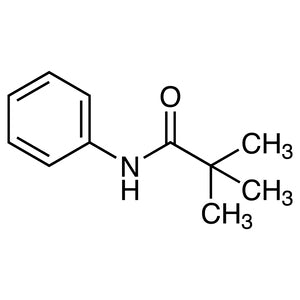
N-Phenylpivalamide is a chemical compound widely used in organic reactions as a building block or intermediate. It plays a crucial role in laboratory settings by serving as a versatile reagent in various synthetic processes. Its simple molecular structure supports the creation of more complex chemical compounds, making it an essential tool for researchers. This compound is commonly employed in esterification, amidation, and substitution reactions, contributing to the development of pharmaceuticals, polymers, and other advanced materials. Its stability and reactivity make it a reliable choice for many chemical applications.
N-Phenylpivalamide is known for its chemical stability and moderate reactivity, which depend on the reaction conditions. It remains resistant to degradation under normal conditions and exhibits good resistance to non-specific chemical reactions. These properties ensure consistent results in laboratory experiments, making it a preferred choice for synthetic chemists. The compound also has well-defined melting and boiling points, which aid in purification and identification processes. Its predictable behavior enhances its usability in both academic and industrial research environments.
In Indonesian laboratories, N-Phenylpivalamide is extensively used by chemists, pharmacologists, and material scientists. It is a key component in the synthesis of bioactive compounds and is integral to research in pharmaceutical development and polymer science. Its availability and reliability make it a staple in both academic and industrial research settings across Indonesia.
Related TCI products
- Organic synthesis applications benefit from N-Phenylpivalamide due to its role as a versatile building block in creating complex chemical structures.
- Pharmaceutical research utilizes this compound for the development of bioactive molecules and drug candidates through amidation and esterification reactions.
- Polymer science applications rely on N-Phenylpivalamide for its ability to participate in substitution reactions, aiding in the synthesis of functional polymers.
- Material science studies incorporate this compound to develop new materials with specific chemical and physical properties.
- Analytical chemistry processes use N-Phenylpivalamide as a reference standard for identifying and quantifying compounds in complex mixtures.
| Brand | TCI |
|---|---|
| CAS number | 6625-74-7 |
| Molecular formula | — |
| Purity | — |
| Category | Chemistry > Building Blocks > Non-Heterocyclic Building Blocks |
| Pack sizes | Available in various quantities as per supplier specifications |
| Physical form | Solid |
| Storage | Store in a cool, dry place away from direct sunlight and moisture |
N-Phenylpivalamide should be stored in a cool, dry environment to maintain its chemical stability. It is recommended to keep it in airtight containers to prevent moisture absorption and contamination. Due to its chemical nature, it should be handled with appropriate personal protective equipment, such as gloves and safety goggles. Avoid exposure to heat and direct sunlight to prevent degradation. In laboratory settings, it should be stored separately from incompatible substances to ensure safety. Regular monitoring of storage conditions is advised to maintain the integrity of the compound.
—
Produk Terkait
-
PivalamidineHydrochloride TCI P1761
Regular price From Rp 2.809.800,00Regular price