

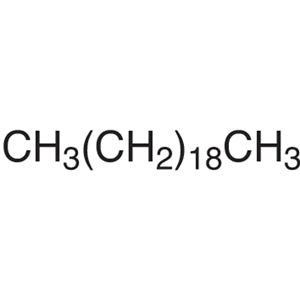
Eicosane (TCI E0003), with the CAS number 112-95-8, is a chemical compound classified as an alkane with the molecular formula C₂₀H₄₂. It serves as a fundamental building block in organic chemistry, widely used in laboratory settings for its structural simplicity and chemical stability. This compound is particularly valuable in synthetic processes where a non-reactive and non-polar environment is required. Its inert nature makes it ideal for applications where maintaining chemical integrity is crucial.
Eicosane is known for its neutral chemical properties, non-reactivity, and non-polar characteristics, which contribute to its reliability in various chemical reactions. These properties ensure that it does not interfere with other compounds or undergo unintended side reactions. Additionally, its high boiling point allows it to remain stable under high-temperature conditions, making it suitable for experiments that require elevated thermal environments. Its lack of functional groups further enhances its safety and predictability in laboratory settings.
In Indonesian laboratories, Eicosane is commonly utilized in pure chemical research and organic synthesis. It is particularly favored for its ability to provide stable, non-polar environments, which are essential in the development of new compounds and materials. Its role in chemical synthesis and research makes it a preferred choice for both academic and industrial applications in the region.
- Organic synthesis experiments benefit from Eicosane's non-reactive and non-polar nature, ensuring minimal interference with reaction pathways.
- Thermal stability applications utilize Eicosane's high boiling point, allowing it to remain stable under elevated temperature conditions.
- Solvent testing and compatibility studies rely on Eicosane's inertness to assess interactions with other compounds without introducing variables.
- Material characterization processes use Eicosane as a reference standard due to its consistent and predictable chemical behavior.
- Non-polar compound isolation and purification techniques employ Eicosane to maintain the integrity of target substances during separation processes.
| Brand | TCI |
|---|---|
| CAS number | 112-95-8 |
| Molecular formula | — |
| Purity | — |
| Category | Chemistry > Building Blocks > Non-Heterocyclic Building Blocks |
| Pack sizes | Available in various quantities as per supplier specifications |
| Physical form | Liquid |
| Storage | Store in a cool, dark place away from heat and direct sunlight |
Eicosane should be stored in a cool, dark location, away from heat and direct sunlight to maintain its chemical stability. It is recommended to use sealed containers made of materials that are chemically inert, such as glass or stainless steel, to prevent any potential contamination or degradation. Due to its non-polar and non-reactive nature, it does not pose significant hazards in standard laboratory conditions. However, it is important to handle it with care to avoid spills or exposure, as it may have physical properties that require attention. Proper labeling and storage practices ensure safe handling and long-term preservation of the compound in laboratory environments.
—
Produk Terkait
-
Eicosane[StandardMaterialforGC] TCI S0292
Regular price Rp 2.068.500,00Regular price -
Undecylcyclohexane TCI U0037
Regular price Rp 6.599.250,00Regular price -
Undecane TCI U0002
Regular price From Rp 505.050,00Regular price -
1,3,5-Trimethyladamantane TCI T3872
Regular price From Rp 2.199.750,00Regular price -
Tetratriacontane TCI T2938
Regular price From Rp 3.260.250,00Regular price -
exo-Tetrahydrodicyclopentadiene TCI T1994
Regular price From Rp 1.246.350,00Regular price -
1,1,2,2-Tetramethylcyclopropane TCI T1721
Regular price Rp 3.180.450,00Regular price -
1,1,3,5-Tetramethylcyclohexane TCI T1717
Regular price Rp 6.148.800,00Regular price
![112-95-8 Eicosane [Standard Material for GC] - AMI Scientific](http://amiscientific.com/cdn/shop/files/TCI2510S0292.jpg?v=1767138629&width=533)


