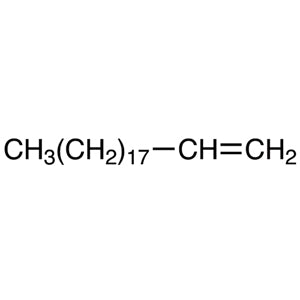
1-Eicosene (CAS 3452-07-1) is an aliphatic compound classified as a non-heterocyclic building block, widely used in chemical experiments to construct more complex molecular structures. It serves as a foundational element in organic synthesis, playing a crucial role in various laboratory processes. This compound is particularly valuable in the development of long-chain carbon compounds, making it an essential tool for researchers in multiple scientific disciplines. Its simplicity and versatility allow it to be a reliable component in both academic and industrial settings.
The stability of 1-Eicosene and its ability to participate in a wide range of chemical reactions make it a preferred choice for laboratory applications. Its non-polar nature and low volatility ensure compatibility with a variety of experimental conditions, while its lack of heteroatoms minimizes the risk of side reactions during synthesis. These characteristics contribute to its popularity in fields such as organic chemistry, pharmaceutical research, and materials science. The compound’s chemical stability also allows for long-term storage without significant degradation, enhancing its practicality for repeated use.
In Indonesian laboratories, 1-Eicosene is commonly utilized in both educational and research environments. It is a key component in the synthesis of organic compounds, particularly in experiments involving hydrogenation, oxidation, and substitution reactions. Its availability and reliability make it a standard material in chemical laboratories across Indonesia, supporting the development of new compounds and materials. Its role in academic training further reinforces its importance in the scientific community.
Related TCI products
- Organic synthesis experiments benefit from 1-Eicosene due to its role as a non-heterocyclic building block, enabling the creation of complex molecular structures with long carbon chains.
- Pharmaceutical research utilizes 1-Eicosene in the development of new compounds, leveraging its stability and compatibility with various chemical reactions.
- Material science applications incorporate 1-Eicosene for the synthesis of polymers and other long-chain organic materials, enhancing the properties of final products.
- Educational institutions use 1-Eicosene in teaching laboratories to demonstrate fundamental chemical reactions and molecular structure building.
- Analytical chemistry laboratories employ 1-Eicosene as a reference standard for chromatographic and spectroscopic analyses due to its consistent properties and purity.
| Brand | TCI |
|---|---|
| CAS number | 3452-07-1 |
| Molecular formula | — |
| Purity | — |
| Category | Chemistry > Building Blocks > Non-Heterocyclic Building Blocks |
| Pack sizes | Available in various quantities as per supplier specifications |
| Physical form | Liquid |
| Storage | Store in a cool, dry place away from direct sunlight and incompatible materials |
1-Eicosene should be stored in a cool, dry environment, away from direct sunlight and sources of heat. It is recommended to use sealed containers made of materials compatible with organic solvents to prevent evaporation and contamination. Due to its non-polar nature, it is important to ensure that the storage area is free from reactive substances that could cause unwanted chemical interactions. Proper labeling of containers is essential for safety and traceability. In laboratory settings, personal protective equipment such as gloves and safety goggles should be worn when handling this compound to minimize exposure risks. Regular inspection of storage conditions ensures the compound remains stable and suitable for use in research and educational applications.
—
Produk Terkait
-
1-Eicosene TCI E0774
Regular price Rp 3.472.350,00Regular price -
1-Eicosene[StandardMaterialforGC] TCI S0350
Regular price Rp 3.843.000,00Regular price -
9-Vinylanthracene TCI V0130
Regular price From Rp 2.545.200,00Regular price -
5-Vinylbicyclo[221]hept-2-ene(stabilizedwithBHT) TCI V0062
Regular price From Rp 769.650,00Regular price -
1,3,5-Undecatriene(mixtureofisomers) TCI U0062
Regular price From Rp 3.155.250,00Regular price -
1-Undecene TCI U0052
Regular price From Rp 2.068.500,00Regular price -
1-Undecene TCI U0025
Regular price Rp 1.060.500,00Regular price -
1,10-Undecadiene TCI U0024
Regular price From Rp 2.491.650,00Regular price

![TCI S0350 3452-07-1 1-Eicosene [Standard Material for GC] — struktur kimia](http://amiscientific.com/cdn/shop/files/TCI2510S0350-struktur.jpg?v=1791525192&width=533)

![3048-64-4 5-Vinylbicyclo[2.2.1]hept-2-ene (stabilized with BHT) - AMI Scientific](http://amiscientific.com/cdn/shop/files/TCI2510V0062.jpg?v=1767145572&width=533)