

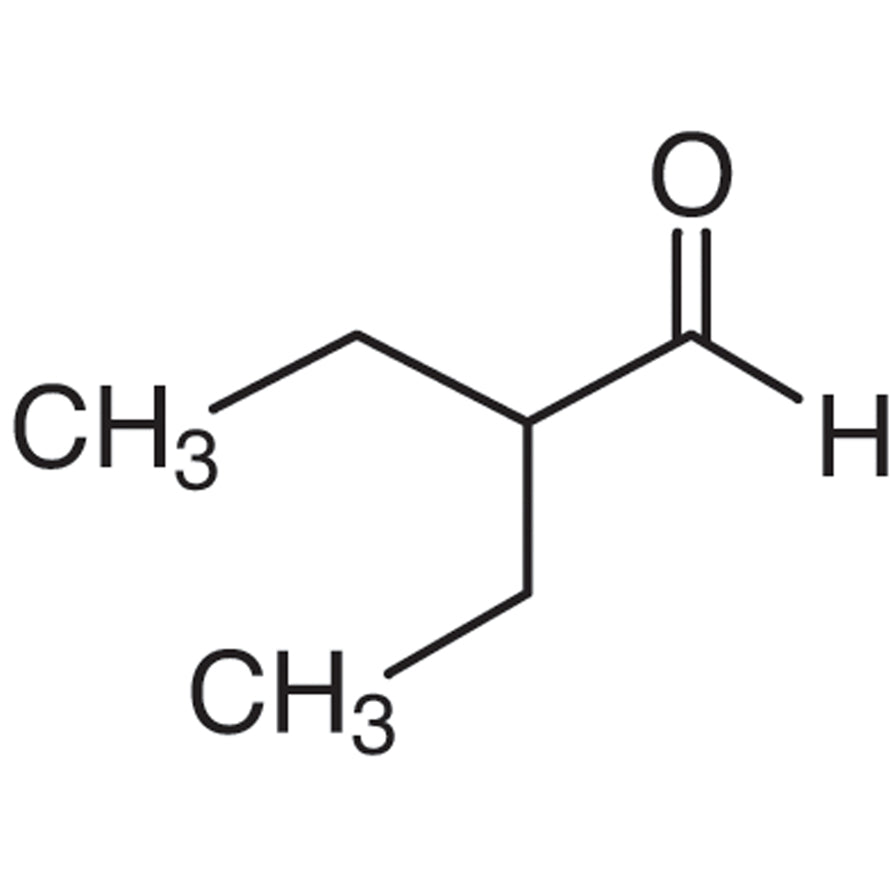
TCI E0069 2-Ethylbutyraldehyde is a branched aliphatic aldehyde that carries a carbonyl group at the end of the carbon chain, with an ethyl branch on the adjacent carbon atom. In the organic synthesis laboratory, aldehydes occupy a central position because the carbonyl group can be converted into a wide range of other functional groups — alcohols, carboxylic acids, imines, and longer carbon chains built up through condensation reactions. This compound therefore serves as a practical non-heterocyclic building block whenever a researcher needs a branched carbon skeleton bearing one clearly defined reactive site.
The reason this compound is selected lies in the high reactivity of the aldehyde group toward nucleophiles, together with the presence of alpha hydrogen atoms that allow the formation of enols and enolates. These two characteristics open the way to aldol reactions, Knoevenagel condensations, reductive aminations, and Wittig reactions with predictable outcomes. The ethyl branch at the alpha position gives the molecule steric character and lipophilic behaviour that differ from those of straight-chain aldehydes, which makes it useful for tuning the physical properties of the final product.
Because the material is supplied as a liquid, it is straightforward to pipette and measure accurately, and the availability of a 25 mL pack suits the working scale of most Indonesian laboratories. University research groups, chemistry teaching laboratories, and industrial R&D units typically draw on a reagent of this kind for exploratory synthesis, method development, and small-batch preparation of intermediates, where a modest quantity of a well-defined building block is more appropriate than a bulk container.
- Aldol condensation reactions — the alpha hydrogen atoms allow clean enol and enolate formation, giving access to beta-hydroxy carbonyl products and extended branched carbon chains.
- Knoevenagel condensation — the reactive carbonyl group couples readily with active methylene compounds, providing a reliable route to alpha,beta-unsaturated products for further functionalisation.
- Reductive amination — the aldehyde reacts with primary and secondary amines to form imine intermediates that are then reduced to branched amine products.
- Wittig olefination — the carbonyl group serves as the electrophilic partner for phosphonium ylides, converting the aldehyde into a defined alkene with predictable geometry.
- Functional group interconversion studies — the single reactive site permits controlled oxidation to the carboxylic acid or reduction to the corresponding alcohol during method development work.
| Brand | TCI |
|---|---|
| CAS number | 97-96-1 |
| Molecular formula | — |
| Purity | — |
| Category | Chemistry > Building Blocks > Non-Heterocyclic Building Blocks |
| Pack sizes | 25 mL (additional pack sizes may be available on request) |
| Physical form | liquid |
| Storage | keep in a tightly closed original container in a cool, well-ventilated place away from ignition sources |
Store the container tightly closed in a cool, dry, well-ventilated area, away from heat, sparks, and open flame, and keep it separated from strong oxidising agents. The original manufacturer bottle is the most suitable container; if transfer is necessary, use compatible glassware with a secure closure and label it clearly with the compound name and CAS number. Handle the liquid inside a fume hood to limit vapour inhalation, and wear safety glasses, chemical-resistant gloves, and a laboratory coat. Aldehydes are prone to slow oxidation on exposure to air, so close the container promptly after dispensing and avoid keeping it open longer than necessary. Dispose of residues and contaminated materials through the laboratory's designated chemical waste stream, and always consult the manufacturer's safety data sheet before first use.
—
Produk Terkait
-
Butyraldehyde TCI B0751
Regular price From Rp 477.750,00Regular price -
2-Methylbutyraldehyde TCI M0166
Regular price Rp 557.550,00Regular price -
3,3-Dimethylbutyraldehyde TCI D4098
Regular price From Rp 2.597.700,00Regular price -
Magnesium(II)2-Ethylbutyrate TCI E0396
Regular price Rp 2.677.500,00Regular price -
Isobutyraldehyde TCI I0101
Regular price From Rp 452.550,00Regular price -
Isopropyl2-Methylbutyrate TCI I0736
Regular price From Rp 477.750,00Regular price -
Propyl2-Methylbutyrate TCI P1809
Regular price Rp 1.326.150,00Regular price -
MethylDL-2-Methylbutyrate TCI M0758
Regular price From Rp 664.650,00Regular price


