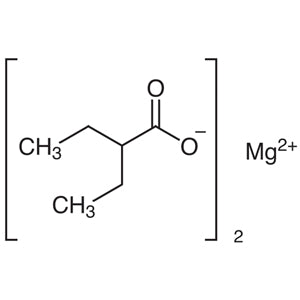
Magnesium(II) 2-Ethylbutyrate is a chemical compound widely used in synthetic laboratory reactions. It serves as a versatile building block in the creation of complex molecules, particularly in organic chemistry. This compound is an ester derived from 2-ethylbutanoic acid, making it a key reagent in various chemical transformations. Its role in the laboratory is primarily as a reagent or catalyst, supporting the synthesis of a wide range of organic compounds. Due to its chemical stability and controlled reactivity, it is a preferred choice for researchers aiming to achieve precise chemical outcomes.
The compound’s chemical properties make it a preferred choice in laboratory settings. It exhibits good solubility in organic solvents such as ethyl acetate and ethanol, which simplifies mixing and separation processes. Its non-polar nature makes it suitable for reactions requiring non-polar solvents. Additionally, it does not contain harmful heavy metal ions, enhancing its safety profile in laboratory environments. These characteristics contribute to its reliability and ease of use in both academic and industrial research.
In Indonesian laboratories, Magnesium(II) 2-Ethylbutyrate is commonly used in organic synthesis applications. It is frequently employed in esterification reactions and the synthesis of aromatic and heterocyclic compounds. Its availability through suppliers like AMI Scientific ensures that researchers in Indonesia have access to this essential reagent for their experimental needs. The compound’s utility in various synthetic pathways underscores its importance in modern chemical research.
TCI brochures (PDF)
- Lipids 2025-12-17 · p. 6
Related TCI products
- Esterification Reactions: Magnesium(II) 2-Ethylbutyrate is ideal for esterification due to its stability and reactivity, enabling the formation of ester compounds efficiently.
- Organic Synthesis of Aromatic Compounds: Its chemical structure supports the synthesis of aromatic compounds, making it a valuable tool in synthetic chemistry.
- Heterocyclic Compound Production: The compound's reactivity allows it to participate in reactions that build heterocyclic structures, essential in pharmaceutical and chemical research.
- Solvent Compatibility Applications: Its solubility in organic solvents makes it suitable for use in reactions requiring compatible solvent systems.
- Catalytic Processes: It acts as a catalyst in various synthetic pathways, enhancing reaction efficiency and yield in laboratory settings.
| Brand | TCI |
|---|---|
| CAS number | 79992-76-0 |
| Molecular formula | — |
| Purity | — |
| Category | Chemistry > Building Blocks > Non-Heterocyclic Building Blocks |
| Pack sizes | Available in standard laboratory quantities |
| Physical form | Solid or liquid, depending on formulation |
| Storage | Store in a cool, dry place away from moisture and direct sunlight |
Magnesium(II) 2-Ethylbutyrate should be stored in a cool, dry environment to maintain its chemical stability. It is recommended to keep the compound in airtight containers to prevent exposure to moisture and air, which could affect its properties. Suitable containers include glass or high-density polyethylene bottles to ensure chemical compatibility. In laboratory settings, it should be handled with standard safety precautions, such as wearing gloves and goggles, to prevent direct contact. Proper labeling of storage containers is essential for safe handling and easy identification. The compound is non-toxic and non-corrosive, but it should be stored away from incompatible materials to ensure long-term stability and safety.
—
Produk Terkait
-
Isopropyl2-Methylbutyrate TCI I0736
Regular price From Rp 477.750,00Regular price -
Propyl2-Methylbutyrate TCI P1809
Regular price Rp 1.326.150,00Regular price -
MethylDL-2-Methylbutyrate TCI M0758
Regular price From Rp 664.650,00Regular price -
EthylDL-2-Methylbutyrate TCI M0757
Regular price From Rp 848.400,00Regular price -
cis-3-Hexen-1-yl2-Methylbutyrate TCI M0734
Regular price Rp 1.618.050,00Regular price -
2-MethylbutylDL-2-Methylbutyrate TCI M0578
Regular price Rp 452.550,00Regular price -
Calcium3-Hydroxy-3-methylbutyrate TCI H0917
Regular price Rp 1.724.100,00Regular price -
Methyl4-Chloro-2-methylbutyrate TCI C1319
Regular price From Rp 1.140.300,00Regular price