

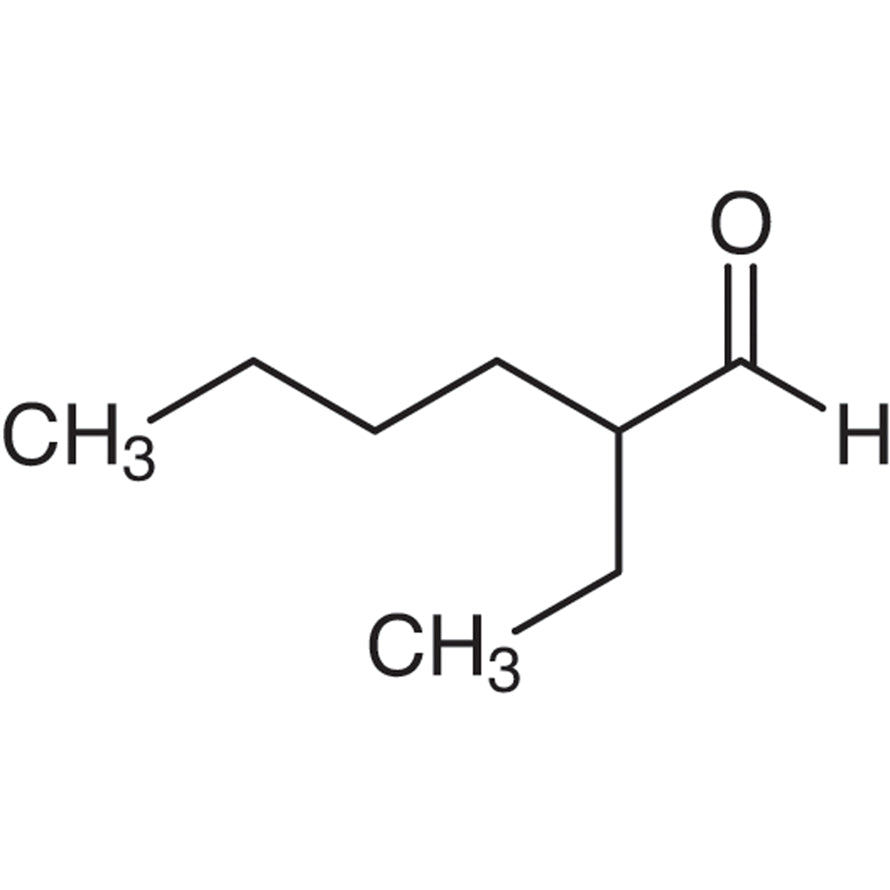
2-Ethylhexanal, CAS 123-05-7, is a branched aliphatic aldehyde widely used as an intermediate raw material in organic synthesis. The aldehyde carbonyl group at the end of the carbon chain makes this compound a highly flexible starting point for a broad range of chemical transformations, including oxidation, reduction, condensation, and the formation of new carbon–carbon bonds. In research laboratories, this material is frequently selected when researchers need a branched carbon skeleton that already carries a reactive functional group, allowing synthetic routes to be shortened without having to construct the chain branching from the beginning.
The characteristic that makes 2-Ethylhexanal a preferred choice is the combination of the high reactivity of the aldehyde group with the presence of an ethyl branch at the alpha position. This branching introduces a distinctive steric hindrance, so that its derivative products often display solubility, viscosity, and surface properties that differ from those of straight-chain analogues. Such behaviour is particularly valuable in the development of plasticisers, synthetic lubricants, and surfactants. In addition, the alpha hydrogen atom that remains available allows aldol condensation reactions to proceed, further extending the range of accessible derivatives.
In Indonesian laboratories, 2-Ethylhexanal is typically handled in university research groups, institutional chemistry laboratories, and industrial R&D units working on organic synthesis and specialty materials. It is generally used at bench scale for building-block work, method development, and the preparation of derivatives that are later scaled up, and it is normally stored alongside other reactive organic intermediates under controlled conditions in a well-ventilated chemical store.
- Organic synthesis intermediate — the terminal aldehyde group provides a reactive handle for oxidation, reduction, and further functionalisation, shortening multi-step routes toward branched target molecules.
- Carbon–carbon bond formation — the carbonyl carbon accepts nucleophiles readily, making this reagent a practical electrophilic partner when researchers need to extend a branched carbon framework.
- Aldol condensation studies — the available alpha hydrogen atom allows aldol reactions to proceed, so the compound serves well in teaching and investigating classical condensation chemistry.
- Plasticiser and synthetic lubricant development — the alpha ethyl branch imparts steric hindrance that gives derivative products viscosity and solubility profiles unlike straight-chain aldehyde derivatives.
- Surfactant research — branched derivatives prepared from this aldehyde often show distinctive surface properties, which supports laboratory-scale exploration of new surface-active formulations.
| Brand | TCI |
|---|---|
| CAS number | 123-05-7 |
| Molecular formula | — |
| Purity | — |
| Category | Chemistry > Building Blocks > Non-Heterocyclic Building Blocks |
| Pack sizes | available in the standard TCI research pack sizes; please refer to the current catalogue listing |
| Physical form | — |
| Storage | store in a cool, dry, well-ventilated area away from ignition sources and strong oxidising agents |
- Catalogue number: E0125
Store 2-Ethylhexanal in a cool, dry, and well-ventilated location, away from heat, open flame, and other ignition sources, and keep it separated from strong oxidising agents. Use tightly closed containers of a material compatible with aldehydes, and keep the container sealed when not in use to limit exposure to air and moisture. Handle the material inside a fume hood, wearing safety goggles, chemical-resistant gloves, and a laboratory coat. Transfer only the quantity required for the work at hand, avoid inhalation of vapours and contact with skin or eyes, and consult the manufacturer's safety data sheet before use and before disposal.
—
Produk Terkait
-
3,5,5-Trimethylhexanal TCI T0940
Regular price From Rp 717.150,00Regular price -
Triethylhexanoin TCI T4161
Regular price From Rp 743.400,00Regular price -
3,5,5-TrimethylhexanoylChloride TCI T0951
Regular price Rp 795.900,00Regular price -
3,5,5-TrimethylhexanoicAcid TCI T0630
Regular price From Rp 477.750,00Regular price -
Sodium2-Ethylhexanoate TCI S0862
Regular price Rp 452.550,00Regular price -
5-MethylhexanoicAcid TCI M1142
Regular price From Rp 1.246.350,00Regular price -
2-MethylhexanoicAcid TCI M0947
Regular price From Rp 689.850,00Regular price -
2-Ethylhexyl2-Ethylhexanoate TCI E1609
Regular price Rp 3.498.600,00Regular price


