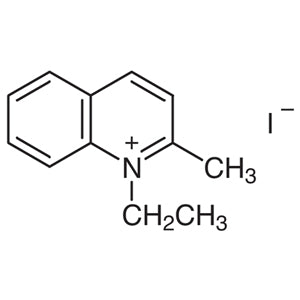
TCI E0172 Quinaldine Ethiodide is a quaternary ammonium salt derived from quinaldine, also known as 2-methylquinoline, in which the ring nitrogen has been ethylated and paired with an iodide counter-ion. Because the quinoline core carries a nitrogen atom within the ring itself, the compound belongs to the family of heterocyclic building blocks. In the laboratory, quinolinium salts of this type serve as key starting materials in dye chemistry, particularly for constructing cyanine compounds and other conjugated derivatives, and they are also employed in studies of charged heterocyclic systems and their photophysical behaviour.
The feature that gives this compound its synthetic value is the methyl group at position 2, which becomes far more reactive once the nitrogen bears a positive charge. That positive charge withdraws electron density and activates the protons on the methyl group, so the group is readily deprotonated by a base and can then be condensed directly with aldehydes or other electrophilic reagents to extend the conjugated system. This reactivity is the foundation of cyanine dye formation, the class of compounds known for absorbing light very strongly. As an ionic salt, the material is a solid that dissolves well in polar solvents such as alcohols, which makes preparing reaction solutions straightforward.
In Indonesian laboratories, this compound is typically handled as a bench-scale reagent for synthetic and photophysical work rather than as a bulk chemical. Its good solubility in alcoholic media suits the solvent systems commonly stocked in academic and institutional laboratories, and its role as a defined heterocyclic building block makes it a practical choice for research groups preparing conjugated dye systems and studying the behaviour of charged heterocycles.
- Cyanine dye synthesis — the activated 2-methyl group condenses readily with aldehydes after deprotonation, providing the direct route to strongly light-absorbing conjugated cyanine structures.
- Heterocyclic building block chemistry — the quinoline core with its in-ring nitrogen atom offers a defined scaffold for assembling more elaborate nitrogen-containing heterocyclic targets in synthetic work.
- Conjugated system extension — condensation with electrophilic reagents lengthens the conjugated chain, allowing researchers to build and tune extended chromophoric systems from a single starting salt.
- Photophysical studies — as a charged heterocyclic compound it serves as a model system for investigating how positive charge on ring nitrogen influences light absorption and related optical behaviour.
- Solution-phase reagent preparation — its ionic salt character gives good solubility in polar solvents such as alcohols, so reaction solutions and stock mixtures are simple to prepare accurately.
| Brand | TCI |
|---|---|
| CAS number | 606-55-3 |
| Molecular formula | — |
| Purity | — |
| Category | Chemistry > Building Blocks > Heterocyclic Building Blocks |
| Pack sizes | available in standard TCI research and laboratory pack sizes |
| Physical form | solid (ionic quaternary salt) |
| Storage | keep in a tightly closed container in a cool, dry place away from light |
Store the material in its original tightly closed container in a cool, dry place, protected from light and moisture, since iodide salts of this type are best kept away from humid air and prolonged light exposure. Amber glass bottles or the supplier's original packaging are suitable containers, and the cap should be replaced immediately after each use. Handle the solid in a well-ventilated area or fume hood using safety glasses, gloves, and a laboratory coat, avoiding the generation of dust and any contact with skin or eyes. Weigh out only the quantity required, keep the container clearly labelled, and consult the manufacturer's safety data sheet before use and before disposing of any residues.
—
Produk Terkait
-
QuinolineEthiodide TCI E0173
Regular price Rp 1.565.550,00Regular price -
1,2,3,4-Tetrahydroquinaldine TCI T0112
Regular price From Rp 3.127.950,00Regular price -
QuinaldineRed TCI Q0007
Regular price From Rp 664.650,00Regular price -
7-Chloroquinaldine TCI C1453
Regular price From Rp 1.378.650,00Regular price