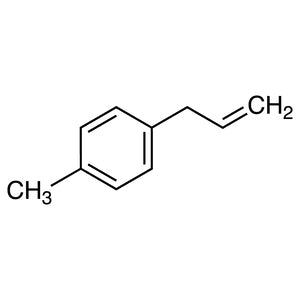
TCI E0186 4-Ethyltoluene is a liquid aromatic hydrocarbon carrying an ethyl group and a methyl group positioned opposite one another at the para positions of the benzene ring. This symmetrical arrangement makes it the most structurally ordered of the ethyltoluene isomers, and also the most readily identified by NMR spectroscopy because it produces a simple aromatic signal pattern. In the laboratory, the compound serves as an analytical reference substance, as a raw material in materials research, and as a model substrate in studies of aromatic reactions that require a ring with clearly defined substitution.
The properties that make this compound a frequent choice begin with its molecular symmetry, which greatly simplifies the interpretation of spectroscopic data. Added to this is the clarity of its reactive positions, since both para positions are already occupied by alkyl groups. In materials research, the para-ethyltoluene framework is recognised as a route toward aromatic vinyl derivatives through dehydrogenation of the ethyl group, which is why the compound appears regularly in catalysis studies concerned with aromatic monomers. As a non-polar hydrocarbon it remains stable under ordinary storage conditions, is insoluble in water, and mixes completely with non-polar organic solvents.
In Indonesian laboratories, TCI E0186 is typically encountered in university research groups, institutional chemistry laboratories, and industrial research units working on aromatic chemistry and polymer precursor studies. Its predictable spectroscopic behaviour makes it useful wherever a well-characterised aromatic reference is needed for instrument checks or method development, while its role as a defined model substrate suits synthetic and catalytic investigations that require a ring whose substitution pattern is unambiguous from the outset.
- Analytical reference standard — the simple aromatic signal pattern arising from its para symmetry gives an easily recognised reference point for NMR method development and routine instrument verification work.
- Aromatic reaction model substrate — both para positions are already blocked by alkyl groups, so reaction sites are clearly defined and mechanistic studies avoid ambiguity from competing substitution pathways.
- Catalysis research on aromatic monomers — the para-ethyltoluene framework is a recognised route to aromatic vinyl derivatives via dehydrogenation of the ethyl group, supporting monomer-oriented catalyst evaluation.
- Materials research raw material — the compound is used as a defined aromatic starting material where a structurally ordered, well-characterised ring system is required for downstream derivative preparation.
- Non-polar organic solvent systems — complete miscibility with non-polar organic solvents and insolubility in water make it suitable for preparing organic-phase reaction and reference mixtures.
| Brand | TCI (Tokyo Chemical Industry) |
|---|---|
| CAS number | 622-96-8 |
| Molecular formula | — |
| Purity | — |
| Category | Chemistry > Building Blocks > Non-Heterocyclic Building Blocks |
| Pack sizes | available in standard TCI catalogue pack sizes; please confirm the required packing when ordering |
| Physical form | liquid aromatic hydrocarbon, non-polar |
| Storage | stable under ordinary laboratory storage conditions |
- Solubility: insoluble in water, completely miscible with non-polar organic solvents
Store the container tightly closed in a cool, dry, well-ventilated area away from heat sources, open flame, and direct sunlight, since the material is a volatile organic liquid. Original manufacturer packaging or compatible tightly sealed glass or metal containers are appropriate; avoid containers that may be degraded by non-polar organic liquids. Handle inside a functioning fume hood to limit vapour exposure, and wear safety goggles, chemically resistant gloves, and a laboratory coat during transfer and weighing. Keep the working area free of ignition sources, ground containers where large volumes are transferred, and clean up spills promptly with an inert absorbent. Always consult the manufacturer's safety data sheet before first use and follow institutional waste disposal procedures for organic solvent residues.
—
Produk Terkait
-
3-tert-Butyl-5-ethyltoluene TCI B1459
Regular price Rp 1.696.800,00Regular price -
3-Ethyltoluene TCI E0185
Regular price From Rp 1.644.300,00Regular price -
2-Ethyltoluene TCI E0184
Regular price From Rp 1.618.050,00Regular price -
3-tert-Butyltoluene TCI B0967
Regular price From Rp 4.797.450,00Regular price -
2-tert-Butyltoluene TCI B0966
Regular price Rp 4.743.900,00Regular price -
4-tert-Butyltoluene TCI B0744
Regular price Rp 769.650,00Regular price -
4-Allyltoluene TCI A3685
Regular price Rp 1.644.300,00Regular price -
4-Propyltoluene TCI P0749
Regular price Rp 1.988.700,00Regular price