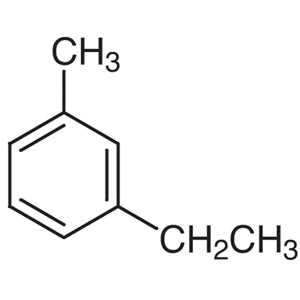
TCI E0185 3-Ethyltoluene is a liquid aromatic hydrocarbon bearing an ethyl group and a methyl group separated by one ring carbon, meaning the two substituents sit in the meta position relative to one another. The compound is one of the C9 alkylbenzene isomers most commonly encountered in the heavy aromatic fractions obtained from petroleum distillation. In the laboratory its principal roles are as an analytical reference compound, as a model substrate in catalysis research, and as an aromatic solvent for reactions that require a nonpolar medium with a relatively high boiling point.
The property that makes this material important is its meta arrangement, which gives the substituents looser freedom of movement than in the ortho isomer while at the same time producing a spectral pattern and a retention time distinct from those of the para isomer. Because all three ethyltoluene isomers share the same molecular mass, mass spectrometry alone is not sufficient to distinguish between them, so the availability of a reference compound for each individual isomer becomes an absolute requirement for confident identification. Its nonpolar character, good chemical stability under ordinary conditions, and complete miscibility with nonpolar organic solvents make it straightforward to use across many types of experiment without demanding special handling procedures.
In Indonesian laboratories, this grade is typically drawn upon by petrochemical and refinery analysis groups, university chemistry departments, and instrumentation laboratories that maintain calibration libraries for aromatic hydrocarbons. It is used where an isomer-specific standard is needed to confirm peak assignments, and where a well-behaved aromatic solvent is wanted for synthetic or catalytic work. Its ready compatibility with common organic media allows it to slot into existing methods with little adjustment.
- Analytical reference standard for chromatography — the compound provides an isomer-specific retention time that allows analysts to assign C9 aromatic peaks with confidence rather than relying on molecular mass alone.
- Identification of ethyltoluene isomers — because the three isomers are indistinguishable by mass spectrometry, this meta reference material is required to separate the meta signal from ortho and para responses.
- Petroleum aromatic fraction characterisation — as one of the C9 alkylbenzenes most abundant in heavy aromatic distillation cuts, it serves as a benchmark component when profiling refinery streams.
- Model substrate in catalysis research — the defined meta substitution pattern gives researchers a substrate whose steric environment is looser than the ortho isomer, useful for probing selectivity behaviour.
- Nonpolar aromatic reaction solvent — its relatively high boiling point and full miscibility with nonpolar organic solvents suit reactions needing a stable aromatic medium at elevated temperature.
| Brand | TCI |
|---|---|
| CAS number | 620-14-4 |
| Molecular formula | — |
| Purity | — |
| Category | Chemistry > Building Blocks > Non-Heterocyclic Building Blocks |
| Pack sizes | available in the pack sizes listed for this catalogue item |
| Physical form | liquid aromatic hydrocarbon |
| Storage | keep in a tightly closed container in a cool, well-ventilated area away from ignition sources |
Store the material in a tightly closed original container in a cool, dry and well-ventilated location, kept away from heat, sparks and open flame, and separated from strong oxidising agents. Amber glass or the manufacturer's supplied packaging is appropriate, since aromatic hydrocarbons of this type are best kept out of direct light and away from plastics they may soften. Handle inside a fume hood to limit vapour inhalation, and wear safety glasses, a laboratory coat and chemically resistant gloves. Keep transfer volumes small, use grounded equipment where flammable vapours may accumulate, and clean up any spill promptly with inert absorbent material. Always consult the manufacturer's safety data sheet before first use.
—
Produk Terkait
-
3-tert-Butyl-5-ethyltoluene TCI B1459
Regular price Rp 1.696.800,00Regular price -
4-Ethyltoluene TCI E0186
Regular price From Rp 3.578.400,00Regular price -
2-Ethyltoluene TCI E0184
Regular price From Rp 1.618.050,00Regular price -
3-tert-Butyltoluene TCI B0967
Regular price From Rp 4.797.450,00Regular price -
2-tert-Butyltoluene TCI B0966
Regular price Rp 4.743.900,00Regular price -
4-tert-Butyltoluene TCI B0744
Regular price Rp 769.650,00Regular price -
4-Allyltoluene TCI A3685
Regular price Rp 1.644.300,00Regular price -
4-Propyltoluene TCI P0749
Regular price Rp 1.988.700,00Regular price