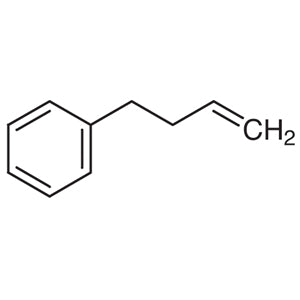
4-Allyltoluene is a chemical compound widely used as a foundational building block in various laboratory applications, particularly in the synthesis of complex organic molecules. Its unique molecular structure, consisting of a toluene group connected to an allyl chain, makes it a versatile reagent that can participate in multiple types of chemical reactions. This compound plays a crucial role in both research and educational settings, enabling chemists to create new compounds with specific functional groups and properties. Due to its reactivity and structural simplicity, it is often selected for its ability to undergo substitution, addition, and polymerization reactions under controlled conditions.
The chemical properties of 4-Allyltoluene make it a preferred choice for laboratory use. It exhibits stability under normal conditions but shows high reactivity in specific chemical environments, which is essential for its role in synthetic processes. Its distinct aroma allows for easy detection during experiments, enhancing the accuracy of identification. Additionally, its compatibility with various reaction conditions and solvents makes it a reliable reagent for a wide range of applications. The compound’s ability to participate in multiple reaction types further increases its utility in both academic and industrial research.
In Indonesian laboratories, 4-Allyltoluene is commonly used in organic chemistry research, especially in the development of new compounds. It is also frequently employed in higher education institutions to teach students about organic reactivity and synthetic strategies. Its widespread use in both research and teaching highlights its importance as a fundamental building block in the field of chemistry. The compound’s versatility and reactivity make it an essential tool for chemists working in diverse experimental settings.
Related TCI products
- TCI I0298 7399-49-7 2-Isopropenyltoluene (stabilized with BHT)
- TCI V0130 2444-68-0 9-Vinylanthracene
- TCI B1550 76439-00-4 1,4-Bis(4-methylstyryl)benzene
- TCI P0609 300-57-2 Allylbenzene
- TCI P0495 637-50-3 beta-Methylstyrene (cis- and trans- mixture) (stabilized with TBC)
- TCI P0161 768-56-9 4-Phenyl-1-butene
- Organic synthesis is a key application where 4-Allyltoluene is used to create complex molecules through substitution and addition reactions.
- Polymer research benefits from its reactivity, allowing it to participate in polymerization processes to form new materials.
- Educational institutions use it to demonstrate organic reactivity and synthetic techniques to students in chemistry courses.
- Drug development projects often incorporate this compound as a building block for synthesizing pharmaceutical compounds.
- Analytical chemistry laboratories use it as a standard reference material for testing and calibrating analytical instruments.
| Brand | TCI |
|---|---|
| CAS number | 3333-13-9 |
| Molecular formula | — |
| Purity | — |
| Category | Chemistry > Building Blocks > Non-Heterocyclic Building Blocks |
| Pack sizes | Available in various quantities as per supplier specifications |
| Physical form | Liquid |
| Storage | Store in a cool, dry place away from direct sunlight |
4-Allyltoluene should be stored in a cool, dry environment, away from direct sunlight and sources of heat. It is recommended to keep the compound in tightly sealed containers made of materials compatible with organic solvents, such as glass or high-density polyethylene. Due to its reactivity, it should be handled in a well-ventilated area, preferably under a fume hood, to minimize exposure. Laboratory personnel should wear appropriate personal protective equipment, including gloves and safety goggles, when working with this compound. It is important to avoid contact with skin and eyes, and to ensure proper disposal according to local regulations. Regular monitoring of storage conditions is essential to maintain the compound’s stability and effectiveness in experimental applications.
—
Produk Terkait
-
2-Isopropenyltoluene(stabilizedwithBHT) TCI I0298
Regular price From Rp 5.062.050,00Regular priceRp 3.539.550,00Sale price From Rp 5.062.050,00 -
9-Vinylanthracene TCI V0130
Regular price From Rp 2.545.200,00Regular priceRp 1.779.750,00Sale price From Rp 2.545.200,00 -
1,4-Bis(4-methylstyryl)benzene TCI B1550
Regular price Rp 5.194.350,00Regular priceRp 3.631.950,00Sale price Rp 5.194.350,00 -
Allylbenzene TCI P0609
Regular price From Rp 1.565.550,00Regular priceRp 1.094.100,00Sale price From Rp 1.565.550,00 -
beta-Methylstyrene(cis-andtrans-mixture)(stabilizedwithTBC) TCI P0495
Regular price Rp 4.771.200,00Regular priceRp 3.335.850,00Sale price Rp 4.771.200,00 -
4-Phenyl-1-butene TCI P0161
Regular price From Rp 848.400,00Regular priceRp 593.250,00Sale price From Rp 848.400,00 -
(2-Methylallyl)benzene TCI M3806
Regular price From Rp 2.625.000,00Regular priceRp 1.835.400,00Sale price From Rp 2.625.000,00 -
(mixtureof1H-and3H-form) TCI M1425
Regular price From Rp 3.287.550,00Regular priceRp 2.298.450,00Sale price From Rp 3.287.550,00