

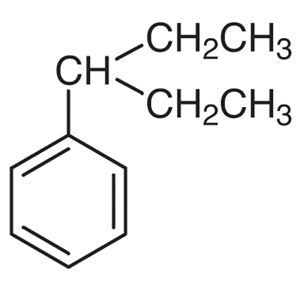
(1-Ethylpropyl)benzene is an organic chemical compound widely used as a foundational material in various laboratory reactions. It serves as a building block in synthetic chemistry, particularly in organic synthesis and pharmaceutical research. This compound is essential for creating more complex molecules by participating in substitution and catalytic reactions. Its structural simplicity and chemical stability make it a reliable choice for researchers seeking to develop new compounds with specific functional groups.
The compound's non-polar nature and volatility are key properties that make it a preferred choice in laboratory settings. These characteristics allow it to function effectively as a solvent in organic reactions and as a component in distillation and chromatography processes. Its controlled reactivity ensures minimal side reactions, making it suitable for applications requiring high chemical purity. Additionally, its lack of heterocyclic groups reduces the risk of unwanted interactions, enhancing its versatility in synthetic pathways.
In Indonesian laboratories, (1-Ethylpropyl)benzene is commonly used in organic chemistry research and the development of new compounds. Its availability in liquid form facilitates easy handling and integration into various experimental scales. Researchers in Indonesia rely on this compound for its reliability and consistency, supporting both academic and industrial chemical applications. Its role in synthetic chemistry remains vital, contributing to the advancement of pharmaceutical and chemical industries in the region.
Related TCI products
- Organic synthesis applications benefit from (1-Ethylpropyl)benzene due to its stability and controlled reactivity, enabling the creation of complex molecular structures.
- Pharmaceutical research utilizes this compound as a building block for synthesizing active pharmaceutical ingredients, leveraging its predictable chemical behavior.
- Distillation processes incorporate (1-Ethylpropyl)benzene as a volatile component, aiding in the separation of compounds based on boiling point differences.
- Chromatography techniques rely on its non-polar nature, making it an effective solvent for separating non-polar compounds in analytical procedures.
- High-purity chemical applications prefer this compound because of its lack of heterocyclic groups, minimizing the risk of impurities in sensitive reactions.
| Brand | TCI |
|---|---|
| CAS number | 1196-58-3 |
| Molecular formula | — |
| Purity | — |
| Category | Chemistry > Building Blocks > Non-Heterocyclic Building Blocks |
| Pack sizes | Available in various quantities as per supplier specifications |
| Physical form | Liquid |
| Storage | Store in a cool, dry place away from direct sunlight |
(1-Ethylpropyl)benzene should be stored in a cool, dry environment to maintain its chemical stability and prevent degradation. It is recommended to keep the compound in tightly sealed containers made of materials such as glass or high-density polyethylene to prevent evaporation and contamination. Due to its volatility, proper ventilation is essential when handling the substance in a laboratory setting. Avoid exposure to heat sources or open flames to minimize the risk of ignition. Always use appropriate personal protective equipment, including gloves and safety goggles, when working with this compound. Regular monitoring of storage conditions ensures the compound remains safe and effective for use in chemical experiments.
—
Produk Terkait
-
(1,2-Dimethylpropyl)benzene TCI D1368
Regular price Rp 4.771.200,00Regular price -
1,4-Bis(4-methylstyryl)benzene TCI B1550
Regular price Rp 5.194.350,00Regular price -
(2-Methylallyl)benzene TCI M3806
Regular price From Rp 2.625.000,00Regular price -
1-Methyl-4-(phenylethynyl)benzene TCI M3021
Regular price From Rp 2.359.350,00Regular price -
(3-Methylbutyl)benzene TCI M0656
Regular price From Rp 2.094.750,00Regular price -
1-Ethyl-4-[(4-methylphenyl)ethynyl]benzene TCI E1408
Regular price From Rp 1.618.050,00Regular price -
1-Ethynyl-4-(phenylethynyl)benzene TCI E0967
Regular price From Rp 3.100.650,00Regular price -
3,3'-Iminobis(N,N-dimethylpropylamine) TCI I0939
Regular price Rp 848.400,00Regular price


![1-Ethyl-4-[(4-methylphenyl)ethynyl]benzene (CAS 22692-80-4) - TCI E1408 - AMI Scientific](http://amiscientific.com/cdn/shop/files/TCI2510E1408.jpg?v=1767112798&width=533)

