O-Ethylhydroxylamine Hydrochloride from TCI, catalogue code E0880, is the hydrochloride salt of O-ethylhydroxylamine, a carbonyl condensation reagent belonging to the non-heterocyclic building block group. The compound reacts with aldehydes and ketones to form O-ethyl oxime ethers, derivatives that are considerably more stable, easier to purify, and easier to analyse than the parent carbonyl compounds. This reactivity gives the reagent two simultaneous roles in the laboratory: as a building block in the synthesis of oxime ether compounds, and as a derivatisation reagent in analytical work, particularly for samples destined for gas chromatography or mass spectrometry.
The hydrochloride salt form is chosen for distinctly practical reasons. Free hydroxylamines tend to be unstable and difficult to handle, whereas the salt form is a solid that is far more stable, easy to weigh accurately, and safe to store over longer periods. The reagent is released into its active form inside the reaction mixture simply by adding a weak base such as sodium acetate or pyridine. Its good solubility in water and polar solvents makes it suitable for both aqueous and mixed reaction systems, so the same material serves organic synthesis and analytical sample preparation without a change of stock.
In Indonesian laboratories, this reagent is typically found in synthetic organic chemistry groups building oxime ether scaffolds, and in analytical service laboratories that need carbonyl compounds converted into stable, chromatography-friendly derivatives before instrumental measurement. Because the salt is weighable and storage-stable, it fits the working pattern of university research laboratories, quality control units, and instrumentation facilities where a single container is drawn on repeatedly across many small-scale preparations and sample batches.
Related TCI products
- TCI B4780 85006-25-3 N,O-Bis(tert-butoxycarbonyl)hydroxylamine
- TCI B4589 39684-28-1 O-(tert-Butyl)hydroxylamine Hydrochloride
- TCI B1700 57497-39-9 N-(tert-Butyl)hydroxylamine Hydrochloride
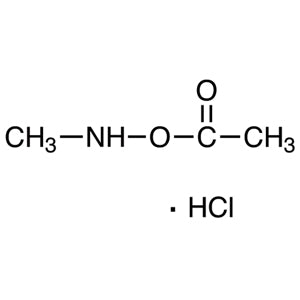
- TCI A2365 19689-95-3 O-Acetyl-N-methylhydroxylamine Hydrochloride
- TCI M0886 593-56-6 O-Methylhydroxylamine Hydrochloride (ca 40% in Water, ca 54mol/L)
- TCI M0804 4229-44-1 N-Methylhydroxylamine Hydrochloride
- Oxime ether synthesis — the reagent condenses directly with aldehydes and ketones to install the O-ethyl oxime ether motif, serving as a non-heterocyclic building block in multi-step organic preparations.
- Carbonyl derivatisation for gas chromatography — converting aldehydes and ketones into O-ethyl oximes yields derivatives that are markedly more stable and better behaved during chromatographic separation than the free carbonyl compounds.
- Mass spectrometry sample preparation — oxime ether formation gives analytically tractable derivatives of carbonyl analytes, improving the reliability of identification and measurement compared with analysing the parent compound directly.
- Carbonyl group protection and characterisation — the resulting oxime ethers are easier to purify and isolate, which helps chemists handle and characterise reactive or volatile carbonyl intermediates during synthesis.
- Aqueous and mixed-solvent reaction work — good solubility in water and polar solvents lets the reagent be applied in aqueous media or solvent mixtures, released in situ with a weak base such as sodium acetate or pyridine.
| Brand | TCI, catalogue code E0880 |
|---|---|
| CAS number | 3332-29-4 |
| Molecular formula | — |
| Purity | — |
| Category | Chemistry > Building Blocks > Non-Heterocyclic Building Blocks |
| Pack sizes | available in the standard TCI catalogue pack sizes for this item; please confirm the packaging option required when ordering |
| Physical form | solid, weighable and storage-stable |
| Storage | keep in a closed container in a cool, dry place, protected from moisture |
- Chemical form: hydrochloride salt of O-ethylhydroxylamine
Store the material in its original tightly closed container in a cool, dry, well-ventilated place, away from moisture and from incompatible reagents, particularly bases and strong oxidising agents. The hydrochloride salt is chosen precisely for its stability in storage, but as a hygroscopic-prone amine salt it should be kept sealed and returned to storage promptly after weighing. Handle in a fume hood using gloves, safety glasses, and a laboratory coat, and avoid inhalation of dust when transferring the solid. Use clean, dry spatulas and glass or chemically compatible plastic containers for weighing and transfer, and keep the reagent clearly labelled. Consult the manufacturer's safety data sheet before use and dispose of residues according to institutional chemical waste procedures.
—
Produk Terkait
-
N,O-Bis(tert-butoxycarbonyl)hydroxylamine TCI B4780
Regular price From Rp 1.378.650,00Regular price -
O-(tert-Butyl)hydroxylamineHydrochloride TCI B4589
Regular price From Rp 2.597.700,00Regular price -
N-(tert-Butyl)hydroxylamineHydrochloride TCI B1700
Regular price From Rp 1.326.150,00Regular price -
O-Acetyl-N-methylhydroxylamineHydrochloride TCI A2365
Regular price From Rp 2.571.450,00Regular price -
O-MethylhydroxylamineHydrochloride(ca40%inWater,ca54mol/L) TCI M0886
Regular price Rp 1.485.750,00Regular price -
N-MethylhydroxylamineHydrochloride TCI M0804
Regular price From Rp 1.988.700,00Regular price -
O-MethylhydroxylamineHydrochloride TCI M0343
Regular price From Rp 1.431.150,00Regular price -
HydroxylamineHydrochloride TCI H1581
Regular price From Rp 477.750,00Regular price