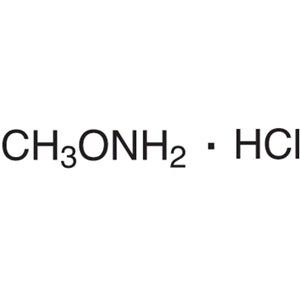
O-Methylhydroxylamine Hydrochloride is a chemical compound widely used in laboratory settings for its ability to participate in various chemical reactions. It serves as a crucial building block in the synthesis of nitrogen-containing heterocyclic compounds, which are essential in pharmaceutical and organic chemistry research. This reagent is particularly valuable for its reactivity and versatility in forming nitrogen bonds, making it indispensable in the creation of complex molecules. Its role in laboratory processes is fundamental, especially in the development of compounds with specific functional groups and structural features.
The compound’s high solubility in water and its reactive nature make it a preferred choice for chemists seeking reliable and efficient reagents. Its stability and consistent concentration ensure reproducibility in experimental results, which is critical for scientific research. The ability to react with a wide range of substrates, including aldehydes, ketones, and other organic compounds, further enhances its utility. These properties allow it to be used in a variety of synthetic pathways, contributing to the advancement of chemical research and development.
In Indonesian laboratories, O-Methylhydroxylamine Hydrochloride is extensively used in organic chemistry and pharmaceutical research. Its application is widespread in academic and industrial settings where the synthesis of nitrogen-containing compounds is required. The compound’s reliability and performance make it a staple in laboratories that prioritize quality and precision in their chemical processes.
Related TCI products
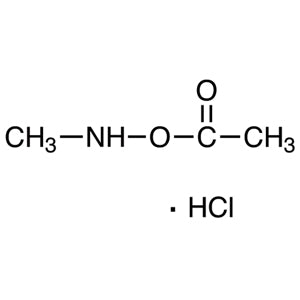
- TCI A2365 19689-95-3 O-Acetyl-N-methylhydroxylamine Hydrochloride
- TCI M0804 4229-44-1 N-Methylhydroxylamine Hydrochloride
- TCI M0343 593-56-6 O-Methylhydroxylamine Hydrochloride
- TCI B4780 85006-25-3 N,O-Bis(tert-butoxycarbonyl)hydroxylamine
- TCI B4589 39684-28-1 O-(tert-Butyl)hydroxylamine Hydrochloride
- TCI B1700 57497-39-9 N-(tert-Butyl)hydroxylamine Hydrochloride
- Organic synthesis of heterocyclic compounds due to its ability to form nitrogen bonds and participate in nucleophilic reactions.
- Preparation of aminoketones and other nitrogen-containing derivatives through its reactivity with carbonyl groups.
- Pharmaceutical research for the development of drugs requiring nitrogen-based functional groups in their molecular structure.
- Material science applications where nitrogen-containing compounds are needed for polymer synthesis and functional materials.
- Analytical chemistry for the characterization of nitrogen-containing compounds in complex mixtures.
| Brand | TCI |
|---|---|
| CAS number | 593-56-6 |
| Molecular formula | — |
| Purity | — |
| Category | Chemistry > Building Blocks > Non-Heterocyclic Building Blocks |
| Pack sizes | Available in various sizes as per standard laboratory requirements |
| Physical form | Solution in water (ca 40% concentration) |
| Storage | Store in a cool, dry place away from direct sunlight and moisture |
O-Methylhydroxylamine Hydrochloride should be stored in a cool, dry environment to maintain its stability and reactivity. It is recommended to keep the solution in a tightly sealed container to prevent moisture absorption and contamination. Due to its reactive nature, it should be handled in a well-ventilated area, preferably under a fume hood, to minimize exposure. Avoid contact with incompatible substances such as strong oxidizing agents. Always use appropriate personal protective equipment, including gloves and safety goggles, when handling this compound. Proper storage and handling ensure the compound remains effective and safe for use in laboratory applications.
—
Produk Terkait
-
O-Acetyl-N-methylhydroxylamineHydrochloride TCI A2365
Regular price From Rp 2.571.450,00Regular price -
N-MethylhydroxylamineHydrochloride TCI M0804
Regular price From Rp 1.988.700,00Regular price -
O-MethylhydroxylamineHydrochloride TCI M0343
Regular price From Rp 1.431.150,00Regular price -
N,O-Bis(tert-butoxycarbonyl)hydroxylamine TCI B4780
Regular price From Rp 1.378.650,00Regular price -
O-(tert-Butyl)hydroxylamineHydrochloride TCI B4589
Regular price From Rp 2.597.700,00Regular price -
N-(tert-Butyl)hydroxylamineHydrochloride TCI B1700
Regular price From Rp 1.326.150,00Regular price -
HydroxylamineHydrochloride TCI H1581
Regular price From Rp 477.750,00Regular price -
HydroxylamineSulfate TCI H0196
Regular price From Rp 477.750,00Regular price