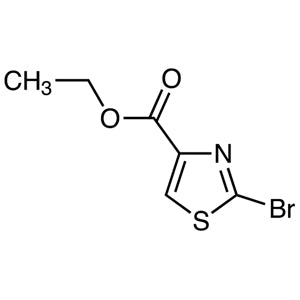
TCI E0900 Ethyl 2-Bromothiazole-4-carboxylate is a heterocyclic building block that combines a thiazole ring with a bromine atom at the two position and an ethyl ester group at the four position. This combination gives the molecule two very clear points of action: the bromine serves as a handle for transition-metal-catalysed cross-coupling reactions, while the ester is a group that can be converted into an acid, an amide, an alcohol, or other derivatives. In organic synthesis laboratories, this compound is widely used as a core scaffold that is then elaborated step by step into larger target molecules.
The characteristic that makes this material stand out is the reactivity of the two position on the thiazole ring. This carbon sits between the nitrogen and the sulfur atoms, making it relatively electron-poor, and the bromine attached there is readily displaced — either through nucleophilic aromatic substitution with amines and alkoxides, or through Suzuki, Stille, Sonogashira, and Buchwald–Hartwig coupling reactions. In this way, a single starting material can lead researchers to many different product families simply by changing the reaction partner. The ester group, which does not participate under standard coupling conditions, offers a further practical advantage: it can be carried through the coupling step untouched and then transformed later in the sequence, giving the chemist control over the order in which each position is functionalised.
In Indonesian laboratories, this building block is typically found in university organic synthesis groups, medicinal chemistry research units, and research and development laboratories that prepare heterocyclic compound libraries. It is generally ordered in small research quantities for method development, route scouting, and the preparation of analogue series, where the same scaffold is coupled with a range of partners to explore structure–activity relationships. Its role is usually as an intermediate rather than a final product, consumed within a multi-step synthetic sequence.
Related TCI products
- Suzuki–Miyaura cross-coupling — the bromine at the two position acts as a reliable handle for palladium-catalysed coupling with boronic acids, allowing aryl and heteroaryl groups to be installed directly onto the thiazole core.
- Buchwald–Hartwig amination — the electron-poor carbon between nitrogen and sulfur allows carbon–nitrogen bond formation with a wide range of amine partners, giving rapid access to two-aminothiazole derivatives from a single starting material.
- Nucleophilic aromatic substitution — because the two position is relatively electron-poor, the bromine can be displaced directly by amines and alkoxides without a metal catalyst, offering a simpler route where coupling conditions are unnecessary.
- Ester group transformation — the ethyl ester at the four position can be hydrolysed to the acid or converted into amides and alcohols, letting chemists functionalise the second position after the coupling step is complete.
- Heterocyclic library preparation — one common scaffold coupled with many different reaction partners produces a series of related analogues, which suits medicinal chemistry and structure–activity relationship studies in research laboratories.
| Brand | TCI (Tokyo Chemical Industry) |
|---|---|
| CAS number | 100367-77-9 |
| Molecular formula | — |
| Purity | — |
| Category | Chemistry > Building Blocks > Heterocyclic Building Blocks |
| Pack sizes | available in standard TCI research pack sizes; please confirm the sizes currently listed for this item |
| Physical form | — |
| Storage | store in a cool, dry place in a tightly closed container, following the storage note on the manufacturer label |
- Product code: E0900
Store this material in its original tightly closed container, kept in a cool, dry, and well-ventilated place away from direct sunlight, heat sources, and incompatible reagents. Amber glass or the supplier's original packaging is suitable, and containers should be resealed promptly after each use to limit exposure to atmospheric moisture. Handle the compound in a fume hood using standard laboratory personal protective equipment: safety glasses, chemical-resistant gloves, and a laboratory coat. Avoid inhalation of dust and contact with skin and eyes. Always consult the manufacturer's safety data sheet before use, and dispose of residues and contaminated materials through the laboratory's approved chemical waste route rather than into general drains or waste bins.
—
Produk Terkait
-
Methyl2-Bromothiazole-5-carboxylate TCI M2669
Regular price From Rp 903.000,00Regular price -
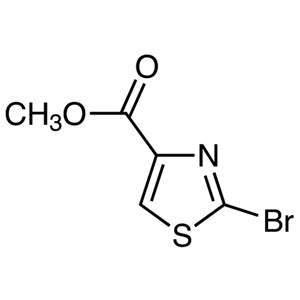
Methyl2-Bromothiazole-4-carboxylate TCI M2615
Regular price From Rp 928.200,00Regular price -
4-Bromothiazole TCI B4594
Regular price From Rp 1.565.550,00Regular price -
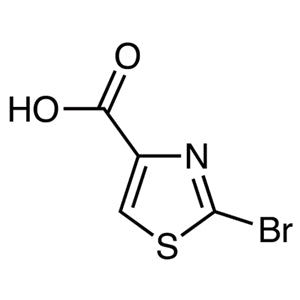
2-Bromothiazole-4-carboxylicAcid TCI B4578
Regular price Rp 1.431.150,00Regular price -
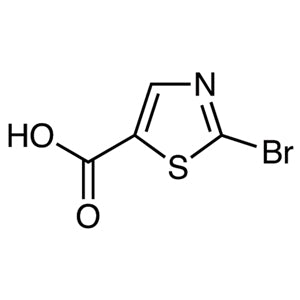
2-Bromothiazole-5-carboxylicAcid TCI B4329
Regular price From Rp 1.115.100,00Regular price -
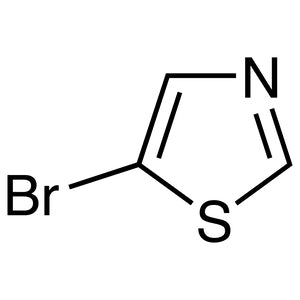
5-Bromothiazole TCI B3569
Regular price From Rp 1.326.150,00Regular price -
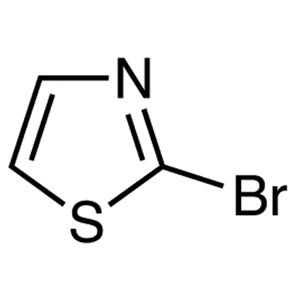
2-Bromothiazole TCI B1280
Regular price From Rp 1.485.750,00Regular price -
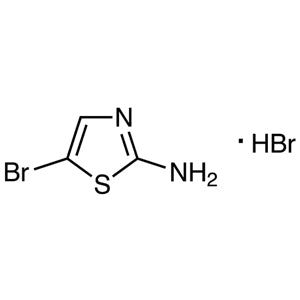
2-Amino-5-bromothiazoleHydrobromide TCI A1573
Regular price From Rp 1.060.500,00Regular price