

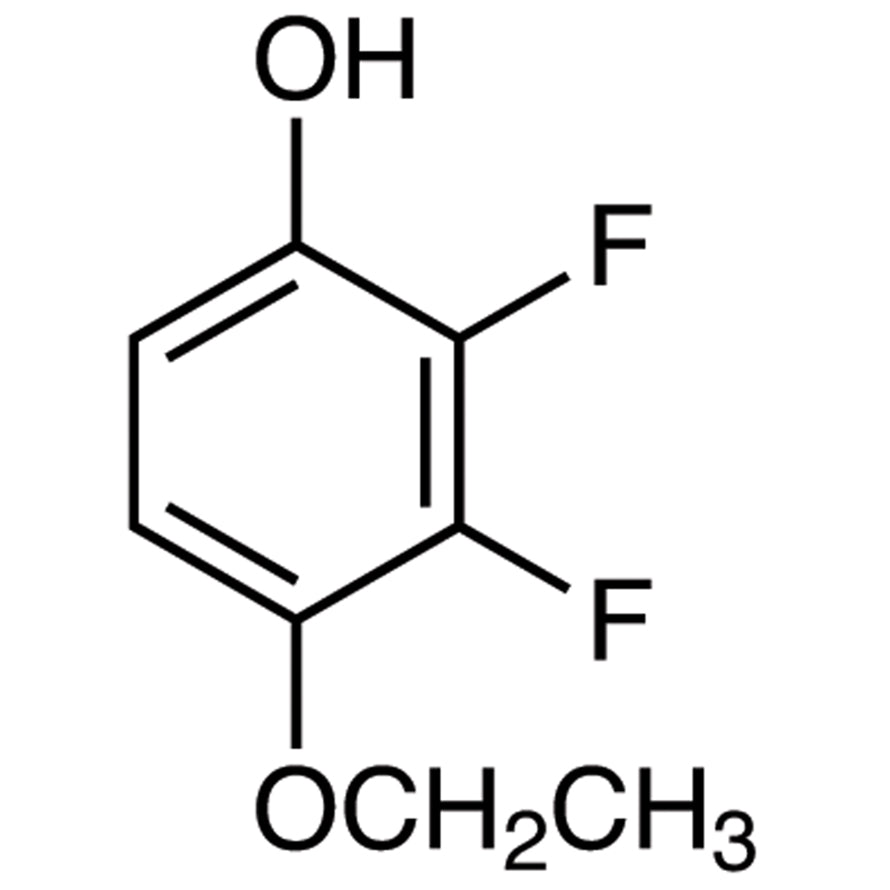
4-Ethoxy-2,3-difluorophenol is a chemical compound widely used as a building block in the synthesis of complex molecules. It is a versatile reagent that plays a key role in organic chemistry, particularly in the development of pharmaceuticals, industrial chemicals, and bioactive compounds. Its unique molecular structure, featuring both fluoro and ethoxy groups, makes it a valuable tool for functional group modification and chemical transformations. In the laboratory, it is often employed in research projects that require precise chemical manipulation and synthetic flexibility.
The compound’s high polarity, due to the presence of fluoro and ethoxy groups, allows it to dissolve in various organic solvents such as ethyl acetate and acetone. This solubility profile enhances its utility in reaction systems and purification processes. Additionally, its chemical stability under controlled conditions ensures reliable performance during storage and use. These properties make it a preferred choice for researchers working in synthetic chemistry and drug development.
In Indonesian laboratories, 4-Ethoxy-2,3-difluorophenol is commonly used in pharmacological research, organic synthesis, and the development of new chemical materials. Its availability and chemical properties make it an essential component in both academic and industrial research settings. Its role in creating bioactive compounds and functionalized molecules underscores its importance in modern chemical research.
Related TCI products
- TCI T3756 132123-45-6 3,4,5-Trifluorophenyl trans,trans-4'-Propylbicyclohexyl-4-carboxylate
- TCI T3129 113798-74-6 2,3,6-Trifluorophenol
- TCI T2407 209995-38-0 2,4,5-Trifluorophenylacetic Acid
- TCI T2299 99627-05-1 3,4,5-Trifluorophenol
- TCI T1785 13089-11-7 Methyl Trifluoropyruvate
- TCI T1713 2516-99-6 3,3,3-Trifluoropropionic Acid
- Organic synthesis applications benefit from its reactivity and functional group versatility, enabling the creation of complex molecules.
- Pharmaceutical research utilizes it as a key intermediate in the development of new drug compounds with specific biological activities.
- Industrial chemical production relies on its stability and solubility for efficient synthesis and purification processes.
- Bioactive compound development leverages its structural features to design molecules with targeted biological effects.
- Academic research in chemistry uses it to explore new synthetic pathways and functional group modifications.
| Brand | TCI |
|---|---|
| CAS number | 126163-56-2 |
| Molecular formula | — |
| Purity | — |
| Category | Chemistry > Building Blocks > Fluorinated Building Blocks |
| Pack sizes | Available in various quantities as per supplier specifications |
| Physical form | Solid or liquid, depending on the specific product variant |
| Storage | Store in a cool, dry place away from direct sunlight |
This compound should be stored in a cool, dry environment to maintain its chemical stability. It is recommended to keep it in a tightly sealed container to prevent exposure to moisture and air. Due to its polarity, it is advisable to use glass or polyethylene containers that are resistant to chemical degradation. Laboratory personnel should wear appropriate personal protective equipment, including gloves and safety goggles, when handling this material. Proper ventilation should be ensured in the workspace to minimize inhalation of vapors. Regular inspection of storage conditions is essential to ensure the integrity of the compound remains unaffected.
—
Produk Terkait
-
3,4,5-Trifluorophenyltrans,trans-4'-Propylbicyclohexyl-4-carboxylate TCI T3756
Regular price From Rp 1.431.150,00Regular price -
2,3,6-Trifluorophenol TCI T3129
Regular price From Rp 955.500,00Regular price -
2,4,5-TrifluorophenylaceticAcid TCI T2407
Regular price Rp 1.193.850,00Regular price -
3,4,5-Trifluorophenol TCI T2299
Regular price From Rp 1.220.100,00Regular price -
MethylTrifluoropyruvate TCI T1785
Regular price From Rp 584.850,00Regular price -
3,3,3-TrifluoropropionicAcid TCI T1713
Regular price From Rp 1.115.100,00Regular price -
2,3,4-Trifluorophenol TCI T1616
Regular price From Rp 875.700,00Regular price -
EthylTrifluoropyruvate TCI T1434
Regular price Rp 1.298.850,00Regular price


