

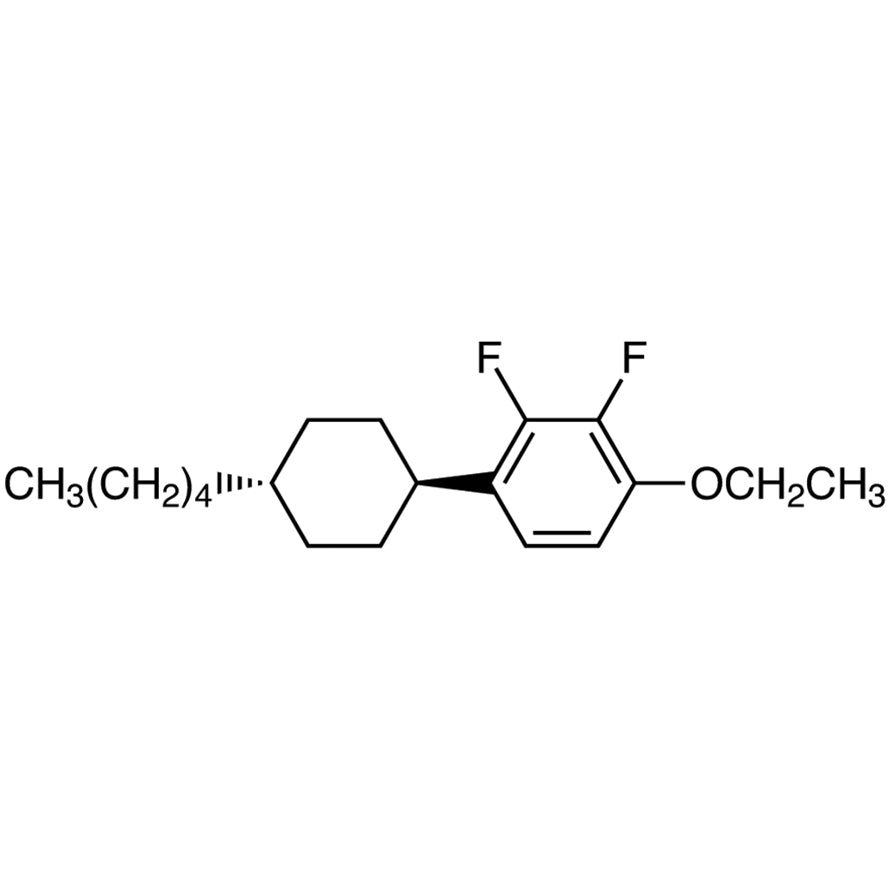
Trans-1-Ethoxy-2,3-difluoro-4-(4-pentylcyclohexyl)benzene is a specialized chemical compound used in electronic material research, particularly in the development of liquid crystal (LC) materials. This compound plays a crucial role in laboratories where researchers are working on advanced display technologies, such as LCD and OLED. Its unique molecular structure enables controlled molecular orientation in response to electric or magnetic fields, making it essential for the creation of high-performance optical and electronic materials. Its application extends to the synthesis of active components that exhibit specific optical and electronic properties, supporting innovation in modern electronic devices.
The compound is preferred due to its excellent polarization properties, ability to form stable crystalline structures, and sensitivity to environmental conditions. The combination of ethoxy, difluoro, and cyclohexyl groups in its molecular structure contributes to its unique optical and response characteristics. These properties make it ideal for applications requiring precise control over material behavior. Its chemical stability and compatibility with various synthetic processes further enhance its appeal in laboratory settings, especially in research focused on advanced materials and display technologies.
In Indonesian laboratories, this compound is commonly used in electronic material research, particularly by higher education institutions and research organizations specializing in information technology and energy. It supports the development of next-generation display technologies and electronic components, contributing to the advancement of scientific research in the region.
TCI brochures (PDF)
- Liquid Crystal Materials 2026-04-01 · p. 5
Related TCI products
- TCI B5364 208709-55-1 1-Butoxy-2,3-difluoro-4-(trans-4-propylcyclohexyl)benzene
- TCI P3259 82991-48-8 1-(trans-4-Pentylcyclohexyl)-4-propylbenzene
- TCI P2696 131790-57-3 4-(trans-4-Pentylcyclohexyl)phenyl (trans,trans)-4'-Propyl-[1,1'-bi(cyclohexane)]-4-carboxylate
- TCI P2150 154102-21-3 (R)-1-Phenyl-1,2-ethanediyl Bis[4-(trans-4-pentylcyclohexyl)benzoate]
- TCI E1487 124728-81-0 (trans,trans)-4-(4-Ethoxy-2,3-difluorophenyl)-4'-pentyl-1,1'-bi(cyclohexane)
- TCI E1477 253199-08-5 trans,trans-4-(4-Ethoxy-2,3-difluorophenyl)-4'-ethyl-1,1'-bi(cyclohexyl)
- Liquid Crystal Display (LCD) Research: This compound is ideal for developing LC materials used in LCDs due to its ability to align molecules under external fields.
- Organic Light-Emitting Diode (OLED) Development: Its optical and electronic properties make it suitable for creating OLED materials with enhanced performance.
- Electronic Material Synthesis: It serves as a key building block for synthesizing materials with specific optical and electronic characteristics.
- Advanced Display Technology Innovation: Its molecular structure allows for precise control, supporting research into next-generation display technologies.
- Material Science Research: It is widely used in studies focused on the behavior of materials under various physical and chemical conditions.
| Brand | TCI |
|---|---|
| CAS number | 124729-02-8 |
| Molecular formula | — |
| Purity | — |
| Category | Materials Science > Electronic Materials > Liquid Crystal (LC) Materials |
| Pack sizes | Available in various quantities as per standard laboratory supply |
| Physical form | Liquid |
| Storage | Store in a cool, dry place away from direct sunlight |
This compound should be stored in a cool, dry environment, away from direct sunlight and sources of heat. It is recommended to use sealed containers made of materials compatible with its chemical properties to prevent contamination and degradation. Due to its sensitivity to environmental factors, it should be handled in a well-ventilated laboratory setting. Proper personal protective equipment, such as gloves and safety goggles, should be worn during handling to ensure safety. The compound should be kept in a secure location to prevent accidental exposure and maintain its integrity for research applications.
—
Produk Terkait
-
1-Butoxy-2,3-difluoro-4-(trans-4-propylcyclohexyl)benzene TCI B5364
Regular price From Rp 1.696.800,00Regular price -
1-(trans-4-Pentylcyclohexyl)-4-propylbenzene TCI P3259
Regular price From Rp 1.378.650,00Regular price -
4-(trans-4-Pentylcyclohexyl)phenyl(trans,trans)-4'-Propyl-[1,1'-bi(cyclohexane)]-4-carboxylate TCI P2696
Regular price From Rp 1.458.450,00Regular price -
(R)-1-Phenyl-1,2-ethanediylBis[4-(trans-4-pentylcyclohexyl)benzoate] TCI P2150
Regular price From Rp 2.518.950,00Regular price -
(trans,trans)-4-(4-Ethoxy-2,3-difluorophenyl)-4'-pentyl-1,1'-bi(cyclohexane) TCI E1487
Regular price From Rp 795.900,00Regular price -
trans,trans-4-(4-Ethoxy-2,3-difluorophenyl)-4'-ethyl-1,1'-bi(cyclohexyl) TCI E1477
Regular price Rp 717.150,00Regular price -
1-Ethoxy-4-(trans-4-propylcyclohexyl)benzene TCI E1369
Regular price From Rp 1.298.850,00Regular price -
1-Ethoxy-4-(trans-4-pentylcyclohexyl)benzene TCI E1367
Regular price From Rp 1.353.450,00Regular price


![131790-57-3 4-(trans-4-Pentylcyclohexyl)phenyl (trans,trans)-4'-Propyl-[1,1'-bi(cyclohexane)]-4-carboxylate - AMI Scientific](http://amiscientific.com/cdn/shop/files/TCI2510P2696.jpg?v=1768819400&width=533)
![154102-21-3 (R)-1-Phenyl-1,2-ethanediyl Bis[4-(trans-4-pentylcyclohexyl)benzoate] - AMI Scientific](http://amiscientific.com/cdn/shop/files/TCI2510P2150.jpg?v=1771057766&width=533)


