


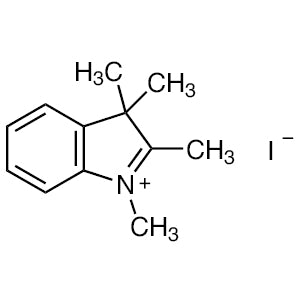
TCI E1544 14134-81-7, 1-Ethyl-2,3,3-trimethyl-3H-indolium Iodide, is a chemical compound widely used in laboratory settings as a building block for the synthesis of heterocyclic compounds. This compound plays a crucial role in organic chemistry by participating in various chemical reactions, including nucleophilic and electrophilic reactions. Its unique structure, featuring an indolium iodide core, makes it a versatile reagent for creating complex organic molecules. In research environments, it is often employed to develop compounds with specific biological activities, contributing to advancements in pharmaceutical and materials science.
The compound is preferred due to its chemical reactivity and the presence of the iodide ion, which facilitates a range of synthetic pathways. Its stability under certain conditions ensures reliable performance during chemical processes, making it a dependable choice for researchers. The ability of this compound to engage in multiple reaction mechanisms enhances its utility in the synthesis of heterocyclic structures, which are fundamental in drug development and functional material design. Its consistent performance and predictable behavior in laboratory settings further support its widespread use.
In Indonesian laboratories, this compound is commonly utilized in organic chemistry research, particularly in academic and industrial settings. It is a key reagent in the development of bioactive compounds and advanced materials. Researchers in pharmaceutical and chemical industries frequently rely on this compound for its role in synthesizing complex molecules with specific functional properties. Its availability and reliability make it an essential tool for scientific innovation in Indonesia.
Advantages (TCI brochure)
- Acceptor unit for the terminal structure of cyanine dyes
- Enables dyes with absorption and fluorescence in NIR and SWIR regions
- Absorption/emission wavelengths and solubility adjustable by structure
TCI brochures (PDF)
- Building Blocks for Near-infrared/Short-wave-infrared Dyes 2025-08-07 · p. 1
Related TCI products
- TCI T3979 5418-63-3 1,2,3,3-Tetramethyl-3H-indolium Iodide
- TCI E1545 80566-25-2 3-Ethyl-1,1,2-trimethyl-1H-benzo[e]indol-3-ium Iodide
- TCI T3457 372081-65-7 1,1,2,3-Tetramethyl-1H-benzo[e]indolium Hexafluorophosphate
- TCI T4332 147-47-7 2,2,4-Trimethyl-1,2-dihydroquinoline
- TCI T4294 63666-10-4 3-(1,1,2-Trimethyl-1H-benzo[e]indol-3-ium-3-yl)propane-1-sulfonate
- TCI T4293 1,1,2-Trimethyl-1H-benzo[e]indole-7-sulfonic Acid Monohydrate
- Organic synthesis of heterocyclic compounds due to its indolium iodide structure and reactivity in nucleophilic and electrophilic reactions.
- Development of bioactive molecules for pharmaceutical research as it enables the formation of complex organic structures with biological activity.
- Synthesis of functional materials in material science applications because of its ability to participate in diverse chemical transformations.
- Use in academic research settings for teaching and experimental purposes due to its well-defined chemical properties and predictable behavior.
- Support for drug discovery projects through its role in creating compounds with targeted pharmacological effects and structural complexity.
From the TCI brochure
- Synthesis of cyanine dyes
- Biomolecular staining and bio-imaging
| Brand | TCI |
|---|---|
| CAS number | 14134-81-7 |
| Molecular formula | — |
| Purity | — |
| Category | Chemistry > Building Blocks > Heterocyclic Building Blocks |
| Pack sizes | Available in various quantities as per standard laboratory supply practices |
| Physical form | Solid, typically in crystalline or powder form |
| Storage | Store in a cool, dry place away from light and moisture |
This compound should be stored in a cool, dry environment, away from direct light and moisture to maintain its chemical stability. It is recommended to use airtight containers to prevent exposure to air and humidity, which could affect its reactivity. Due to its iodide content, it is important to handle it with care, ensuring proper ventilation in the laboratory to avoid inhalation of vapors. While it is not classified as highly hazardous, standard laboratory safety protocols should be followed, including the use of personal protective equipment such as gloves and safety goggles. The compound is generally stable under normal storage conditions, making it suitable for routine use in research and development settings.
—
Produk Terkait
-
1,2,3,3-Tetramethyl-3H-indoliumIodide TCI T3979
Regular price Rp 1.670.550,00Regular price -
3-Ethyl-1,1,2-trimethyl-1H-benzo[e]indol-3-iumIodide TCI E1545
Regular price From Rp 1.776.600,00Regular price -
1,1,2,3-Tetramethyl-1H-benzo[e]indoliumHexafluorophosphate TCI T3457
Regular price From Rp 1.035.300,00Regular price -
2,2,4-Trimethyl-1,2-dihydroquinoline TCI T4332
Regular price From Rp 2.862.300,00Regular price -
3-(1,1,2-Trimethyl-1H-benzo[e]indol-3-ium-3-yl)propane-1-sulfonate TCI T4294
Regular price From Rp 505.050,00Regular price -
AcidMonohydrate TCI T4293
Regular price From Rp 1.696.800,00Regular price -
4-(1,1,2-Trimethyl-1H-benzo[e]indol-3-ium-3-yl)butane-1-sulfonate TCI T4291
Regular price From Rp 505.050,00Regular price -
2,4,6-Trimethyl-1,3,5-triazine TCI T4122
Regular price Rp 3.127.950,00Regular price
![3-Ethyl-1,1,2-trimethyl-1H-benzo[e]indol-3-ium Iodide (CAS 80566-25-2) - TCI E1545 - AMI Scientific](http://amiscientific.com/cdn/shop/files/TCI2510E1545.jpg?v=1767113034&width=533)
![372081-65-7 1,1,2,3-Tetramethyl-1H-benzo[e]indolium Hexafluorophosphate - AMI Scientific](http://amiscientific.com/cdn/shop/files/TCI2510T3457.jpg?v=1767144125&width=533)

![63666-10-4 3-(1,1,2-Trimethyl-1H-benzo[e]indol-3-ium-3-yl)propane-1-sulfonate - AMI Scientific](http://amiscientific.com/cdn/shop/files/TCI2510T4294.jpg?v=1767145030&width=533)
![1,1,2-Trimethyl-1H-benzo[e]indole-7-sulfonic Acid Monohydrate - AMI Scientific](http://amiscientific.com/cdn/shop/files/TCI2510T4293.jpg?v=1767145027&width=533)
![63149-24-6 4-(1,1,2-Trimethyl-1H-benzo[e]indol-3-ium-3-yl)butane-1-sulfonate - AMI Scientific](http://amiscientific.com/cdn/shop/files/TCI2510T4291.jpg?v=1767145022&width=533)
