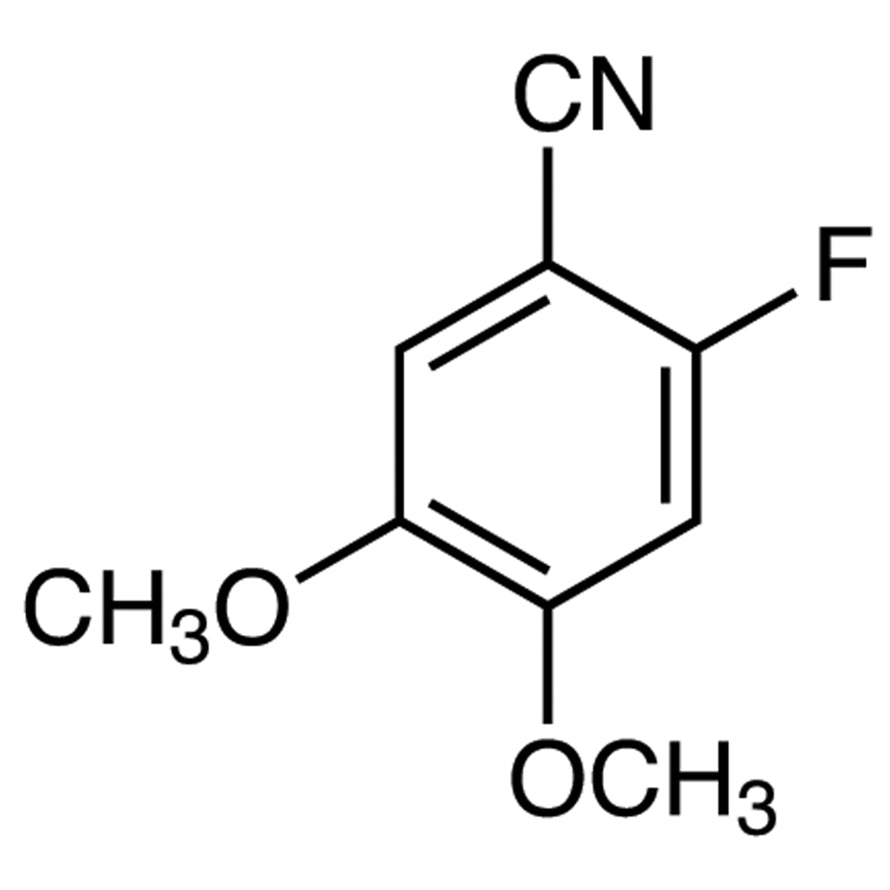
2-Fluoro-4,5-dimethoxybenzonitrile, supplied under TCI catalogue code F0641, is an aromatic building block that combines a nitrile group, two methoxy groups, and a single fluorine atom on one benzene ring. This fairly specific substitution pattern makes it a high-value starting material in directed organic synthesis, particularly when researchers require an aromatic ring that already carries a mature level of functionalisation. Assembling such a substitution pattern from simple precursors demands many reaction steps, so having the compound available in ready-to-use form saves a significant amount of laboratory working time while also improving the reproducibility of the synthetic routes being developed.
The characteristic advantages of this compound arise from the electronic interplay between its substituents. The two methoxy groups are electron-donating and activate the ring, whereas the nitrile group is a strong electron-withdrawing substituent. The fluorine atom, positioned ortho to the nitrile, becomes a potential leaving group in nucleophilic aromatic substitution reactions, because the adjacent nitrile stabilises the negatively charged intermediate formed during the reaction. This combination gives chemists two lines of attack at once within a single molecule, allowing a chosen transformation to be directed at either the activated ring positions or the fluorine-bearing carbon.
In Indonesian laboratories, a building block of this kind is typically used in university research groups, government research institutes, and the research and development units of the pharmaceutical and fine chemical industries. Because it is supplied ready to use, working teams can move directly to the key step of their synthetic route without first having to prepare the intermediate themselves, which is particularly valuable where laboratory time, reagent availability, and analytical capacity have to be planned carefully around an ongoing research programme.
TCI brochures (PDF)
- Fluorination Reagents, Fluorinated Building Blocks 2026-03-18 · p. 27
Related TCI products
- TCI F0985 140675-43-0 2-Fluoro-6-hydroxybenzonitrile
- TCI F0969 94088-46-7 2-Fluoro-6-methoxybenzonitrile
- TCI F0671 331-62-4 3-Fluoro-4-methoxybenzonitrile
- TCI F0642 127667-01-0 2-Fluoro-5-methoxybenzonitrile
- TCI F0638 405-04-9 3-Fluoro-4-hydroxybenzonitrile
- TCI F0479 189628-38-4 5-Fluoro-2-methoxybenzonitrile
- Nucleophilic aromatic substitution studies — the fluorine ortho to the nitrile acts as a leaving group while the nitrile stabilises the anionic intermediate, giving a clean and predictable site of attack.
- Pharmaceutical intermediate synthesis — the dimethoxy-substituted aromatic core is a recurring motif in medicinal chemistry, so the compound shortens routes toward target molecules that require this ring pattern.
- Fine chemical route development — supplying the substitution pattern ready-made removes several preparative steps and improves the reproducibility of routes being scaled from bench to pilot work.
- Nitrile transformation chemistry — the cyano group provides a handle for conversion into other functionality, allowing a single starting material to serve several branches of a synthetic plan.
- Fluorinated building block research — the defined position of the fluorine atom makes the compound useful for investigating how ring fluorination influences reactivity and the electronic character of aromatic systems.
| Brand | TCI (Tokyo Chemical Industry) |
|---|---|
| CAS number | 119396-88-2 |
| Molecular formula | — |
| Purity | — |
| Category | Chemistry > Building Blocks > Fluorinated Building Blocks |
| Pack sizes | available in the standard research-scale pack sizes offered for this catalogue item |
| Physical form | — |
| Storage | store in a closed container under the conditions stated on the manufacturer's label and safety data sheet |
- Catalogue code: F0641
Store the compound in its original tightly closed container, kept in a cool, dry, and well-ventilated place away from direct sunlight, moisture, and incompatible reagents. Containers should be chemically resistant and clearly labelled, and the compound should be returned to storage promptly after weighing so that repeated exposure to laboratory air and humidity is minimised. All handling should be carried out in a fume hood using appropriate personal protective equipment, including safety glasses, gloves, and a laboratory coat. Consult the manufacturer's safety data sheet before first use, observe the institution's own chemical handling procedures, and dispose of residues and contaminated materials through the laboratory's established chemical waste stream.
—
Produk Terkait
-
2-Fluoro-6-hydroxybenzonitrile TCI F0985
Regular price From Rp 1.405.950,00Regular price -
2-Fluoro-6-methoxybenzonitrile TCI F0969
Regular price From Rp 928.200,00Regular price -
3-Fluoro-4-methoxybenzonitrile TCI F0671
Regular price From Rp 505.050,00Regular price -
2-Fluoro-5-methoxybenzonitrile TCI F0642
Regular price From Rp 1.035.300,00Regular price -
3-Fluoro-4-hydroxybenzonitrile TCI F0638
Regular price From Rp 2.704.800,00Regular price -
5-Fluoro-2-methoxybenzonitrile TCI F0479
Regular price From Rp 610.050,00Regular price -
2-Fluoro-4-hydroxybenzonitrile TCI F0462
Regular price From Rp 1.246.350,00Regular price -
4-Fluoro-3-methoxybenzonitrile TCI F0408
Regular price From Rp 769.650,00Regular price