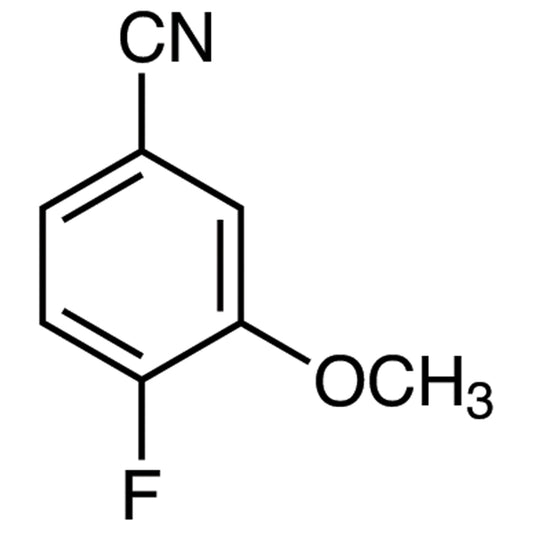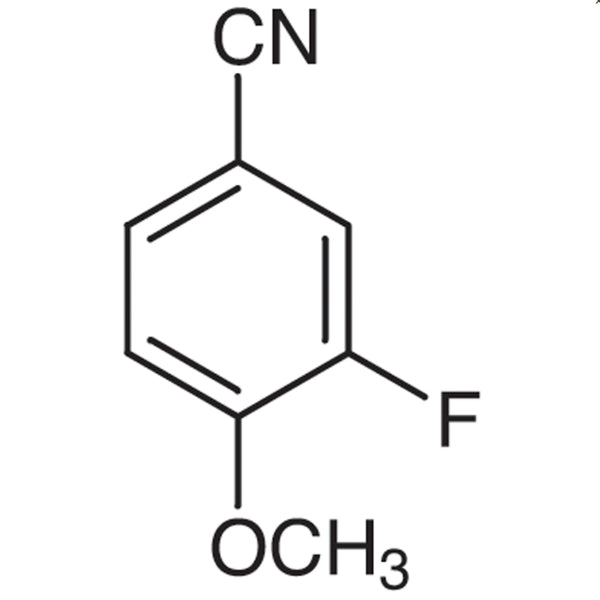
3-Fluoro-4-methoxybenzonitrile is a substituted benzonitrile compound carrying a fluorine atom and a methoxy group at neighbouring positions on the aromatic ring. This particular fluorine and methoxy substitution pattern is frequently encountered in modern bioactive molecules, and the material is therefore widely positioned as a ready-to-use building block for researchers who wish to avoid carrying out separate fluorination or methylation steps of their own. The presence of the nitrile group provides a highly flexible synthetic handle, because this group can be converted into a wide range of other functional groups through well-established reactions that are straightforward to reproduce in an ordinary laboratory.
The characteristic that makes this compound an attractive choice is the combination of complementary electronic effects it carries. The fluorine atom withdraws electron density inductively, while the methoxy group donates electron density through resonance, and the result is a distinctive electron density distribution across the aromatic ring. This pattern influences the regioselectivity of subsequent reactions as well as the physicochemical properties of the final molecule, including its lipophilicity and its metabolic stability. In terms of transformations, the nitrile group can be reduced to the corresponding benzylamine or hydrolysed to the benzoic acid or the benzamide, giving the chemist several divergent routes from a single starting material.
In Indonesian laboratories, a building block of this kind is typically used in university and institutional research groups working on medicinal chemistry and organic synthesis, where a pre-functionalised aromatic core shortens a synthetic sequence considerably. It also suits method development work, reference standard preparation, and small-scale exploratory synthesis, where researchers prefer to source an intermediate that already carries the required substitution pattern rather than construct it in house from simpler precursors.
TCI brochures (PDF)
- Fluorination Reagents, Fluorinated Building Blocks 2026-03-18 · p. 22
Related TCI products
- TCI F0969 94088-46-7 2-Fluoro-6-methoxybenzonitrile
- TCI F0642 127667-01-0 2-Fluoro-5-methoxybenzonitrile
- TCI F0479 189628-38-4 5-Fluoro-2-methoxybenzonitrile
- TCI F0408 243128-37-2 4-Fluoro-3-methoxybenzonitrile
- TCI F0985 140675-43-0 2-Fluoro-6-hydroxybenzonitrile
- TCI F0641 119396-88-2 2-Fluoro-4,5-dimethoxybenzonitrile
- Medicinal chemistry building block: the fluorine and methoxy pattern already present on the ring matches motifs common in modern bioactive molecules, removing the need for separate fluorination or methylation steps in the route.
- Benzylamine synthesis: the nitrile group can be reduced to the corresponding benzylamine, giving direct access to a fluorinated, methoxy-substituted amine intermediate through a well-established and readily reproducible laboratory reaction.
- Carboxylic acid and amide preparation: hydrolysis of the nitrile delivers the benzoic acid or the benzamide, allowing several different downstream scaffolds to be reached from one commonly stocked starting material.
- Structure-activity relationship studies: the complementary inductive withdrawal by fluorine and resonance donation by methoxy let researchers probe how ring electronics affect lipophilicity and metabolic stability in candidate molecules.
- Regioselective aromatic functionalisation studies: the distinctive electron density distribution across the ring makes this substrate useful for investigating and predicting the regioselectivity of further substitution reactions in the laboratory.
| Brand | TCI |
|---|---|
| CAS number | 331-62-4 |
| Molecular formula | — |
| Purity | — |
| Category | Chemistry > Building Blocks > Fluorinated Building Blocks |
| Pack sizes | available in standard TCI research-scale packaging; please confirm the size required when ordering |
| Physical form | — |
| Storage | store in a cool, dry place in the tightly closed original container |
- Catalogue number: F0671
- Chemical name: 3-Fluoro-4-methoxybenzonitrile
Store the container tightly closed in a cool, dry, well-ventilated area away from direct sunlight, heat sources, moisture, and incompatible materials such as strong oxidising agents, strong acids, and strong bases. Keep the material in its original supplier container wherever possible, or in a clean, chemically compatible, clearly labelled vessel if it must be transferred. Handle in a fume hood using appropriate personal protective equipment, including safety glasses, chemically resistant gloves, and a laboratory coat. Avoid inhalation of dust and contact with skin and eyes. Always consult the manufacturer's Safety Data Sheet before use, and follow institutional procedures for waste collection and disposal.
—
Produk Terkait
-
2-Fluoro-6-methoxybenzonitrile TCI F0969
Regular price From Rp 928.200,00Regular price -
2-Fluoro-5-methoxybenzonitrile TCI F0642
Regular price From Rp 1.035.300,00Regular price -
5-Fluoro-2-methoxybenzonitrile TCI F0479
Regular price From Rp 610.050,00Regular price -
4-Fluoro-3-methoxybenzonitrile TCI F0408
Regular price From Rp 769.650,00Regular price -
2-Fluoro-6-hydroxybenzonitrile TCI F0985
Regular price From Rp 1.405.950,00Regular price -
2-Fluoro-4,5-dimethoxybenzonitrile TCI F0641
Regular price Rp 6.281.100,00Regular price -
3-Fluoro-4-hydroxybenzonitrile TCI F0638
Regular price From Rp 2.704.800,00Regular price -
2-Fluoro-4-hydroxybenzonitrile TCI F0462
Regular price From Rp 1.246.350,00Regular price