

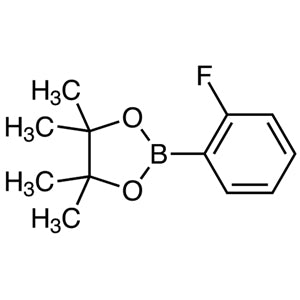
2-(2-Fluorophenyl)-4,4,5,5-tetramethyl-1,3,2-dioxaborolane is an organoboron compound widely used in chemical reactions, particularly in the synthesis of aromatic and heterocyclic compounds. As a key reagent in organometallic chemistry, it serves as a versatile source of boron hydride, contributing to the formation of complex molecular structures. This compound is essential in various synthetic pathways, enabling the development of pharmaceuticals and advanced materials through its unique reactivity. Its presence in laboratory settings underscores its importance in modern chemical research and industrial applications.
The compound's reactivity and selectivity make it a preferred choice for synthetic chemists. It exhibits polar characteristics due to its boron content, allowing it to interact with a range of ligands such as halides, alcohols, and amines. This versatility enhances its utility in reactions requiring high reactivity and specificity. Additionally, its molecular structure is stable under normal conditions, ensuring reliability in laboratory experiments. These properties collectively position it as a valuable reagent in both academic and industrial chemical processes.
In Indonesian laboratories, this compound is commonly used in organic chemistry research, especially in the development of pharmaceutical compounds and inorganic materials. Its role in coupling reactions like Suzuki and Kumada makes it a critical component in the synthesis of complex molecules. Researchers rely on its predictable behavior and effectiveness to advance their work in chemical synthesis and material science. The compound's widespread application in both academic and industrial settings highlights its significance in the chemical research landscape.
TCI brochures (PDF)
- Suzuki-Miyaura Cross Coupling Reaction 2025-12-01 · p. 17
- Boron Compounds 2025-10-07 · p. 17
Related TCI products
- TCI F1201 214360-58-4 2-(4-Fluorophenyl)-4,4,5,5-tetramethyl-1,3,2-dioxaborolane
- TCI T4407 1609484-75-4 4,4,5,5-Tetramethyl-2-(spiro[fluorene-9,9'-xanthen]-4-yl)-1,3,2-dioxaborolane
- TCI T4387 1160862-12-3 4,4,5,5-Tetramethyl-2-(spiro[fluorene-9,9'-xanthen]-2-yl)-1,3,2-dioxaborolane
- TCI T4061 870004-04-9 4,4,5,5-Tetramethyl-2-(4-vinylphenyl)-1,3,2-dioxaborolane
- TCI T3875 1080632-76-3 2-([1,1':4',1''-Terphenyl]-4-yl)-4,4,5,5-tetramethyl-1,3,2-dioxaborolane
- TCI T3831 269410-26-6 4,4,5,5-Tetramethyl-2-(4-phenoxyphenyl)-1,3,2-dioxaborolane
- Suzuki coupling reactions for the synthesis of aromatic compounds due to its reactivity and selectivity in forming carbon-carbon bonds.
- Kumada coupling applications in the development of complex organic molecules through its ability to participate in cross-coupling processes.
- Organic synthesis of pharmaceuticals where its role as a boron hydride source enables the formation of high-value compounds.
- Material science research for the creation of inorganic and hybrid materials through its interaction with various ligands.
- Characterization of complex molecules in analytical chemistry due to its stability and reactivity under controlled conditions.
| Brand | TCI |
|---|---|
| CAS number | 876062-39-4 |
| Molecular formula | — |
| Purity | — |
| Category | Chemistry > Organometallic Reagents > Organoboron [Organometallic Reagents] |
| Pack sizes | Available in various quantities as per standard laboratory supply |
| Physical form | Liquid or solid, depending on the specific formulation |
| Storage | Store in a cool, dry place away from moisture and direct sunlight |
This compound should be stored in a cool, dry environment to maintain its stability and reactivity. It is recommended to keep it in a tightly sealed container to prevent exposure to moisture and air. Due to its polar nature, it may require storage in a container that is chemically inert to avoid unwanted reactions. Laboratory personnel should handle it with care, using appropriate personal protective equipment. It is important to ensure that the storage area is well-ventilated to minimize any potential exposure. Proper labeling and safe handling procedures are essential to maintain the integrity and safety of the compound during storage and use.
—
Produk Terkait
-
2-(4-Fluorophenyl)-4,4,5,5-tetramethyl-1,3,2-dioxaborolane TCI F1201
Regular price From Rp 795.900,00Regular price -
4,4,5,5-Tetramethyl-2-(spiro[fluorene-9,9'-xanthen]-4-yl)-1,3,2-dioxaborolane TCI T4407
Regular price From Rp 955.500,00Regular price -
4,4,5,5-Tetramethyl-2-(spiro[fluorene-9,9'-xanthen]-2-yl)-1,3,2-dioxaborolane TCI T4387
Regular price Rp 3.870.300,00Regular price -
4,4,5,5-Tetramethyl-2-(4-vinylphenyl)-1,3,2-dioxaborolane TCI T4061
Regular price From Rp 4.056.150,00Regular price -
2-([1,1':4',1''-Terphenyl]-4-yl)-4,4,5,5-tetramethyl-1,3,2-dioxaborolane TCI T3875
Regular price Rp 3.340.050,00Regular price -
4,4,5,5-Tetramethyl-2-(4-phenoxyphenyl)-1,3,2-dioxaborolane TCI T3831
Regular price From Rp 743.400,00Regular price -
4,4,5,5-Tetramethyl-2-(4-nitrophenyl)-1,3,2-dioxaborolane TCI T3710
Regular price From Rp 1.035.300,00Regular price -
4,4,5,5-Tetramethyl-2-[3-(trifluoromethyl)phenyl]-1,3,2-dioxaborolane TCI T3707
Regular price From Rp 2.016.000,00Regular price

![1609484-75-4 4,4,5,5-Tetramethyl-2-(spiro[fluorene-9,9'-xanthen]-4-yl)-1,3,2-dioxaborolane - AMI Scientific](http://amiscientific.com/cdn/shop/files/TCI2510T4407.jpg?v=1768206674&width=533)
![1160862-12-3 4,4,5,5-Tetramethyl-2-(spiro[fluorene-9,9'-xanthen]-2-yl)-1,3,2-dioxaborolane - AMI Scientific](http://amiscientific.com/cdn/shop/files/TCI2510T4387.jpg?v=1768206674&width=533)

![1080632-76-3 2-([1,1':4',1''-Terphenyl]-4-yl)-4,4,5,5-tetramethyl-1,3,2-dioxaborolane - AMI Scientific](http://amiscientific.com/cdn/shop/files/TCI2510T3875.jpg?v=1769143785&width=533)


![325142-82-3 4,4,5,5-Tetramethyl-2-[3-(trifluoromethyl)phenyl]-1,3,2-dioxaborolane - AMI Scientific](http://amiscientific.com/cdn/shop/files/TCI2510T3707.jpg?v=1768206618&width=533)
![325142-82-3 4,4,5,5-Tetramethyl-2-[3-(trifluoromethyl)phenyl]-1,3,2-dioxaborolane - AMI Scientific](http://amiscientific.com/cdn/shop/files/TCI2510T3707_33e9f8e4-e658-4057-bacc-a15dbe367597.jpg?v=1769058281&width=533)