
![4-Fluorophenyl trans,trans-4'-Propyl[1,1'-bi(cyclohexyl)]-4-carboxylate (CAS 81701-13-5) - TCI F1312 - AMI Scientific](http://amiscientific.com/cdn/shop/files/TCI2510F1312.jpg?v=1768819017&width=1946)
![4-Fluorophenyl trans,trans-4'-Propyl[1,1'-bi(cyclohexyl)]-4-carboxylate (CAS 81701-13-5) - TCI F1312 - AMI Scientific](http://amiscientific.com/cdn/shop/files/TCI2510F1312_2530c01f-d578-485c-a973-cff29cc774d9.jpg?v=1769056201&width=1946)
![4-Fluorophenyl trans,trans-4'-Propyl[1,1'-bi(cyclohexyl)]-4-carboxylate (CAS 81701-13-5) - TCI F1312 - AMI Scientific](http://amiscientific.com/cdn/shop/files/TCI2510F1312.jpg?v=1768819017&width=1445)
![4-Fluorophenyl trans,trans-4'-Propyl[1,1'-bi(cyclohexyl)]-4-carboxylate (CAS 81701-13-5) - TCI F1312 - AMI Scientific](http://amiscientific.com/cdn/shop/files/TCI2510F1312_2530c01f-d578-485c-a973-cff29cc774d9.jpg?v=1769056201&width=1445)
TCI F1312, with the CAS number 81701-13-5, is a specialized chemical compound used in materials science, particularly in the study and development of liquid crystal (LC) materials. This compound is a key component in research that requires precise control over optical and thermal properties of materials. Its complex molecular structure, featuring a bi-cyclohexyl backbone and a carboxylate group, makes it suitable for advanced applications in optoelectronics and display technologies. In the laboratory, TCI F1312 plays a crucial role in experiments involving the synthesis and characterization of LC materials, contributing to the advancement of materials with unique optical and electronic properties.
The compound is valued for its chemical stability and controlled reactivity, which ensure consistent results in experimental settings. Its molecular structure allows for tailored modifications to suit specific application needs, enhancing its versatility in research. The material exhibits favorable thermal properties, making it ideal for use in environments requiring stable temperature conditions. These characteristics make TCI F1312 a reliable and preferred choice for researchers working on LC materials, especially those focused on developing high-performance optical components and display technologies.
In Indonesian laboratories, TCI F1312 is commonly used in academic and industrial research settings. It supports both educational and applied research in materials science, particularly in the development of liquid crystal-based technologies. Its application in LC material research contributes to advancements in display engineering, optical devices, and other fields that rely on precise material properties. The compound’s reliability and performance make it a valuable resource for researchers in Indonesia seeking to explore and innovate in the field of electronic materials.
TCI brochures (PDF)
- Liquid Crystal Materials 2026-04-01 · p. 8
Related TCI products
- TCI E1477 253199-08-5 trans,trans-4-(4-Ethoxy-2,3-difluorophenyl)-4'-ethyl-1,1'-bi(cyclohexyl)
- TCI T3756 132123-45-6 3,4,5-Trifluorophenyl trans,trans-4'-Propylbicyclohexyl-4-carboxylate
- TCI P2696 131790-57-3 4-(trans-4-Pentylcyclohexyl)phenyl (trans,trans)-4'-Propyl-[1,1'-bi(cyclohexane)]-4-carboxylate
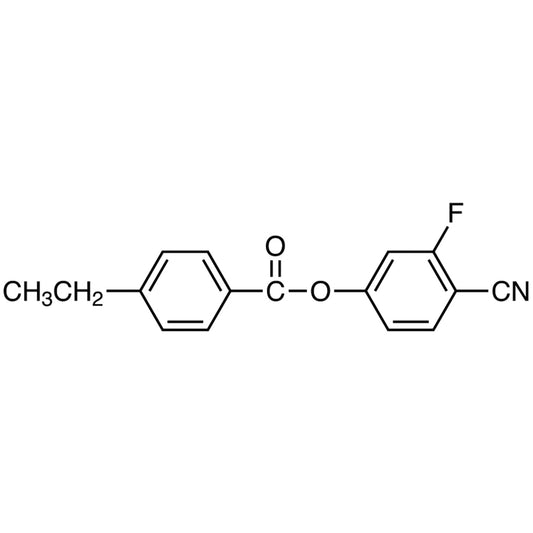
- TCI C3540 86776-50-3 4-Cyano-3-fluorophenyl 4-Ethylbenzoate
- TCI C3341 86776-52-5 4-Cyano-3-fluorophenyl 4-Butylbenzoate
- TCI T2896 361393-85-3 [[4-(Trifluoromethyl)cyclohexyl]methyl]amine (cis- and trans- mixture)
- Liquid Crystal Material Synthesis: TCI F1312 is ideal for synthesizing LC materials due to its molecular structure that allows for precise control over optical and thermal properties.
- Optical Device Development: The compound's stability and reactivity make it suitable for creating optical components that require consistent performance under various conditions.
- Display Technology Research: Its role in LC material research supports the development of advanced display technologies such as LCDs and other optoelectronic devices.
- Thermal Stability Testing: The compound's favorable thermal properties make it useful in experiments that require stable temperature environments for material analysis.
- Educational Research in Materials Science: TCI F1312 is widely used in academic settings to teach and research the properties and applications of LC materials.
| Brand | TCI |
|---|---|
| CAS number | 81701-13-5 |
| Molecular formula | — |
| Purity | — |
| Category | Materials Science > Electronic Materials > Liquid Crystal (LC) Materials |
| Pack sizes | Available in various quantities as per standard laboratory supply |
| Physical form | Solid or liquid, depending on formulation |
| Storage | Store in a cool, dry place away from direct sunlight |
TCI F1312 should be stored in a cool, dry place, away from direct sunlight and sources of heat to maintain its chemical stability. It is recommended to use airtight containers to prevent moisture absorption and contamination. In laboratory settings, proper personal protective equipment (PPE) such as gloves and safety goggles should be worn when handling the compound. The material should be kept in a well-ventilated area to minimize exposure to vapors. Due to its controlled reactivity, it should be handled with care to avoid unintended chemical interactions. Storage conditions should be monitored regularly to ensure the material remains in optimal condition for research applications.
—
Produk Terkait
-
trans,trans-4-(4-Ethoxy-2,3-difluorophenyl)-4'-ethyl-1,1'-bi(cyclohexyl) TCI E1477
Regular price Rp 717.150,00Regular priceRp 500.850,00Sale price Rp 717.150,00 -
3,4,5-Trifluorophenyltrans,trans-4'-Propylbicyclohexyl-4-carboxylate TCI T3756
Regular price From Rp 1.483.650,00Regular priceRp 1.053.150,00Sale price From Rp 1.483.650,00 -
4-(trans-4-Pentylcyclohexyl)phenyl(trans,trans)-4'-Propyl-[1,1'-bi(cyclohexane)]-4-carboxylate TCI P2696
Regular price From Rp 1.510.950,00Regular priceRp 1.072.050,00Sale price From Rp 1.510.950,00 -
4-Cyano-3-fluorophenyl4-Ethylbenzoate TCI C3540
Regular price From Rp 1.272.600,00Regular priceRp 905.100,00Sale price From Rp 1.272.600,00 -
4-Cyano-3-fluorophenyl4-Butylbenzoate TCI C3341
Regular price Rp 1.192.800,00Regular priceRp 849.450,00Sale price Rp 1.192.800,00 -
[[4-(Trifluoromethyl)cyclohexyl]methyl]amine(cis-andtrans-mixture) TCI T2896
Regular price Rp 1.483.650,00Regular priceRp 1.053.150,00Sale price Rp 1.483.650,00 -
4-Fluorophenyltrans,trans-4'-Pentylbicyclohexyl-4-carboxylate TCI F1120
Regular price From Rp 769.650,00Regular priceRp 553.350,00Sale price From Rp 769.650,00 -
Ethyl2-[trans-4-[(tert-Butoxycarbonyl)amino]cyclohexyl]acetate TCI E1387
Regular price From Rp 1.246.350,00Regular priceRp 887.250,00Sale price From Rp 1.246.350,00


![131790-57-3 4-(trans-4-Pentylcyclohexyl)phenyl (trans,trans)-4'-Propyl-[1,1'-bi(cyclohexane)]-4-carboxylate - AMI Scientific](http://amiscientific.com/cdn/shop/files/TCI2510P2696.jpg?v=1768819400&width=533)


![361393-85-3 [[4-(Trifluoromethyl)cyclohexyl]methyl]amine (cis- and trans- mixture) - AMI Scientific](http://amiscientific.com/cdn/shop/files/TCI2510T2896.jpg?v=1768363497&width=533)

![TCI E1387 946598-34-1 Ethyl 2-[trans-4-[(tert-Butoxycarbonyl)amino]cyclohexyl]acetate](http://amiscientific.com/cdn/shop/files/TCI2510E1387_99ec8a12-cb10-4ae3-adb3-6d43c805f692.jpg?v=1792641802&width=533)
![Ethyl 2-[trans-4-[(tert-Butoxycarbonyl)amino]cyclohexyl]acetate (CAS 946598-34-1) - TCI E1387 - AMI Scientific](http://amiscientific.com/cdn/shop/files/TCI2510E1387.jpg?v=1767112760&width=533)