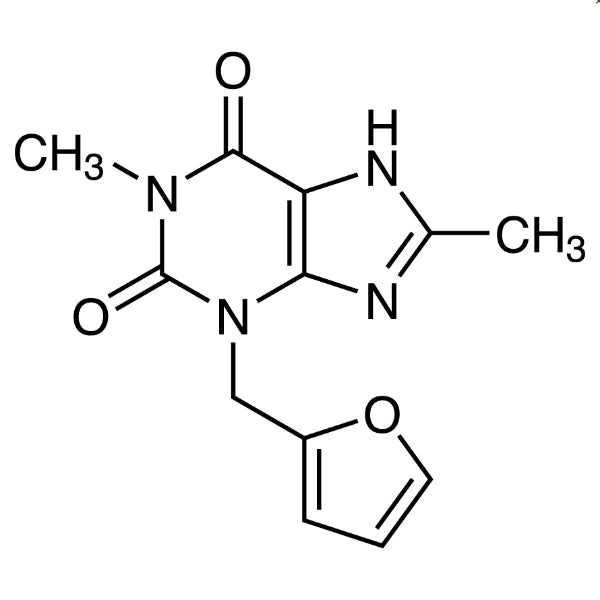
Furafylline is a chemical compound widely used in life sciences research, particularly in cell biology and cancer research. It plays a crucial role in laboratory settings by enabling scientists to investigate the effects of specific compounds on cancer cell growth and cellular responses to therapeutic agents. Its pharmacological activity is unique, as it influences the nervous system and inhibits certain enzymes, making it an essential tool for studying disease mechanisms. This compound is highly valued for its ability to provide insights into complex biological processes and contribute to the development of new treatments.
Furafylline is preferred due to its chemical stability and ease of storage under controlled conditions. These properties make it a reliable choice for laboratory use, ensuring consistent performance across various experiments. Its solid form and appropriate concentration allow researchers to use it effectively without compromising its activity. Additionally, Furafylline exhibits good reactivity with a variety of reagents, making it suitable for a wide range of chemical and biochemical reactions. This versatility enhances its utility in diverse research applications.
In Indonesian laboratories, Furafylline is commonly used in cancer research and cell biology studies to understand disease mechanisms and drug development. It is also applied in investigations into the effects of specific compounds on cellular behavior, contributing to both academic and applied research efforts. Its presence in these studies supports the advancement of scientific knowledge and the pursuit of innovative therapeutic solutions.
- Cancer Research: Furafylline is used to study the effects of compounds on cancer cell growth and drug resistance, aiding in the development of targeted therapies.
- Cell Biology Studies: It helps in analyzing cellular responses to various stimuli, providing insights into fundamental biological processes.
- Enzyme Inhibition Studies: Its ability to inhibit specific enzymes makes it valuable for investigating metabolic pathways and biochemical mechanisms.
- Drug Development: Researchers use it to evaluate how compounds interact with biological systems, supporting the discovery of new pharmaceuticals.
- Neuropharmacological Research: Its impact on the nervous system allows for the study of neurological disorders and potential therapeutic interventions.
| Brand | TCI |
|---|---|
| CAS number | 80288-49-9 |
| Molecular formula | — |
| Purity | — |
| Category | Life Science > Cell Biology > Cancer Research |
| Pack sizes | Available in various quantities as per standard laboratory requirements |
| Physical form | Solid |
| Storage | Store in a cool, dry place away from direct light |
Furafylline should be stored in a cool, dry environment, away from direct sunlight and moisture to maintain its chemical stability. It is recommended to use airtight containers to prevent contamination and degradation. In laboratory settings, proper personal protective equipment (PPE) such as gloves and safety goggles should be worn when handling the compound. While it is generally stable, it should be kept away from incompatible substances to avoid chemical reactions. Regular monitoring of storage conditions ensures that the compound remains effective for research purposes. Proper labeling of containers is essential for safety and traceability in the lab environment.
—
Product Categories
Produk Terkait
-
Aminopterin TCI A0410
Regular price From Rp 1.829.100,00Regular price -
Isoliquiritigenin TCI I0822
Regular price From Rp 1.035.300,00Regular price -
Imatinib TCI I0906
Regular price From Rp 1.326.150,00Regular price -
Zerumbone TCI Z0060
Regular price Rp 8.322.300,00Regular price -
YM-750 TCI Y0032
Regular price Rp 3.630.900,00Regular price -
YakuchinoneA TCI Y0022
Regular price Rp 7.473.900,00Regular price -
WHI-P180Hydrochloride TCI W0021
Regular price Rp 3.340.050,00Regular price -
WHI-P154 TCI W0013
Regular price From Rp 2.491.650,00Regular price