

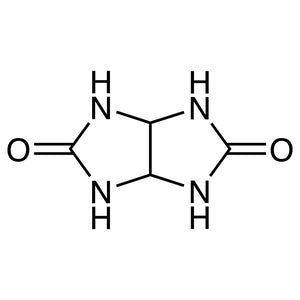
Glycoluril is a chemical compound classified under the heterocyclic category, widely used in various laboratory reactions. It serves as a fundamental building block in organic chemistry, enabling the synthesis of complex molecules. Its unique molecular structure, consisting of two urea groups connected by a carbon chain, provides high reactivity under different conditions. This makes it a versatile compound for chemical transformations in both research and industrial settings. Glycoluril is particularly valuable in the development of heterocyclic compounds, which are essential in pharmaceutical and organic chemistry. Its role as a building block allows chemists to create a wide range of derivatives through specific chemical reactions.
Glycoluril is preferred due to its chemical stability under controlled conditions and its reactivity towards various reaction parameters such as temperature, catalysts, and solvents. These properties make it suitable for substitution reactions, hydrolysis, and condensation processes. Its ability to participate in multiple reaction types enhances its utility in synthetic chemistry. The compound’s versatility and predictable behavior in different reaction environments make it a reliable choice for researchers and students alike. Its stability ensures consistent results, while its reactivity allows for the exploration of diverse chemical pathways.
In Indonesian laboratories, Glycoluril is commonly used by researchers and students for organic chemistry experiments. It is an essential component in the synthesis of heterocyclic compounds, which are crucial in drug development and material science. Its availability and reliability make it a preferred choice for both academic and industrial applications. The compound’s role in supporting chemical innovation underscores its importance in the scientific community.
- Organic synthesis is a key application where Glycoluril is used to create complex molecules due to its reactivity and structural versatility.
- Pharmaceutical research benefits from Glycoluril as it is a building block for synthesizing heterocyclic compounds essential in drug development.
- Analytical chemistry uses Glycoluril in various reactions to test and characterize chemical compounds under controlled conditions.
- Teaching laboratories incorporate Glycoluril in experiments to demonstrate the principles of heterocyclic chemistry and synthetic pathways.
- Industrial chemical processes rely on Glycoluril for the production of specialized materials due to its stability and reactivity in different environments.
| Brand | TCI |
|---|---|
| CAS number | 496-46-8 |
| Molecular formula | — |
| Purity | — |
| Category | Chemistry > Building Blocks > Heterocyclic Building Blocks |
| Pack sizes | Available in various quantities as per supplier specifications |
| Physical form | Solid |
| Storage | Store in a cool, dry place away from moisture and direct sunlight |
Glycoluril should be stored in a cool, dry environment to maintain its chemical stability. It is recommended to keep it in airtight containers to prevent moisture absorption, which could affect its reactivity. Due to its potential reactivity with certain solvents and catalysts, it should be handled in a well-ventilated area. Laboratory personnel should use appropriate personal protective equipment, such as gloves and safety goggles, when working with this compound. Avoid exposure to high temperatures and direct sunlight to ensure long-term stability. Proper storage and handling are essential to maintain the compound's effectiveness and safety in laboratory settings.
—
Produk Terkait
-
N,N',N'',N'''-Tetraacetylglycoluril TCI T0985
Regular price Rp 1.351.350,00Regular priceRp 960.750,00Sale price Rp 1.351.350,00 -
1,3,4,6-Tetrakis(methoxymethyl)glycoluril TCI T2058
Regular price Rp 1.140.300,00Regular priceRp 812.700,00Sale price Rp 1.140.300,00

