

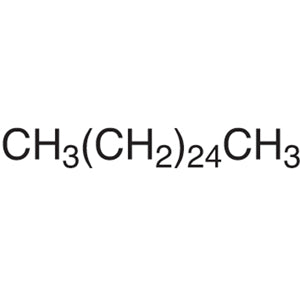
TCI H0050 Hexacosane is a straight-chain saturated hydrocarbon containing twenty-six carbon atoms, classified among the very-long-chain n-alkanes and existing as a waxy solid at room temperature. The molecule carries no reactive functional groups, so its role in the laboratory is not that of a reagent but that of a reference material and a model substance. Hexacosane is widely used as a member of the n-alkane series for gas chromatography standards, as a model component of plant waxes and mineral waxes, and as a test material in research on heat-storage materials and hydrophobic coatings.
The characteristic that makes this material a preferred choice is its structural purity as a single discrete compound with a defined chain length, in contrast to commercial paraffins, which are always mixtures of many chain lengths. This distinction matters whenever a researcher needs a consistent point of reference rather than an averaged property. As a long-chain alkane, hexacosane is strongly non-polar and practically insoluble in water, chemically stable toward acids and bases under ordinary conditions, and it melts over a sharp and repeatable temperature range. This combination of stability and chemical inertness is what allows it to serve safely as a matrix or a comparison material without interfering with the system under observation.
In Indonesian laboratories, hexacosane is typically found in chromatography facilities that maintain n-alkane retention index series, in materials and polymer research groups examining phase-change and surface-wetting behaviour, and in academic laboratories studying natural waxes and petroleum-derived fractions. Because it functions as a reference rather than as a consumable reagent, a single package normally supports a considerable period of routine analytical and research work.
- Gas chromatography retention index standards: as a defined member of the n-alkane series, it provides a fixed and reproducible reference point for calibrating retention behaviour in GC analysis.
- Plant wax and cuticular wax modelling: its single defined chain length allows researchers to represent one specific component of natural wax mixtures without the ambiguity of a blended paraffin.
- Mineral wax and petroleum fraction studies: it serves as a pure comparison material against which the composition and behaviour of commercial paraffin mixtures can be assessed.
- Phase-change and thermal energy storage research: the sharp, repeatable melting range of a single-compound alkane makes it a suitable test material for heat-storage investigations.
- Hydrophobic coating development: its strongly non-polar character and practical insolubility in water make it a useful model substance for studying water-repellent surface behaviour.
| Brand | TCI (Tokyo Chemical Industry) |
|---|---|
| CAS number | 630-01-3 |
| Molecular formula | — |
| Purity | — |
| Category | Chemistry > Building Blocks > Non-Heterocyclic Building Blocks |
| Pack sizes | available in standard TCI catalogue pack sizes; please confirm the currently offered option when ordering |
| Physical form | waxy solid at room temperature |
| Storage | keep in a tightly closed container in a cool, dry place |
- Catalogue Code: H0050
Store hexacosane in a tightly closed original container in a cool, dry area away from direct sunlight, heat sources, and open flames, since the material softens and melts on warming. Glass bottles or the manufacturer's supplied packaging are appropriate; keep the closure sealed to prevent dust and moisture from contaminating a material that is intended to serve as an analytical reference. Handle the solid in a well-ventilated area using standard laboratory personal protective equipment, including a laboratory coat, safety glasses, and chemical-resistant gloves. Avoid generating fine particulates during weighing, use clean spatulas dedicated to reference materials to prevent cross-contamination, and consult the manufacturer's safety data sheet before first use and before disposal.
—
Produk Terkait
-
4,7,13,16,21,24-Hexaoxa-1,10-diazabicyclo[8.8.8]hexacosane TCI H0932
Regular price From Rp 3.498.600,00Regular price -
Undecylcyclohexane TCI U0037
Regular price Rp 6.599.250,00Regular price -
Undecane TCI U0002
Regular price From Rp 505.050,00Regular price -
1,3,5-Trimethyladamantane TCI T3872
Regular price From Rp 2.199.750,00Regular price -
Tetratriacontane TCI T2938
Regular price From Rp 3.260.250,00Regular price -
exo-Tetrahydrodicyclopentadiene TCI T1994
Regular price From Rp 1.246.350,00Regular price -
1,1,2,2-Tetramethylcyclopropane TCI T1721
Regular price Rp 3.180.450,00Regular price -
1,1,3,5-Tetramethylcyclohexane TCI T1717
Regular price Rp 6.148.800,00Regular price
![23978-09-8 4,7,13,16,21,24-Hexaoxa-1,10-diazabicyclo[8.8.8]hexacosane - AMI Scientific](http://amiscientific.com/cdn/shop/files/TCI2510H0932.jpg?v=1768205532&width=533)


