

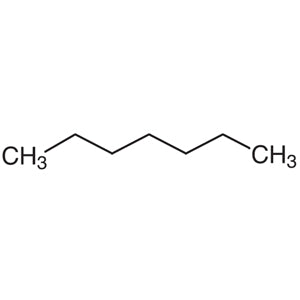
TCI H0088 Heptane is a straight-chain aliphatic hydrocarbon solvent built on a seven-carbon backbone, supplied as a clear, colourless liquid with strongly nonpolar character. It belongs to the hydrocarbon solvent family and ranks among the most frequently encountered working solvents in chemistry laboratories, pharmaceutical facilities, and instrumental analysis units. Its role is deliberately broad: it serves as an inert reaction medium, an extraction solvent for nonpolar compounds, a mobile-phase component in chromatography, and a rinsing solvent for glassware and surfaces contaminated with oil or grease residues.
The properties that make heptane a preferred choice begin with its very low polarity, which allows it to dissolve nonpolar species such as lipids, oils, and other hydrocarbons that resist more polar media. Equally important is its chemical inertness toward most reagents; heptane does not react readily, so it can be used safely as a medium for reactions that are sensitive to protic solvents. In chromatography, heptane is often selected in place of other hydrocarbon solvents because it delivers comparable elution strength while offering a more controlled evaporation profile, which translates into steadier baselines and more reproducible runs.
In Indonesian laboratories, heptane appears wherever nonpolar extraction, instrumental separation, or thorough degreasing is part of the daily routine — academic research groups, quality control benches in pharmaceutical and chemical plants, and analytical service laboratories alike. Because it is a general-purpose working solvent rather than a specialised reagent, it is typically held as a standing stock item and drawn upon across many different methods within the same facility.
Related TCI products
- TCI Q0037 142-82-5 Heptane [Sequencing Solvent]
- TCI H0491 142-82-5 Heptane [for HPLC Solvent]
- TCI H0027 142-82-5 Heptane [for Spectrophotometry]
- TCI V0195 106-87-6 3-(Oxiran-2-yl)-7-oxabicyclo[410]heptane (mixture of isomers)
- TCI B5032 1041026-70-3 tert-Butyl 2,6-Diazaspiro[3.3]heptane-2-carboxylate
- TCI B2054 116258-17-4 (1S,4S)-2-Benzyl-2,5-diazabicyclo[2.2.1]heptane Dihydrobromide
- Nonpolar liquid–liquid extraction: heptane's very low polarity lets it selectively pull lipids, oils, and hydrocarbon analytes out of aqueous or polar matrices with clean phase separation.
- Chromatographic mobile phase: heptane provides elution strength comparable to other hydrocarbon solvents while its more controlled evaporation profile supports steadier, more reproducible separations in normal-phase work.
- Inert reaction medium: because heptane resists reaction with most reagents, it serves as a solvent for chemistry that would be disturbed by protic or otherwise reactive media.
- Glassware and surface rinsing: heptane readily dissolves oil and grease residues, making it an effective final rinse for contaminated glassware and laboratory surfaces before reuse.
- Dissolution of nonpolar compounds: heptane acts as a general dissolving medium for lipids, oils, and other hydrocarbons in sample preparation for downstream chemical or instrumental analysis.
| Brand | TCI |
|---|---|
| CAS number | 142-82-5 |
| Molecular formula | — |
| Purity | — |
| Category | Chemistry > Solvents > Hydrocarbon Solvents |
| Pack sizes | available in the standard TCI packaging options for this catalogue item |
| Physical form | clear, colourless liquid |
| Storage | keep in a tightly closed container in a cool, well-ventilated area away from ignition sources |
- Product code: H0088
Heptane is highly flammable and its vapour is heavier than air, so it must be handled with that hazard in mind at all times. Store it in a cool, well-ventilated location, ideally inside a dedicated flammable-solvent cabinet, and keep containers tightly closed to limit evaporative loss and vapour accumulation at floor level. Use the original manufacturer container or a compatible, properly labelled solvent bottle; avoid open vessels. Dispense and work with heptane inside a fume hood, away from open flames, hot surfaces, and sources of sparks or static discharge. Wear appropriate gloves, safety glasses, and a laboratory coat, and collect used solvent as organic waste rather than discharging it to the drain.
—
Product Categories
Produk Terkait
-
Heptane[SequencingSolvent] TCI Q0037
Regular price Rp 1.167.600,00Regular price -
Heptane[forHPLCSolvent] TCI H0491
Regular price Rp 3.630.900,00Regular price -
Heptane[forSpectrophotometry] TCI H0027
Regular price Rp 1.193.850,00Regular price -
3-(Oxiran-2-yl)-7-oxabicyclo[410]heptane(mixtureofisomers) TCI V0195
Regular price From Rp 3.870.300,00Regular price -
tert-Butyl2,6-Diazaspiro[3.3]heptane-2-carboxylate TCI B5032
Regular price Rp 3.232.950,00Regular price -
(1S,4S)-2-Benzyl-2,5-diazabicyclo[2.2.1]heptaneDihydrobromide TCI B2054
Regular price Rp 2.889.600,00Regular price -
Heptane[StandardMaterialforGC] TCI S0279
Regular price Rp 1.590.750,00Regular price -
2-Oxa-6-azaspiro[3.3]heptane TCI O0466
Regular price Rp 6.201.300,00Regular price
![142-82-5 Heptane [Sequencing Solvent] - AMI Scientific](http://amiscientific.com/cdn/shop/files/TCI2510Q0037.jpg?v=1767137545&width=533)
![Heptane [for HPLC Solvent] (CAS 142-82-5) - TCI H0491 - AMI Scientific](http://amiscientific.com/cdn/shop/files/TCI2510H0491.jpg?v=1767116511&width=533)
![Heptane [for Spectrophotometry] (CAS 142-82-5) - TCI H0027 - AMI Scientific](http://amiscientific.com/cdn/shop/files/TCI2510H0027.jpg?v=1767115532&width=533)
![106-87-6 3-(Oxiran-2-yl)-7-oxabicyclo[4.1.0]heptane (mixture of isomers) - AMI Scientific](http://amiscientific.com/cdn/shop/files/TCI2510V0195.jpg?v=1767145750&width=533)
![1041026-70-3 tert-Butyl 2,6-Diazaspiro[3.3]heptane-2-carboxylate - AMI Scientific](http://amiscientific.com/cdn/shop/files/TCI2510B5032.jpg?v=1767091949&width=533)
![116258-17-4 (1S,4S)-2-Benzyl-2,5-diazabicyclo[2.2.1]heptane Dihydrobromide - AMI Scientific](http://amiscientific.com/cdn/shop/files/TCI2510B2054.jpg?v=1769141649&width=533)
![142-82-5 Heptane [Standard Material for GC] - AMI Scientific](http://amiscientific.com/cdn/shop/files/TCI2510S0279.jpg?v=1768362991&width=533)
![174-78-7 2-Oxa-6-azaspiro[3.3]heptane - AMI Scientific](http://amiscientific.com/cdn/shop/files/TCI2510O0466.jpg?v=1767131945&width=533)