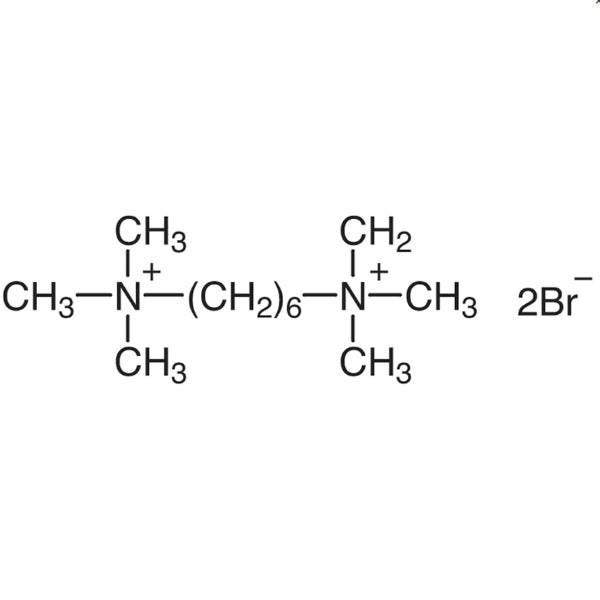
Hexamethonium Bromide is a chemical compound widely used in materials science research, particularly in the field of colloidal quantum dot (QD) studies. This reagent plays a crucial role in the synthesis and characterization of semiconductor materials with nanoscale dimensions. In laboratory settings, it serves as an essential tool for controlling the optical and electronic properties of quantum dots, which are fundamental in advanced nanotechnology applications. Its presence is vital for achieving precise and consistent results in experimental processes that require high accuracy and reproducibility.
Hexamethonium Bromide is valued for its stable chemical properties and non-volatile nature, making it a preferred choice for laboratory use. Its molecular structure is complex, and it exhibits highly specific chemical behavior that enhances its effectiveness in various research applications. The compound's stability under normal conditions ensures that it remains effective over time, reducing the risk of degradation. This reliability makes it ideal for use in environments where reagents must maintain their integrity and performance throughout extended research periods.
In Indonesian laboratories, Hexamethonium Bromide is particularly relevant for research in information technology and advanced material sciences. Its ability to interact with a variety of semiconductor materials expands its applicability in developing new technologies. As a key reagent in nanomaterial synthesis, it supports the growth of innovative scientific projects that align with the country's focus on technological advancement and scientific research.
TCI brochures (PDF)
- Neurotransmission Research Reagents 2026-07-17 · p. 1
- Colloidal Quantum Dot Synthesis: Hexamethonium Bromide is used to control the growth and properties of quantum dots, enabling precise tuning of their optical and electronic characteristics.
- Semiconductor Material Characterization: Its stable properties make it suitable for analyzing and modifying semiconductor materials at the nanoscale.
- Optical Property Modulation: The compound helps in adjusting the optical behavior of quantum dots, which is essential for applications in optoelectronics and photovoltaics.
- Nanomaterial Stability Testing: Its non-volatile nature ensures consistent performance during long-term experiments involving nanomaterials.
- Advanced Material Research: It supports research into new materials with unique electronic and optical properties, driving innovation in nanotechnology.
| Brand | TCI |
|---|---|
| CAS number | 55-97-0 |
| Molecular formula | — |
| Purity | — |
| Category | Materials Science > Electronic Materials > Colloidal Quantum Dot (QD) Research Reagents |
| Pack sizes | Available in various quantities as per standard laboratory requirements |
| Physical form | Solid powder |
| Storage | Store in a cool, dry place away from direct sunlight and moisture |
Hexamethonium Bromide should be stored in a cool, dry environment to maintain its stability and effectiveness. It is recommended to keep the compound in a tightly sealed container to prevent exposure to moisture and air, which could affect its chemical integrity. Laboratory personnel should handle the material with care, using appropriate personal protective equipment such as gloves and safety goggles. Due to its non-volatile nature, it does not pose significant evaporation risks, but it is still important to follow standard chemical handling procedures to ensure safety. Proper storage and handling practices help preserve the compound's properties and ensure its suitability for use in research applications.
—
Produk Terkait
-
DecamethoniumBromide TCI D1314
Regular price From Rp 2.254.350,00Regular price -
HexamethoniumChlorideDihydrate TCI H0090
Regular price From Rp 2.147.250,00Regular price -
4-AminobutyricAcid TCI A0282
Regular price From Rp 505.050,00Regular price -
AcetylcholineBromide TCI A0083
Regular price Rp 2.411.850,00Regular price -
TrimethylpropylammoniumBromide TCI T2762
Regular price Rp 6.651.750,00Regular price -
TrimethylnonylammoniumBromide TCI T2734
Regular price Rp 1.749.300,00Regular price -
Tetra-n-octylammoniumBromide TCI T1603
Regular price From Rp 1.565.550,00Regular price -
TetraheptylammoniumBromide TCI T1602
Regular price From Rp 1.246.350,00Regular price