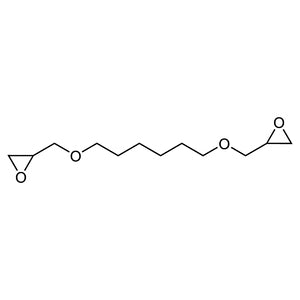
TCI H0571 1,6-Bis(oxiran-2-ylmethoxy)hexane, also known as the diglycidyl ether of 1,6-hexanediol, is a difunctional compound carrying two epoxide rings at either end of a flexible hexyl chain. In the laboratory, this material serves as a crosslinker and reactive diluent that joins two nucleophilic groups — such as amines, thiols, or hydroxyls — into a single molecular network. It plays an important role in the preparation of resins, hydrogels, and support matrices that require strong covalent linkages while still retaining mechanical flexibility.
The property that makes this reagent a frequent choice is the high reactivity of the oxirane rings toward nucleophilic ring opening, combined with a long, non-rigid aliphatic linking chain. This hexyl bridge provides sufficient distance between reactive sites so that the resulting crosslinked network does not become brittle, an advantage over short-arm crosslinkers. Its viscosity is relatively low for an epoxy compound, making it easy to blend homogeneously, and the reaction can be controlled through adjustment of pH and temperature, so researchers can tune the degree of crosslinking to suit the requirements of each experiment.
In Indonesian laboratories, this compound is typically used in polymer and materials research groups, university chemistry departments, and formulation laboratories working on resin systems and hydrogel supports. It is generally handled in small quantities at the bench scale, where its ability to form controlled covalent networks under mild conditions makes it practical for repeated experimental work, method development, and preparation of support matrices for further study.
TCI brochures (PDF)
- Epoxide Monomers 2025-09-19 · p. 2
Related TCI products
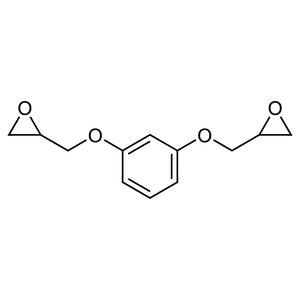
- TCI R0324 101-90-6 1,3-Bis(oxiran-2-ylmethoxy)benzene
- TCI O0693 119692-59-0 4-(Oxiran-2-ylmethoxy)butyl Acrylate (stabilized with MEHQ)
- TCI V0195 106-87-6 3-(Oxiran-2-yl)-7-oxabicyclo[410]heptane (mixture of isomers)
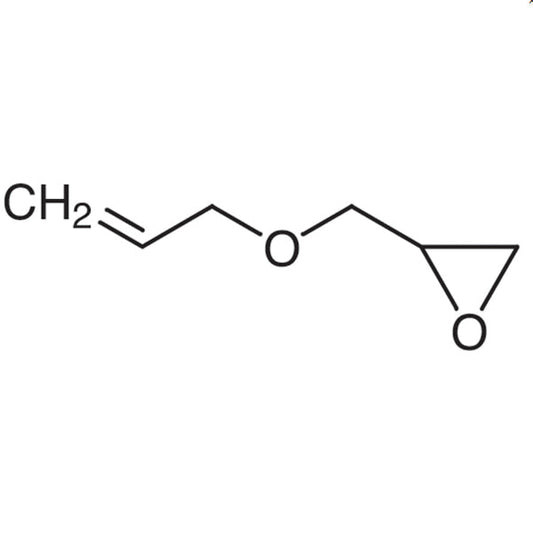
- TCI A0221 106-92-3 Allyl Glycidyl Ether
- TCI B2108 2930-05-4 Benzyl Glycidyl Ether
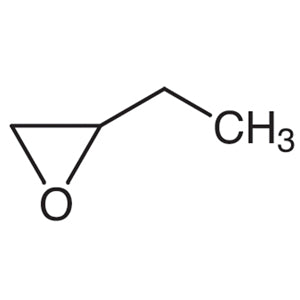
- TCI B0719 106-88-7 1,2-Butylene Oxide
- Resin preparation — the two terminal epoxide rings react with amine or hydroxyl curing agents to build a covalent resin network, while the flexible hexyl bridge keeps the cured material from becoming excessively brittle.
- Hydrogel synthesis — as a difunctional crosslinker it ties polymer chains bearing nucleophilic groups into a three-dimensional gel, with crosslink density adjustable through reaction pH and temperature control.
- Reactive diluent in epoxy formulations — its comparatively low viscosity for an epoxy compound lets it lower the viscosity of a mixture while still participating chemically in the final crosslinked structure.
- Preparation of support matrices — the reagent introduces covalently anchored linkages onto hydroxyl- or amine-bearing supports, producing matrices that combine mechanical stability with the flexibility needed for subsequent work.
- Building block chemistry — as a non-heterocyclic difunctional building block, it allows nucleophilic ring opening at one or both ends, giving access to bridged structures separated by a defined aliphatic spacer.
| Brand | TCI |
|---|---|
| CAS number | 16096-31-4 |
| Molecular formula | — |
| Purity | — |
| Category | Chemistry > Building Blocks > Non-Heterocyclic Building Blocks |
| Pack sizes | available in standard TCI catalogue pack sizes; please confirm the size required when ordering |
| Physical form | liquid epoxy compound of relatively low viscosity |
| Storage | store in a closed container in a cool, dry place away from moisture and incompatible reagents |
Store the container tightly closed in a cool, dry, well-ventilated area, protected from moisture and kept away from strong nucleophiles such as amines, thiols, and alcohols, which can initiate premature ring opening. Original manufacturer containers or compatible tightly sealed glass bottles are suitable; avoid leaving the material open to laboratory air. Handle in a fume hood using gloves, safety glasses, and a laboratory coat, since epoxides are reactive toward skin and mucous membranes. Allow refrigerated material to reach room temperature before opening to prevent condensation, and consult the supplier safety data sheet before use.
—
Produk Terkait
-
1,3-Bis(oxiran-2-ylmethoxy)benzene TCI R0324
Regular price From Rp 1.220.100,00Regular price -
4-(Oxiran-2-ylmethoxy)butylAcrylate(stabilizedwithMEHQ) TCI O0693
Regular price From Rp 2.359.350,00Regular price -
3-(Oxiran-2-yl)-7-oxabicyclo[410]heptane(mixtureofisomers) TCI V0195
Regular price From Rp 3.870.300,00Regular price -
AllylGlycidylEther TCI A0221
Regular price From Rp 477.750,00Regular price -
BenzylGlycidylEther TCI B2108
Regular price From Rp 1.510.950,00Regular price -
1,2-ButyleneOxide TCI B0719
Regular price From Rp 477.750,00Regular price -
(S)-2-Methyloxirane TCI P3117
Regular price From Rp 452.550,00Regular price -
3-(Oxiran-2-ylmethoxy)-N,N-bis(oxiran-2-ylmethyl)aniline TCI O0642
Regular price From Rp 2.121.000,00Regular price

![106-87-6 3-(Oxiran-2-yl)-7-oxabicyclo[4.1.0]heptane (mixture of isomers) - AMI Scientific](http://amiscientific.com/cdn/shop/files/TCI2510V0195.jpg?v=1767145750&width=533)