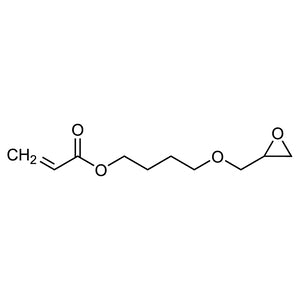
TCI O0693 4-(Oxiran-2-ylmethoxy)butyl Acrylate is a bifunctional monomer with an acrylate group at one end of the molecule and an epoxide (oxirane) group at the other. A flexible butyl ether chain links the two groups. The product is stabilized with MEHQ (monomethyl ether of hydroquinone) to keep it from polymerizing during storage. Laboratories use it as a building block and monomer for polymers, coatings and adhesives that need two curing mechanisms, or that need reactive groups left over after polymerization.
Its main advantage is that it is dual-reactive. The acrylate group polymerizes quickly by a radical mechanism, for example with a photoinitiator and UV light. The epoxide group reacts separately through ring-opening by amines, acids or cationic initiators. This lets researchers make acrylate polymers that still carry epoxide groups for later crosslinking or functionalization. The flexible butyl chain also tends to give polymer networks that are less brittle than those made from short-chain bifunctional monomers. Because both reactive ends sit on one well-defined molecule, researchers have finer control over network design and how the material is processed afterwards.
In Indonesia, this monomer is useful to polymer research laboratories, university chemistry and materials science departments, and industrial R&D teams that develop coatings, adhesives and UV-curable formulations. Researchers studying dual-cure systems, functional polymers or surface modification can use it to explore how sequential curing steps affect final material performance. AMI Scientific supplies this TCI product to Indonesian laboratories that need a reliable, research-grade bifunctional monomer for synthesis and formulation work.
Related TCI products
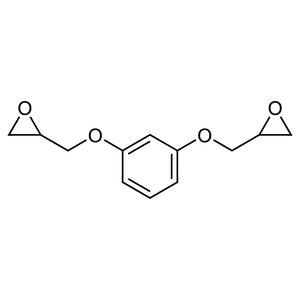
- TCI R0324 101-90-6 1,3-Bis(oxiran-2-ylmethoxy)benzene
- TCI H0571 16096-31-4 1,6-Bis(oxiran-2-ylmethoxy)hexane
- TCI E1384 64630-63-3 (3,4-Epoxycyclohexyl)methyl Acrylate (stabilized with HQ)
- TCI V0195 106-87-6 3-(Oxiran-2-yl)-7-oxabicyclo[410]heptane (mixture of isomers)
- TCI G0497 106-90-1 Glycidyl Acrylate (stabilized with MEHQ)
- TCI M0590 106-91-2 Glycidyl Methacrylate (stabilized with MEHQ)
- Dual-cure coating research: the acrylate group allows fast UV radical curing, while the epoxide group can be cured separately afterwards, which suits studies of staged curing behavior.
- Synthesis of epoxide-functional polymers: after radical polymerization of the acrylate, the remaining epoxide groups stay available for crosslinking or further chemical functionalization of the polymer chain.
- Adhesive formulation development: two independent reactive groups let researchers combine fast initial set with a second curing step, useful for studying adhesion and bond durability.
- Flexible polymer network design: the butyl ether spacer tends to give networks that are less brittle than short-chain bifunctional monomers, which helps when studying toughness and flexibility.
- Surface modification and grafting studies: the epoxide group can react with amines or acids on surfaces, while the acrylate group can then take part in later polymerization or grafting steps.
| Brand | TCI (product code O0693) |
|---|---|
| CAS number | 119692-59-0 |
| Molecular formula | — |
| Purity | — |
| Category | Chemistry > Building Blocks > Non-Heterocyclic Building Blocks |
| Pack sizes | available in TCI's standard pack sizes; please confirm the available options when ordering |
| Physical form | see TCI's product specification and certificate of analysis |
| Storage | stabilized with MEHQ; store according to the label and safety data sheet |
Keep this monomer in its original, tightly closed container, in a cool, dark, well-ventilated place away from heat, ignition sources, direct sunlight and incompatible materials such as strong acids, bases, amines, oxidizers and radical initiators. Follow the storage temperature on the TCI label and safety data sheet. Because the product contains MEHQ, which helps prevent polymerization during storage, do not remove the stabilizer until immediately before use. Acrylates and epoxides can irritate or sensitize skin, eyes and the respiratory tract. Handle the material in a fume hood and wear chemical-resistant gloves, safety goggles and a lab coat. Read the full safety data sheet before use, and dispose of residues according to local chemical waste regulations.
—
Product Categories
Produk Terkait
-
1,3-Bis(oxiran-2-ylmethoxy)benzene TCI R0324
Regular price From Rp 1.220.100,00Regular price -
1,6-Bis(oxiran-2-ylmethoxy)hexane TCI H0571
Regular price From Rp 1.193.850,00Regular price -
(3,4-Epoxycyclohexyl)methylAcrylate(stabilizedwithHQ) TCI E1384
Regular price From Rp 928.200,00Regular price -
3-(Oxiran-2-yl)-7-oxabicyclo[410]heptane(mixtureofisomers) TCI V0195
Regular price From Rp 3.870.300,00Regular price -
GlycidylAcrylate(stabilizedwithMEHQ) TCI G0497
Regular price Rp 4.506.600,00Regular price -
GlycidylMethacrylate(stabilizedwithMEHQ) TCI M0590
Regular price From Rp 477.750,00Regular price -
AllylGlycidylEther TCI A0221
Regular price From Rp 477.750,00Regular price -
BenzylGlycidylEther TCI B2108
Regular price From Rp 1.510.950,00Regular price


![106-87-6 3-(Oxiran-2-yl)-7-oxabicyclo[4.1.0]heptane (mixture of isomers) - AMI Scientific](http://amiscientific.com/cdn/shop/files/TCI2510V0195.jpg?v=1767145750&width=533)