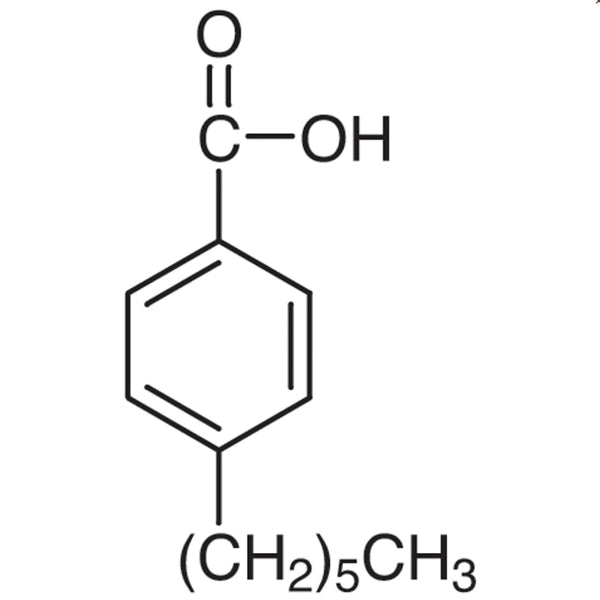
TCI H0829 4-Hexylbenzoic Acid is a benzoic acid carrying a straight hexyl chain at the para position. Its structure is simple yet highly characteristic: one end is a polar carboxylic acid group capable of forming hydrogen bonds, while the other end is a flexible, nonpolar alkyl chain. In the laboratory this compound is known as a building block for liquid crystal materials, because the "polar head with an alkyl tail" architecture is one of the most fundamental design patterns used in preparing materials that exhibit molecular ordering over a defined temperature range.
The characteristic that makes it a preferred choice is the ability of the carboxylic acid group to form dimers through hydrogen bonding. Two acid molecules pairing together produce a unit that is far longer and more rigid than the individual molecule, and it is this elongated unit that drives the formation of oriented arrangements. The hexyl chain, on the other hand, contributes flexibility and lowers the transition temperature so that the material is easier to handle. In addition, the carboxylate group is a highly versatile reaction point: it can be esterified, amidated, converted into an acyl chloride, or coupled with phenols to build larger structures.
In Indonesian laboratories, this material is typically used in university and institutional research groups working on materials science, organic synthesis, and functional materials development. It serves as a starting point for preparing ester and amide derivatives, for comparative studies of how alkyl chain length influences ordering behaviour, and for teaching purposes in advanced organic and materials chemistry practicals where a well-defined, structurally simple mesogenic precursor is required.
- Liquid crystal building block synthesis: the para-substituted acid provides the rigid core and flexible tail combination needed as a starting unit for constructing mesogenic molecules.
- Ester derivative preparation: the carboxylic acid group reacts readily with phenols and alcohols, allowing researchers to extend the molecular length and tune ordering behaviour systematically.
- Amide and acyl chloride chemistry: conversion of the carboxylate into activated intermediates opens access to amide-linked structures used in functional materials research programmes.
- Hydrogen-bonded supramolecular studies: the acid dimerises through hydrogen bonding, making it a convenient model compound for investigating self-assembly driven by non-covalent interactions.
- Structure-property relationship research: comparing this hexyl homologue with other chain lengths helps researchers understand how alkyl tail length affects transition behaviour and material handling.
| Brand | TCI (Tokyo Chemical Industry) |
|---|---|
| CAS number | 21643-38-9 |
| Molecular formula | — |
| Purity | — |
| Category | Materials Science > Material Building Blocks > Liquid Crystal (LC) Building Blocks |
| Pack sizes | available in standard research-scale pack sizes; please confirm the currently listed options when ordering |
| Physical form | solid organic acid |
| Storage | — |
- Catalogue Number: H0829
Store the container tightly closed in a cool, dry, well-ventilated area away from direct sunlight, moisture, and sources of ignition. Keep the material in its original supplier container or in a compatible tightly sealed glass or chemically resistant plastic vessel, clearly labelled with the compound name and CAS number. Handle inside a fume hood where dust may be generated, and wear a laboratory coat, safety goggles, and suitable chemical-resistant gloves. Avoid contact with skin and eyes and avoid inhaling dust. Keep separated from strong bases and strong oxidising agents. Always consult the manufacturer's Safety Data Sheet before use, and dispose of residues and contaminated materials according to institutional chemical waste procedures.
—
Produk Terkait
-
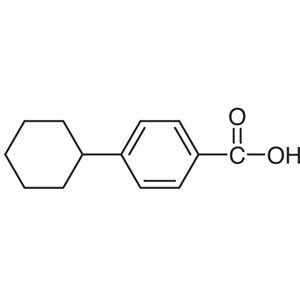
4-CyclohexylbenzoicAcid TCI C1523
Regular price From Rp 1.538.250,00Regular price -
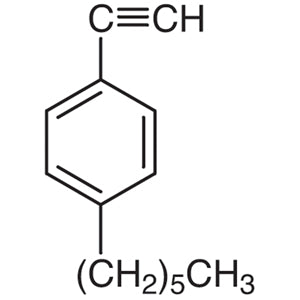
1-Ethynyl-4-hexylbenzene TCI E0564
Regular price From Rp 2.254.350,00Regular price -
Hexylbenzene TCI H0136
Regular price From Rp 2.782.500,00Regular price -
1,4-Dicyclohexylbenzene TCI D1028
Regular price From Rp 875.700,00Regular price -
N-Cyclohexylbenzamide TCI C3936
Regular price From Rp 3.075.450,00Regular price -
4-AminobenzoicAcid TCI A0269
Regular price From Rp 530.250,00Regular price -
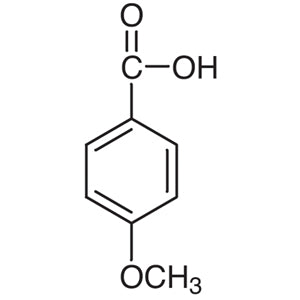
p-AnisicAcid TCI A0482
Regular price Rp 505.050,00Regular price -
4-(trans-4-Butylcyclohexyl)benzoicAcid TCI B5318
Regular price Rp 1.246.350,00Regular price