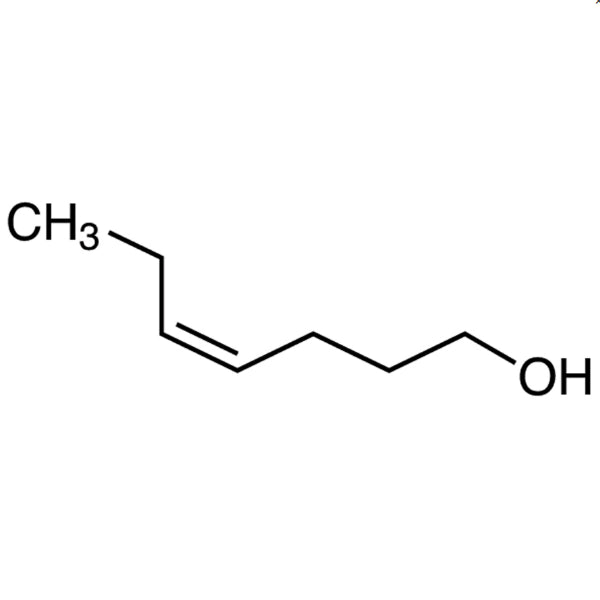
TCI H0833 cis-4-Hepten-1-ol is an unsaturated primary alcohol built on a seven-carbon chain, carrying a double bond at the fourth position in the cis configuration. This defined double-bond geometry is precisely what gives the material its value in the laboratory: many target molecules, particularly aroma compounds and insect pheromones, only display their expected properties when the double-bond configuration is correct. By beginning from a starting material whose geometry is already fixed, researchers avoid the difficulty of controlling alkene stereochemistry in the middle of a synthetic sequence, and they avoid the equally awkward task of separating isomer mixtures that resist separation.
The characteristic that makes this compound a preferred choice is the combination of a reactive primary hydroxyl group with an isolated cis alkene. The primary alcohol is readily oxidised to the corresponding aldehyde, esterified, converted into a leaving group, or transformed into a halide for chain-extension reactions, while the double bond can be left intact when reagents are selected with care. The compound is also recognised for its distinctive green, fresh aroma character, which is why it appears both as a component and as a reference material in flavour and fragrance studies. Its liquid form makes measurement and handling straightforward at the bench.
In Indonesian laboratories, this building block is typically found in university research groups and in the analytical and formulation laboratories of the flavour, fragrance, and agricultural sectors. It is used where a stereochemically defined starting material is needed for multi-step synthesis, or where a well-characterised green-note compound is required as a comparison standard. The liquid presentation suits routine dispensing with a micropipette or syringe, and the material integrates easily into existing bench workflows without special preparation.
- Insect pheromone synthesis — the fixed cis geometry at the fourth carbon matches the configuration required for biological activity in many lepidopteran pheromone structures, removing a difficult stereocontrol step.
- Flavour and fragrance research — its distinctive green, fresh aroma character makes it useful both as a formulation component and as a sensory reference point in comparative olfactory evaluation work.
- Building block for chain extension — the primary hydroxyl can be converted into a halide or other leaving group, allowing the seven-carbon cis-alkenyl fragment to be joined to larger molecular frameworks.
- Oxidation and esterification chemistry — the readily accessible primary alcohol serves as a convenient substrate for preparing the corresponding aldehyde or a range of ester derivatives while preserving the alkene.
- Analytical reference material — as a compound with defined structure and geometry, it supports identification and comparison work in chromatographic studies of green-note volatiles and related aroma compounds.
| Brand | TCI (Tokyo Chemical Industry) |
|---|---|
| CAS number | 6191-71-5 |
| Molecular formula | — |
| Purity | — |
| Category | Chemistry > Building Blocks > Non-Heterocyclic Building Blocks |
| Pack sizes | Available in standard TCI research-scale packaging; please confirm the currently listed pack options when ordering |
| Physical form | Liquid |
| Storage | Store in a cool, dark place in a tightly closed container |
- Product Code: H0833
Store the container tightly closed in a cool, dark, well-ventilated area away from heat sources, direct sunlight, and oxidising agents, since the alkene functionality can be sensitive to oxidative conditions over time. Amber glass bottles with chemically resistant closures are appropriate, and the original manufacturer packaging should be retained wherever possible. Dispense inside a fume hood using clean, dry glassware or a syringe, and close the container promptly to limit air exposure. Wear safety glasses, nitrile gloves, and a laboratory coat during handling. Consult the manufacturer's Safety Data Sheet before first use and follow institutional procedures for chemical waste disposal.
—
Produk Terkait
-
6-Hepten-1-ol TCI H0949
Regular price From Rp 11.793.600,00Regular price -
trans-2-Hepten-1-ol TCI H0682
Regular price Rp 2.466.450,00Regular price -
6-Methyl-5-hepten-2-one TCI M0252
Regular price Rp 637.350,00Regular price -
3-Hepten-2-one TCI H0838
Regular price Rp 2.650.200,00Regular price