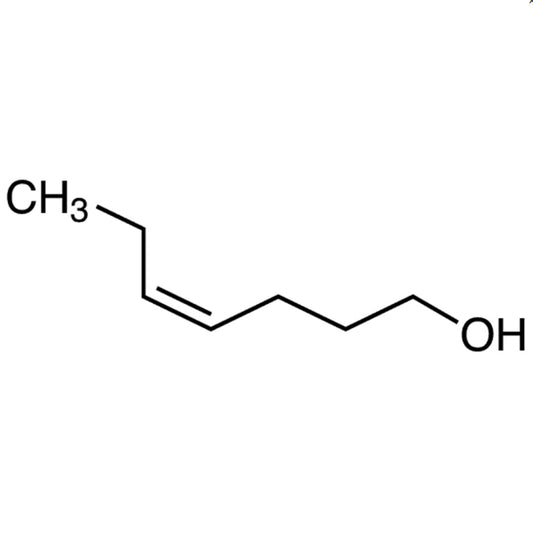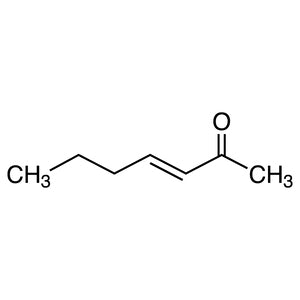
TCI H0838 3-Hepten-2-one is a seven-carbon alpha,beta-unsaturated ketone bearing a double bond conjugated directly with the carbonyl group. Enones of this class rank among the most classical and most productive building blocks in organic synthesis, because a single molecule presents two electrophilic centres at once: the carbonyl carbon and the beta carbon. In the laboratory, the compound is used routinely as a Michael acceptor, as a substrate for conjugate addition reactions, and as a starting material for ring construction through Robinson annulation and various cycloaddition reactions. It is also recognised in the study of aroma and flavour compounds.
The property that makes this material a preferred choice is its conjugation, which activates the beta position toward attack by soft nucleophiles such as enolates, amines, thiols, and organocopper reagents. Conjugate addition proceeds with good selectivity and delivers products that still retain the carbonyl group for subsequent transformation, for example reduction, aldol condensation, or the formation of oximes and hydrazones. The propyl chain on the alkene side contributes a mild lipophilic character and exerts a measurable influence on steric reactivity, giving chemists a predictable handle when tuning a reaction sequence.
In Indonesian laboratories, 3-Hepten-2-one is typically encountered in university and institutional research groups working on synthetic methodology, in medicinal chemistry programmes that need a short-chain enone scaffold, and in flavour and fragrance research units. It is drawn on in postgraduate thesis work, in reaction-development studies where a reliable Michael acceptor is required, and in analytical work that uses the compound as a reference material for chromatographic and spectroscopic identification of unsaturated ketones.
- Michael addition reactions: the conjugated enone system provides an activated beta carbon that accepts soft nucleophiles such as enolates and thiols with good, reproducible selectivity.
- Robinson annulation and ring formation: the compound supplies the enone partner required to build six-membered carbocyclic rings, a step central to many multi-step synthetic routes.
- Conjugate addition with organocopper reagents: organocuprates add cleanly at the beta position, allowing controlled carbon–carbon bond formation while leaving the ketone intact for later steps.
- Cycloaddition chemistry: the electron-poor double bond participates as a dienophile or two-carbon component, giving access to cyclic frameworks from simple acyclic precursors.
- Aroma and flavour research: as a compound known in flavour and fragrance studies, it serves as a reference substance and a model unsaturated ketone in sensory and analytical investigations.
| Brand | TCI (Tokyo Chemical Industry) |
|---|---|
| CAS number | 1119-44-4 |
| Molecular formula | — |
| Purity | — |
| Category | Chemistry > Building Blocks > Non-Heterocyclic Building Blocks |
| Pack sizes | available in standard TCI catalogue research quantities; please confirm the required size when ordering |
| Physical form | liquid at room temperature |
| Storage | keep in a tightly closed container in a cool, well-ventilated place |
- Product Code: H0838
Store the container tightly closed in a cool, dry, and well-ventilated area, away from heat sources, open flame, and direct sunlight. Keep it separated from strong oxidising agents and from strong bases and nucleophilic reagents, which may react with the activated enone system. Use the original manufacturer bottle or a compatible tightly sealed glass container; avoid materials that may be attacked by organic liquids. Handle inside a fume hood, and wear safety goggles, chemical-resistant gloves, and a laboratory coat. Transfer the liquid carefully to limit vapour release, close the container immediately after use, and consult the manufacturer's safety data sheet before first handling and before disposal.
—
Produk Terkait
-
6-Methyl-5-hepten-2-one TCI M0252
Regular price Rp 637.350,00Regular price -
6-Hepten-1-ol TCI H0949
Regular price From Rp 11.793.600,00Regular price -
cis-4-Hepten-1-ol TCI H0833
Regular price From Rp 1.856.400,00Regular price -
trans-2-Hepten-1-ol TCI H0682
Regular price Rp 2.466.450,00Regular price