

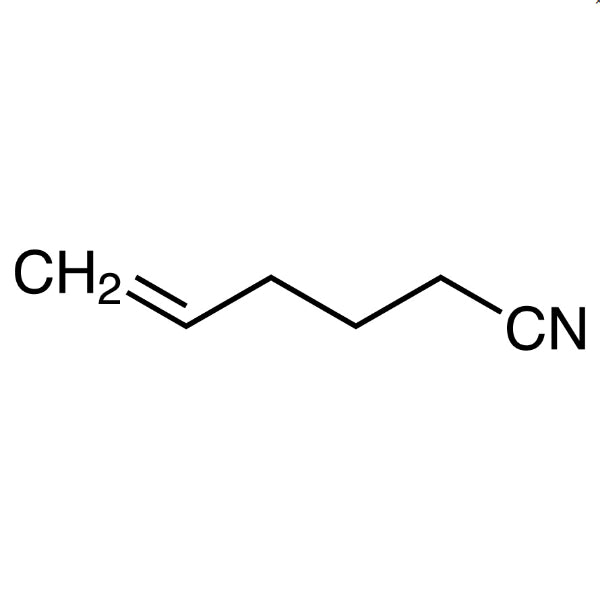
TCI H0836 5-Hexenenitrile is an aliphatic nitrile built on a six-carbon chain that carries a terminal double bond at the fifth position. It belongs to the family of non-heterocyclic building blocks and is valued because it presents two distinct functional groups on a single, simple skeleton: a polar nitrile group that is reactive toward nucleophiles, and a terminal alkene that serves as an entry point for a wide range of addition reactions and transition-metal catalysis. In laboratory practice, the compound is widely used as a starting material for the preparation of amines, carboxylic acids, aldehydes, and cyclic frameworks accessible through radical reactions and cycloadditions.
The property that makes this compound a preferred choice is the versatility of its reactivity. The nitrile group can be reduced to a primary amine, hydrolysed to a carboxylic acid or an amide, treated with organometallic reagents to form ketones, or converted into a tetrazole in medicinal chemistry work. The terminal alkene, meanwhile, is open to hydrogenation, hydroformylation, epoxidation, hydroboration, cross metathesis, hydrothiolation, and thiol-ene reactions. The five-carbon spacing between the two functional groups also favours the formation of five- and six-membered rings in radical and cycloaddition-based cyclisations, so a single reagent supports several distinct synthetic strategies.
In Indonesian laboratories, 5-Hexenenitrile is typically handled in university research groups, synthetic organic chemistry laboratories, and industrial research and development units that build molecular scaffolds step by step. It is normally used on a bench scale in fume-hood work, where the bifunctional character of the molecule allows a research team to explore several transformation routes from one common intermediate. Supplied by AMI Scientific under the TCI brand, it fits laboratories that need a dependable, well-characterised building block for exploratory and route-development chemistry.
- Primary amine synthesis — the nitrile group can be reduced directly to a primary amine, giving researchers a straightforward route to unsaturated amine intermediates while the terminal alkene remains available for later modification.
- Carboxylic acid and amide preparation — controlled hydrolysis of the nitrile function delivers either the carboxylic acid or the corresponding amide, making this compound a convenient precursor for chain-extended acid derivatives.
- Ketone formation with organometallic reagents — reaction of the nitrile with organometallic species produces ketones, allowing chemists to build carbonyl-containing targets from a simple and readily handled starting material.
- Alkene functionalisation chemistry — the terminal double bond participates in hydrogenation, hydroformylation, epoxidation, hydroboration, cross metathesis, hydrothiolation, and thiol-ene coupling, supporting broad exploration of structure-activity relationships.
- Ring construction through cyclisation — the five-carbon separation between nitrile and alkene favours formation of five- and six-membered rings in radical cyclisations and cycloadditions, useful in scaffold-building programmes.
| Brand | TCI |
|---|---|
| CAS number | 5048-19-1 |
| Molecular formula | — |
| Purity | — |
| Category | Chemistry > Building Blocks > Non-Heterocyclic Building Blocks |
| Pack sizes | available in standard TCI research-scale packaging; please confirm the currently listed pack options when ordering |
| Physical form | — |
| Storage | store in a tightly closed container in a cool, dry, well-ventilated area away from ignition sources |
- Product code: H0836
Keep the container tightly closed and store it in a cool, dry, well-ventilated place, away from heat, open flame, and other ignition sources, and separated from strong oxidising agents, strong acids, and strong bases. Retain the material in its original manufacturer container, or transfer it to a chemically compatible, clearly labelled and tightly sealed vessel. All handling, weighing, and transfer operations should be carried out inside a functioning fume hood by trained personnel wearing safety goggles, chemically resistant gloves, and a laboratory coat. Avoid inhalation of vapours and any contact with skin or eyes, and keep the workspace free of incompatible chemicals. Always consult the manufacturer's safety data sheet before use, and follow institutional procedures for spill response and chemical waste disposal.
—
Produk Terkait
-
4-Pentenenitrile TCI P1207
Regular price From Rp 5.619.600,00Regular price -
2-Methyl-3-butenenitrile TCI M0840
Regular price From Rp 795.900,00Regular price -
2-Methyl-2-butenenitrile TCI M0839
Regular price From Rp 769.650,00Regular price -
Undecanenitrile TCI U0044
Regular price Rp 3.710.700,00Regular price -
3-Oxo-3-(p-tolyl)propanenitrile TCI T3700
Regular price Rp 1.273.650,00Regular price -
6-Aminohexanenitrile TCI A3525
Regular price Rp 4.001.550,00Regular price -
Tridecanenitrile TCI T0819
Regular price Rp 2.016.000,00Regular price -
3-Phenyl-2-propynenitrile TCI P2333
Regular price Rp 3.367.350,00Regular price


