

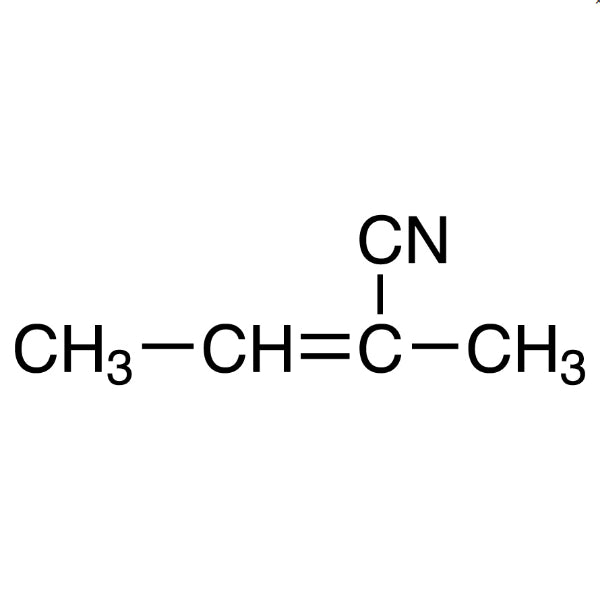
2-Methyl-2-butenenitrile is a chemical compound widely used as a building block in the synthesis of complex organic compounds. It plays a crucial role in laboratory settings by enabling chemists to construct intricate molecular structures through various reaction mechanisms such as substitution and addition. This compound is essential for researchers aiming to develop new materials, pharmaceuticals, and industrial chemicals. Its versatility makes it a valuable tool in both academic and industrial research environments.
The compound's unique molecular structure, featuring a nitrile group and a branched carbon chain, contributes to its reactivity and applicability in diverse chemical reactions. Its chemical stability allows it to be used in controlled reaction conditions, making it suitable for precise synthetic processes. The absence of heterocyclic components simplifies synthesis pathways and reduces structural complexity, enhancing its appeal for organic chemists. This stability, combined with its reactivity, ensures that it remains a preferred choice for many laboratory applications.
In Indonesian laboratories, 2-Methyl-2-butenenitrile is commonly used in research focused on organic chemistry and applied sciences. It is frequently employed in the development of new compounds and materials, supporting both fundamental and applied research initiatives. Its availability and reliability make it a standard component in the chemical supply chain for Indonesian institutions, contributing to the advancement of scientific knowledge and innovation.
- Organic synthesis is a key application where 2-Methyl-2-butenenitrile is used to construct complex molecules by participating in various reaction mechanisms.
- Pharmaceutical research benefits from this compound as it is used in the development of new drugs and therapeutic agents through synthetic pathways.
- Industrial chemistry applications rely on this material for the production of polymers and specialty chemicals due to its reactivity and structural versatility.
- Material science research utilizes this compound to create advanced materials with specific chemical properties and functional characteristics.
- Academic research in Indonesian universities frequently incorporates this compound in experimental studies to explore new chemical reactions and molecular structures.
| Brand | TCI |
|---|---|
| CAS number | 4403-61-6 |
| Molecular formula | — |
| Purity | — |
| Category | Chemistry > Building Blocks > Non-Heterocyclic Building Blocks |
| Pack sizes | Available in standard laboratory quantities |
| Physical form | Liquid |
| Storage | Store in a cool, dry place away from light and incompatible materials |
This compound should be stored in a cool, dry environment, away from direct sunlight and sources of heat. It is recommended to use sealed containers made of materials compatible with organic solvents to prevent contamination and evaporation. Due to its reactivity with acids, bases, and alkali metals, it should be handled with appropriate personal protective equipment, including gloves and safety goggles. Proper ventilation is essential when working with this material to minimize exposure. Storage should be in a well-ventilated area, and it should not be stored near incompatible substances such as strong oxidizers or flammable materials. Regular inspection of storage conditions is advised to ensure the integrity and safety of the compound.
—
Produk Terkait
-
2-Methyl-3-butenenitrile TCI M0840
Regular price From Rp 795.900,00Regular price -
4-Pentenenitrile TCI P1207
Regular price From Rp 5.619.600,00Regular price -
5-Hexenenitrile TCI H0836
Regular price From Rp 3.207.750,00Regular price -
Undecanenitrile TCI U0044
Regular price Rp 3.710.700,00Regular price -
3-Oxo-3-(p-tolyl)propanenitrile TCI T3700
Regular price Rp 1.273.650,00Regular price -
6-Aminohexanenitrile TCI A3525
Regular price Rp 4.001.550,00Regular price -
Tridecanenitrile TCI T0819
Regular price Rp 2.016.000,00Regular price -
3-Phenyl-2-propynenitrile TCI P2333
Regular price Rp 3.367.350,00Regular price


