

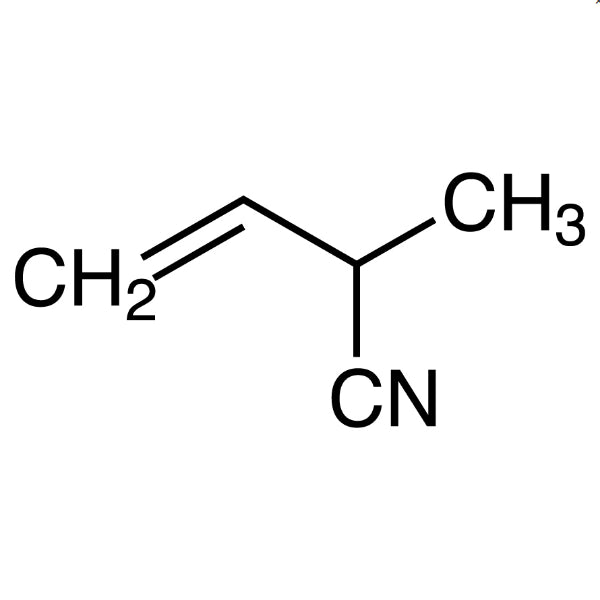
2-Methyl-3-butenenitrile is a chemical compound widely used as a building block in the synthesis of complex organic compounds. Its nitrile functional group enables a variety of chemical reactions, including addition, substitution, and electrophilic reactions. This compound plays a crucial role in organic chemistry by serving as a versatile intermediate in the creation of heterocyclic compounds, esters, and other derivatives with applications in pharmaceuticals, materials science, and chemical industries. Due to its simple yet adaptable structure, it readily reacts with various reagents such as acids, bases, and organic solvents.
The compound’s stability under normal conditions makes it a preferred choice for laboratory use. Its relatively high boiling point allows it to be suitable for reactions requiring elevated temperatures. The chemical’s reactivity and stability make it an essential tool for chemists working on synthetic pathways. Its ability to participate in multiple reaction types enhances its utility in both academic and industrial research settings.
In Indonesian laboratories, 2-Methyl-3-butenenitrile is commonly used in organic chemistry research, particularly in the synthesis of compounds requiring nitrile functional groups. It is frequently employed in the development of new synthetic compounds with potential applications in the medical field. Many research institutions and universities in Indonesia rely on this compound for advancing chemical innovations and drug discovery efforts.
- Organic synthesis is a key application where this compound serves as a versatile building block for creating complex molecules.
- Heterocyclic compound development benefits from its reactivity, allowing for the formation of ring structures essential in pharmaceuticals.
- Ester synthesis often utilizes this compound due to its ability to undergo substitution reactions under appropriate conditions.
- Material science research leverages its chemical properties to develop new polymers and functional materials.
- Pharmaceutical research employs it in the creation of synthetic compounds with potential therapeutic applications.
| Brand | TCI |
|---|---|
| CAS number | 16529-56-9 |
| Molecular formula | — |
| Purity | — |
| Category | Chemistry > Building Blocks > Non-Heterocyclic Building Blocks |
| Pack sizes | Available in various quantities as per standard laboratory supply |
| Physical form | Liquid |
| Storage | Store in a cool, dry place away from direct sunlight and incompatible materials |
This compound should be stored in a cool, dry place away from direct sunlight and incompatible materials. It is recommended to use airtight containers made of glass or polyethylene to prevent contamination and evaporation. Due to its reactivity, it should be handled with care, using appropriate personal protective equipment such as gloves and safety goggles. It is important to ensure proper ventilation in the laboratory to minimize exposure to vapors. Avoid contact with strong acids or bases, as they may cause unwanted reactions. Always follow standard laboratory safety protocols when working with this compound.
—
Produk Terkait
-
2-Methyl-2-butenenitrile TCI M0839
Regular price From Rp 769.650,00Regular price -
4-Pentenenitrile TCI P1207
Regular price From Rp 5.619.600,00Regular price -
5-Hexenenitrile TCI H0836
Regular price From Rp 3.207.750,00Regular price -
Undecanenitrile TCI U0044
Regular price Rp 3.710.700,00Regular price -
3-Oxo-3-(p-tolyl)propanenitrile TCI T3700
Regular price Rp 1.273.650,00Regular price -
6-Aminohexanenitrile TCI A3525
Regular price Rp 4.001.550,00Regular price -
Tridecanenitrile TCI T0819
Regular price Rp 2.016.000,00Regular price -
3-Phenyl-2-propynenitrile TCI P2333
Regular price Rp 3.367.350,00Regular price


