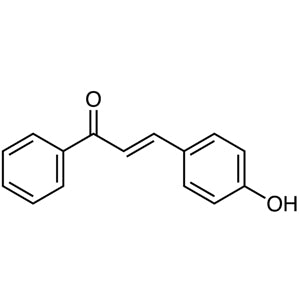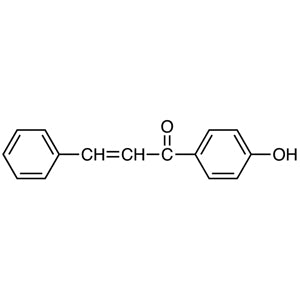
TCI H0945 4'-Hydroxychalcone is a member of the chalcone family, a class of unsaturated aromatic ketones in which two benzene rings are joined by a three-carbon chain bearing a conjugated double bond. Chalcones are widely recognised as the biosynthetic precursor scaffold of flavonoids in plants, which is why this compound is frequently used both as a reference material and as a starting material in natural product research. In the laboratory, 4'-hydroxychalcone serves as a non-heterocyclic building block that can be converted into flavanones, flavones, pyrazolines and a range of other derivatives through cyclisation or addition reactions, while also acting as a test substance in studies of the biological activity of phenolic compounds.
The properties that make this compound a preferred choice begin with its conjugated enone system, which behaves as a Michael acceptor and therefore reacts readily with a variety of nucleophiles such as amines, hydrazines and thiols under relatively simple conditions. The extended conjugation between the two aromatic rings also gives the molecule strong absorption in the ultraviolet-visible region, so reaction progress can be followed easily by thin-layer chromatography or by spectrophotometry. The phenolic hydroxy group on the acetophenone ring adds polarity, which improves handling in common laboratory solvent systems and provides an additional reactive site for further functionalisation.
In Indonesian laboratories, 4'-hydroxychalcone is typically encountered in university and institutional research groups working on natural product chemistry, synthetic organic chemistry and pharmaceutical screening. It is used at bench scale for the preparation of flavonoid analogues, for teaching and demonstrating condensation and cyclisation chemistry at postgraduate level, and as a comparison standard in analytical work. Supply is normally arranged in research-scale quantities suitable for method development rather than production volumes.
TCI brochures (PDF)
- Polyphenols 2024-12-05 · p. 2
- Flavonoid analogue synthesis: the chalcone skeleton cyclises directly to flavanones and flavones, giving researchers a short and well-established route into the flavonoid class.
- Heterocycle construction: reaction of the conjugated enone with hydrazines and related binucleophiles yields pyrazolines and similar ring systems without requiring an additional activating step.
- Michael addition studies: the enone acts as a reliable Michael acceptor toward amines, hydrazines and thiols, making it a convenient substrate for conjugate addition methodology work.
- Natural product reference work: as a biosynthetic precursor scaffold of plant flavonoids, it serves as a reference material when identifying or comparing chalcones isolated from botanical sources.
- Biological activity screening: it functions as a test compound in investigations of phenolic compound activity, where the free phenolic hydroxy group is a relevant structural feature.
| Brand | TCI |
|---|---|
| CAS number | 2657-25-2 |
| Molecular formula | — |
| Purity | — |
| Category | Chemistry > Building Blocks > Non-Heterocyclic Building Blocks |
| Pack sizes | available in standard TCI research-scale pack sizes; please confirm the current options when ordering. |
| Physical form | — |
| Storage | keep in a cool, dark place in a tightly closed container. |
- Product code: H0945
Store the container tightly closed in a cool, dark and well-ventilated place, away from heat, direct sunlight, strong oxidising agents and strong bases. Amber glass bottles or the original supplier packaging are suitable, since the extended conjugation of the molecule means it absorbs strongly in the ultraviolet region and prolonged light exposure is best avoided. Handle the solid in a fume hood using gloves, safety glasses and a laboratory coat, and avoid generating dust during weighing and transfer. Because the conjugated enone is reactive toward nucleophiles such as amines and thiols, keep it separated from incompatible reagents. Consult the manufacturer's safety data sheet before use and dispose of residues as chemical waste according to institutional procedures.
—
Product Categories
Produk Terkait
-
(E)-4-Hydroxychalcone TCI H0955
Regular price Rp 1.220.100,00Regular price -
(E)-2'-Hydroxychalcone TCI H0385
Regular price Rp 2.625.000,00Regular price -
(E)-2-Hydroxychalcone TCI H0234
Regular price From Rp 1.193.850,00Regular price -
4-Methoxychalcone TCI M1409
Regular price Rp 3.207.750,00Regular price -
4-Butyl-4'-hydroxychalcone TCI B2741
Regular price Rp 3.922.800,00Regular price -
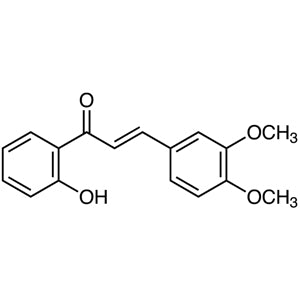
(E)-2'-Hydroxy-3,4-dimethoxychalcone TCI H1598
Regular price Rp 8.162.700,00Regular price -
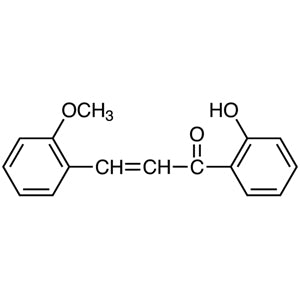
2'-Hydroxy-2-methoxychalcone TCI H1493
Regular price Rp 2.889.600,00Regular price -
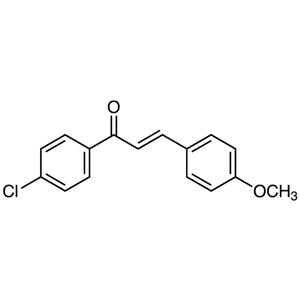
(E)-4'-Chloro-4-methoxychalcone TCI C3280
Regular price From Rp 2.916.900,00Regular price