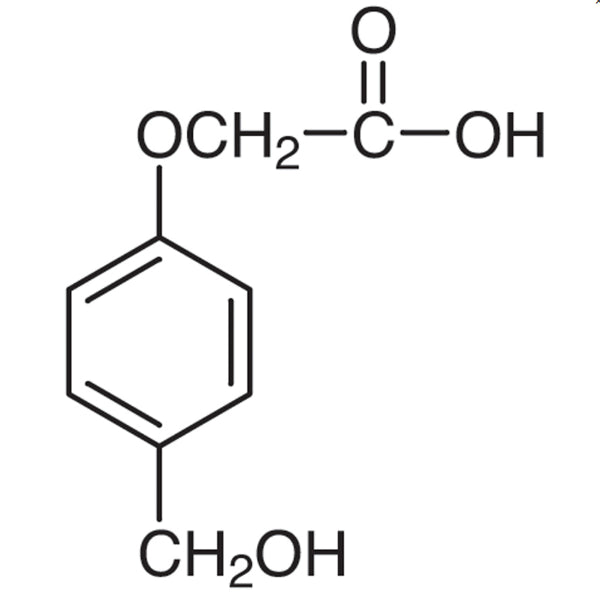
4-(Hydroxymethyl)phenoxyacetic Acid is a bifunctional aromatic compound widely known among peptide researchers as the HMPA linker, or Wang-type linker. Its structure consists of a benzene ring bearing a hydroxymethyl group on one side and a phenoxyacetate chain terminating in a carboxylic acid on the opposite side. In the laboratory, its role is highly specific: this compound serves as the chemical bridge that attaches a growing peptide chain to a solid support resin, allowing the entire solid-phase peptide synthesis process to proceed in a stepwise and fully controlled manner.
The property that makes this linker a preferred choice is the very clear division of labour between the two ends of the molecule. The carboxylic acid terminus is used to bind the linker permanently to an amino resin, such as aminomethyl resin or MBHA resin, through formation of an amide bond that withstands synthesis conditions. Meanwhile, the benzylic hydroxymethyl group at the other end acts as the attachment point for the first amino acid in ester form. That benzylic ester bond is stable towards the piperidine base used to remove the Fmoc protecting group in every cycle, yet can be cleanly cleaved by trifluoroacetic acid.
In Indonesian laboratories, this reagent is typically found in peptide chemistry, medicinal chemistry, and biochemistry groups at universities and research institutes, as well as in laboratories developing peptide-based candidate compounds. It is normally purchased in small research quantities alongside resins, coupling reagents, and Fmoc-protected amino acids, and is handled by researchers already familiar with standard solid-phase synthesis workflows and anhydrous handling practice.
Related TCI products
- TCI P0111 14316-61-1 Phenoxyacetic Anhydride
- TCI P0107 122-59-8 Phenoxyacetic Acid
- TCI D2672 126828-35-1 4-[(2,4-Dimethoxyphenyl)[(9H-fluoren-9-ylmethoxy)carbonylamino]methyl]phenoxyacetic Acid
- TCI B2746 1878-91-7 4-Bromophenoxyacetic Acid
- TCI T1063 575-89-3 2,4,6-Trichlorophenoxyacetic Acid
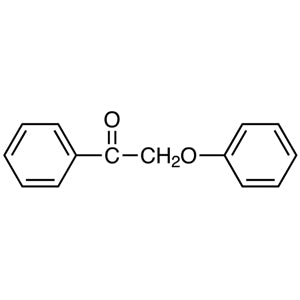
- TCI P2121 721-04-0 2-Phenoxyacetophenone
- Solid-phase peptide synthesis (SPPS): serves as the anchoring linker between the resin support and the growing peptide chain, making stepwise assembly controlled and reproducible.
- Fmoc-strategy peptide assembly: the benzylic ester survives repeated piperidine deprotection cycles, so the peptide stays anchored throughout every coupling and deprotection step.
- Resin functionalisation: the carboxylic acid end couples permanently to aminomethyl or MBHA amino resins via amide bond formation, converting plain resin into a ready peptide support.
- Acid-mediated peptide cleavage work: the benzylic ester is cleanly cleaved by trifluoroacetic acid, allowing the finished peptide to be released from the support without harsh conditions.
- Medicinal and peptide chemistry research: supports preparation of synthetic peptide candidates where a well-defined, predictable linker chemistry is required for each synthesis cycle.
| Brand | TCI |
|---|---|
| CAS number | 68858-21-9 |
| Molecular formula | — |
| Purity | — |
| Category | TCI |
| Pack sizes | available in research-scale laboratory pack sizes; please confirm the currently available packing when ordering. |
| Physical form | — |
| Storage | store in a tightly closed container in a cool, dry place away from moisture. |
- Product code: H0961
Store this reagent in a cool, dry and well-ventilated area, in its original tightly closed container, protected from moisture and direct sunlight. Because it is used in solid-phase synthesis where anhydrous conditions matter, keep the container sealed and allow it to reach room temperature before opening to reduce condensation on the solid. Handle in a fume hood using safety glasses, gloves, and a laboratory coat, and avoid generating or inhaling dust. Use clean, dry spatulas to prevent contamination, keep the material away from incompatible chemicals, and consult the manufacturer's safety data sheet before use.
—
Produk Terkait
-
PhenoxyaceticAnhydride TCI P0111
Regular price From Rp 4.399.500,00Regular price -
PhenoxyaceticAcid TCI P0107
Regular price From Rp 637.350,00Regular price -
4-[(2,4-Dimethoxyphenyl)[(9H-fluoren-9-ylmethoxy)carbonylamino]methyl]phenoxyaceticAcid TCI D2672
Regular price Rp 2.121.000,00Regular price -
4-BromophenoxyaceticAcid TCI B2746
Regular price From Rp 637.350,00Regular price -
2,4,6-TrichlorophenoxyaceticAcid TCI T1063
Regular price From Rp 3.232.950,00Regular price -
2-Phenoxyacetophenone TCI P2121
Regular price Rp 1.298.850,00Regular price -
4'-Phenoxyacetophenone TCI P1355
Regular price Rp 1.298.850,00Regular price -
4-NitrophenoxyaceticAcid TCI N0226
Regular price From Rp 1.115.100,00Regular price


![TCI D2672 126828-35-1 4-[(2,4-Dimethoxyphenyl)[(9H-fluoren-9-ylmethoxy)carbonylamino]methyl]phenoxyacetic Acid — struktur kimia](http://amiscientific.com/cdn/shop/files/TCI2510D2672-struktur.jpg?v=1791524993&width=533)