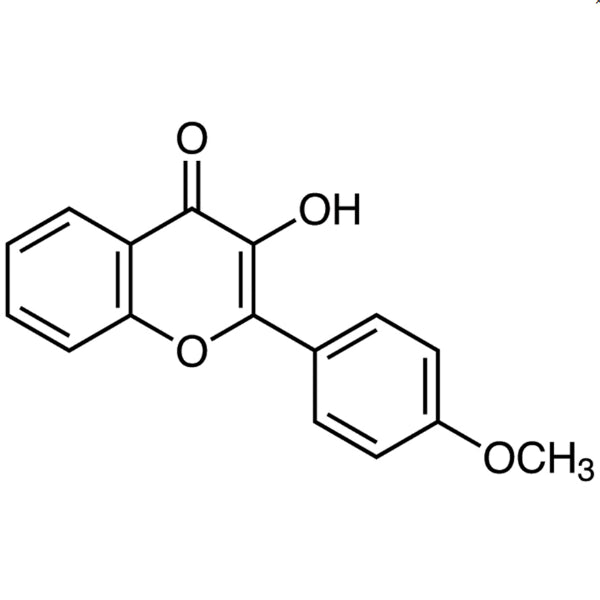
3-Hydroxy-4'-methoxyflavone is a synthetic flavonol bearing a hydroxyl group at position 3 of the flavone skeleton and a methoxy group at the para position of the B ring. The 3-hydroxyflavone framework is widely recognised among photochemistry researchers because its hydroxyl group sits adjacent to the carbonyl, an arrangement that permits excited-state intramolecular proton transfer. In the laboratory, compounds of this type serve as fluorescent probes and as model materials in studies of polyphenols, organic molecular photophysics, and the relationship between structure and emission behaviour.
The property that makes this compound a preferred choice is the characteristic dual emission shown by 3-hydroxyflavone derivatives, namely the appearance of two luminescence bands originating from the normal form and from the tautomer produced by proton transfer. The ratio between these two bands is highly sensitive to polarity, hydrogen-bonding capability, and the microviscosity of the environment surrounding the molecule. The methoxy group on the B ring adds electron-donating character that influences charge distribution in the excited state, so the compound is frequently used to compare substituent effects on photophysical behaviour across a series of flavonol derivatives.
In Indonesian laboratories, this material is typically handled in university photochemistry and natural-product chemistry groups, in spectroscopy facilities, and in research units working on fluorescent probes and polyphenol chemistry. It is normally used at small scale in solution-phase measurements, where it is dissolved in solvents of differing polarity and examined by absorption and emission spectroscopy. Its role is usually that of a reference or comparison compound within a planned series of experiments rather than a bulk consumable.
TCI brochures (PDF)
- Polyphenols 2024-12-05 · p. 1
- Phytochemicals 2025-12-17 · p. 10
- Fluorescent probe development: the dual-band emission responds to the surrounding medium, so the compound can report on local polarity and hydrogen bonding without requiring an additional reporting label.
- Excited-state intramolecular proton transfer studies: the hydroxyl adjacent to the carbonyl provides the structural arrangement needed to observe proton transfer directly in emission measurements.
- Solvent polarity and microviscosity investigations: because the ratio of the two luminescence bands shifts with the environment, the compound works as a sensitive ratiometric indicator in comparative solvent series.
- Structure-property relationship research on flavonols: the para methoxy substituent on the B ring allows researchers to isolate electron-donating effects when comparing photophysical behaviour across related derivatives.
- Polyphenol and aromatic polyketide model studies: the defined synthetic flavonol skeleton offers a reproducible reference structure for work on naturally occurring polyphenols and their emission characteristics.
| Brand | TCI |
|---|---|
| CAS number | 6889-78-7 |
| Molecular formula | — |
| Purity | — |
| Category | Life Science > Biochemicals and Reagents > Phenylpropanoids, Aromatic Polyketides |
| Pack sizes | available in standard research-scale packaging as listed on the product page |
| Physical form | — |
| Storage | keep in the closed original container under the conditions stated on the manufacturer label |
- Product code: TCI H1405
Store the compound in its original tightly closed container, protected from light and moisture, and keep it in a cool, dry, well-ventilated place away from strong oxidising agents. Amber glass vials or the supplied container are suitable for storage, and solutions prepared for spectroscopic work should be kept in sealed, clean glassware and protected from prolonged light exposure, since photoactive compounds can degrade under illumination. Handle the material in a fume hood using gloves, safety glasses, and a laboratory coat, and avoid generating dust when weighing small quantities. Always consult the manufacturer safety data sheet before use, and dispose of residues and contaminated consumables through the laboratory chemical waste route.
—
Produk Terkait
-
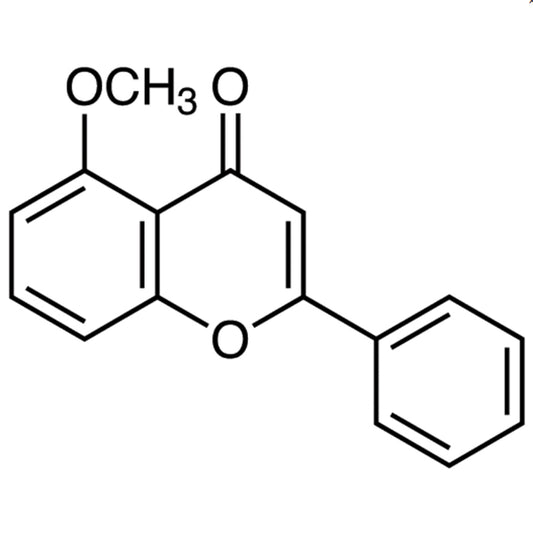
5-Methoxyflavone TCI M2365
Regular price From Rp 2.174.550,00Regular price -
3-Methoxyflavone TCI M2364
Regular price From Rp 3.340.050,00Regular price -
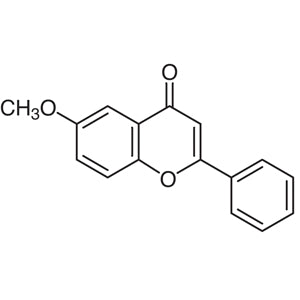
6-Methoxyflavone TCI M1346
Regular price From Rp 1.220.100,00Regular price -
5,7-Dimethoxyflavone TCI D6232
Regular price Rp 5.672.100,00Regular price -
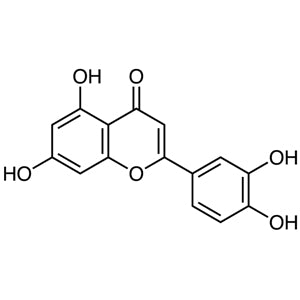
3',4',5,7-Tetrahydroxyflavone TCI T2682
Regular price From Rp 1.565.550,00Regular price -
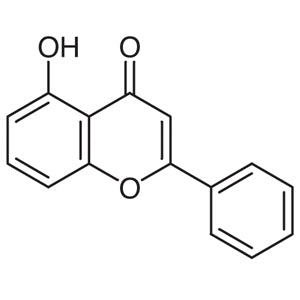
5-Hydroxyflavone TCI H1238
Regular price Rp 5.089.350,00Regular price -
7-Hydroxyflavone TCI H0852
Regular price From Rp 903.000,00Regular price -
6-Hydroxyflavone TCI H0851
Regular price From Rp 505.050,00Regular price