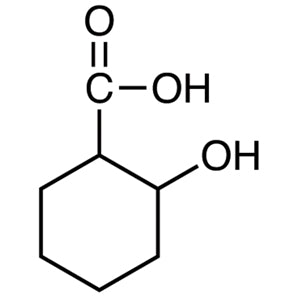
2-Hydroxycyclohexanecarboxylic Acid, supplied as a mixture of cis- and trans- isomers, is an alicyclic building block that carries a hydroxyl group directly adjacent to a carboxylic acid group on a cyclohexane ring. This beta-hydroxy acid arrangement gives the molecule two neighbouring stereogenic centres together with two reactive functional groups held in very close proximity. In organic synthesis laboratories, a compound of this kind serves as a practical starting point for constructing functionalised saturated structures, preparing lactones, and assembling three-dimensional frameworks in medicinal chemistry programmes.
The advantage that leads researchers to select this compound lies in the closeness of its two functional groups. The 1,2-relationship between the hydroxyl and the carboxylic acid facilitates the formation of five-membered lactones and allows reactions that involve both groups simultaneously, such as the formation of acetonides or other cyclic derivatives. That proximity also makes the relative stereochemistry a determining factor: the cis and trans isomers can display different cyclisation tendencies and different reaction rates. Supplying the material as a mixture gives researchers the freedom to study both behaviours before committing to a particular strategy.
In Indonesian laboratories, this building block is typically used in university research groups and institutional synthesis facilities working on saturated scaffolds and small-molecule intermediates. It is generally handled at bench scale for exploratory reaction work, method development, and derivatisation studies, where a compact difunctional ring system is needed. Researchers commonly use it in projects that require a rigid alicyclic core rather than a flat aromatic one, particularly in early-stage medicinal chemistry and teaching-level advanced synthesis work.
Related TCI products
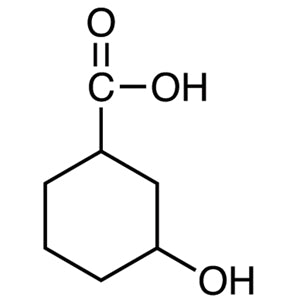
- TCI H1408 606488-94-2 3-Hydroxycyclohexanecarboxylic Acid (cis- and trans- mixture)
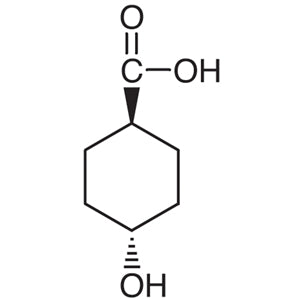
- TCI H1175 3685-26-5 trans-4-Hydroxycyclohexanecarboxylic Acid
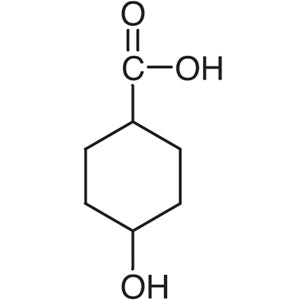
- TCI H0960 17419-81-7 4-Hydroxycyclohexanecarboxylic Acid (cis- and trans- mixture)
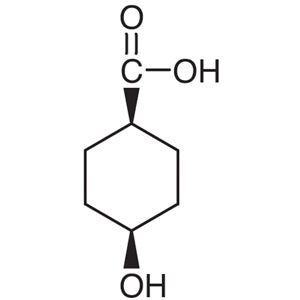
- TCI H0980 3685-22-1 cis-4-Hydroxycyclohexanecarboxylic Acid
- TCI T2278 118-56-9 3,3,5-Trimethylcyclohexyl Salicylate (cis- and trans- mixture)
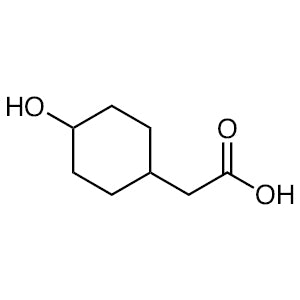
- TCI H1753 99799-09-4 2-(4-Hydroxycyclohexyl)acetic Acid (cis- and trans- mixture)
- Lactone synthesis: the adjacent hydroxyl and carboxylic acid groups allow direct intramolecular esterification to five-membered lactones without the need for additional linking steps.
- Medicinal chemistry scaffold construction: the saturated cyclohexane ring supplies a three-dimensional framework that chemists use when moving away from flat aromatic cores in structure-activity studies.
- Cyclic derivative preparation: both functional groups can be engaged together, making the compound suitable for forming acetonides and related cyclic protected intermediates in multistep routes.
- Stereochemistry investigations: because the cis and trans isomers cyclise and react at different rates, the mixture lets researchers compare both behaviours within a single experimental series.
- Functionalised intermediate preparation: the two reactive handles give synthetic chemists independent points for derivatisation when building more elaborate saturated target molecules in research programmes.
| Brand | TCI |
|---|---|
| CAS number | 609-69-8 |
| Molecular formula | — |
| Purity | — |
| Category | Chemistry > Building Blocks > Non-Heterocyclic Building Blocks |
| Pack sizes | available in standard research and laboratory pack sizes; please confirm the current options when ordering |
| Physical form | — |
| Storage | store according to the conditions stated on the manufacturer's label and safety data sheet |
- Catalogue reference: H1409
- Composition: mixture of cis- and trans- isomers
Store the container tightly closed in a cool, dry, well-ventilated area, away from direct sunlight, heat sources, and incompatible materials such as strong bases and strong oxidising agents. Keep the material in its original supplier packaging or in a chemically compatible, clearly labelled container, and reseal it promptly after each use to limit moisture uptake. Handle the compound in a fume hood while wearing safety goggles, a laboratory coat, and suitable chemical-resistant gloves, since it is an organic acid capable of irritating skin and eyes. Always consult the manufacturer's safety data sheet before use, and dispose of residues and contaminated materials through the laboratory's chemical waste procedures.
—
Produk Terkait
-
3-HydroxycyclohexanecarboxylicAcid(cis-andtrans-mixture) TCI H1408
Regular price Rp 3.658.200,00Regular price -
trans-4-HydroxycyclohexanecarboxylicAcid TCI H1175
Regular price From Rp 3.949.050,00Regular price -
4-HydroxycyclohexanecarboxylicAcid(cis-andtrans-mixture) TCI H0960
Regular price From Rp 4.213.650,00Regular price -
cis-4-HydroxycyclohexanecarboxylicAcid TCI H0980
Regular price From Rp 4.373.250,00Regular price -
3,3,5-TrimethylcyclohexylSalicylate(cis-andtrans-mixture) TCI T2278
Regular price From Rp 664.650,00Regular price -
2-(4-Hydroxycyclohexyl)aceticAcid(cis-andtrans-mixture) TCI H1753
Regular price From Rp 1.060.500,00Regular price -
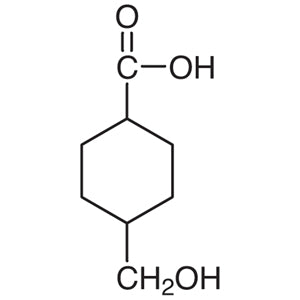
4-(Hydroxymethyl)cyclohexanecarboxylicAcid(cis-andtrans-mixture) TCI H1015
Regular price Rp 4.347.000,00Regular price -
Methyltrans-4-Hydroxycyclohexanecarboxylate TCI M1991
Regular price From Rp 717.150,00Regular price