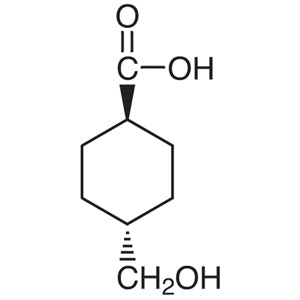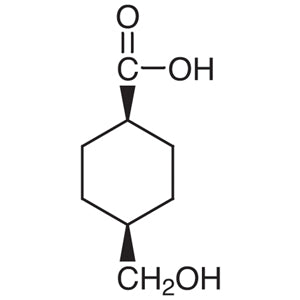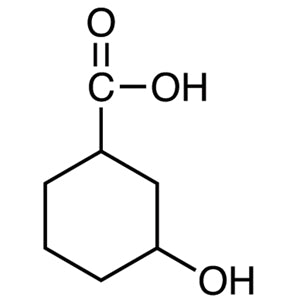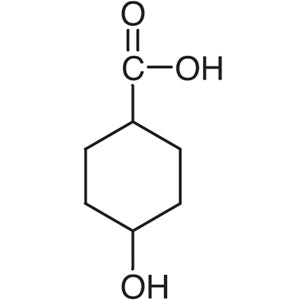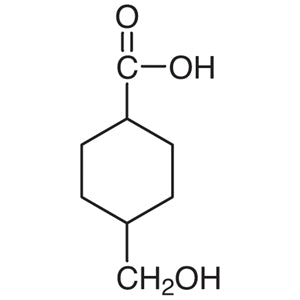
4-(Hydroxymethyl)cyclohexanecarboxylic Acid (cis- and trans- mixture) is a versatile chemical compound widely used in laboratory settings for the synthesis of complex organic molecules. As a building block in chemical reactions, it serves as a crucial intermediate in various synthetic pathways. Its unique molecular structure allows it to participate in multiple reaction types, including substitution and oxidation reactions, making it an essential tool for chemists. This compound is commonly employed in both academic and industrial research to develop new compounds and materials.
The compound's favorable solubility in organic solvents and its stable chemical and physical properties make it a preferred choice for laboratory applications. Its ability to dissolve in a variety of solvents simplifies the process of handling and purification, which is critical in synthetic chemistry. Additionally, its chemical stability ensures that it maintains its integrity under various reaction conditions, reducing the risk of unwanted side reactions. These characteristics contribute to its reliability and effectiveness in laboratory environments.
In Indonesian laboratories, this compound is frequently used in research focused on organic chemistry, drug development, and material science. It is a valuable resource for universities and research institutions that conduct experiments involving the synthesis of new compounds. Its availability in the local market supports ongoing scientific investigations and educational activities, making it an essential component of the chemical supply chain in Indonesia.
Related TCI products
- TCI H1243 66185-74-8 trans-4-(Hydroxymethyl)cyclohexanecarboxylic Acid
- TCI H1242 73094-35-6 cis-4-(Hydroxymethyl)cyclohexanecarboxylic Acid
- TCI T2278 118-56-9 3,3,5-Trimethylcyclohexyl Salicylate (cis- and trans- mixture)
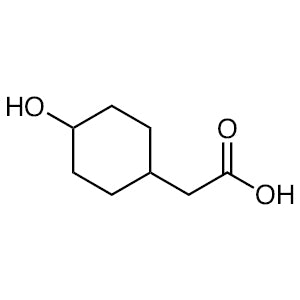
- TCI H1753 99799-09-4 2-(4-Hydroxycyclohexyl)acetic Acid (cis- and trans- mixture)
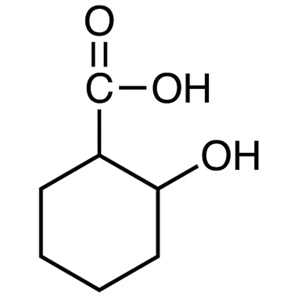
- TCI H1409 609-69-8 2-Hydroxycyclohexanecarboxylic Acid (cis- and trans- mixture)
- TCI H1408 606488-94-2 3-Hydroxycyclohexanecarboxylic Acid (cis- and trans- mixture)
- Organic synthesis applications benefit from this compound's ability to participate in multiple reaction types, making it ideal for creating complex molecular structures.
- Drug development research utilizes its reactivity to design and synthesize potential pharmaceutical compounds with specific functional groups.
- Material science experiments leverage its structural versatility to develop new polymers and functional materials with tailored properties.
- Academic research in chemistry relies on its role as a building block for teaching and experimental purposes in undergraduate and graduate programs.
- Analytical chemistry applications use its distinct chemical properties for calibration and as a reference standard in various analytical techniques.
| Brand | TCI |
|---|---|
| CAS number | 13380-84-2 |
| Molecular formula | — |
| Purity | — |
| Category | Chemistry > Building Blocks > Non-Heterocyclic Building Blocks |
| Pack sizes | Available in various quantities as per supplier specifications |
| Physical form | Solid or crystalline, depending on the batch |
| Storage | Store in a cool, dry place away from direct sunlight and moisture |
This compound should be stored in a cool, dry environment to maintain its chemical stability and prevent degradation. It is recommended to use airtight containers to protect it from moisture and air exposure. Due to its potential reactivity, it should be handled in a well-ventilated area, and appropriate personal protective equipment such as gloves and safety goggles should be worn. Avoid contact with incompatible substances, and ensure that storage conditions are consistent with standard laboratory safety protocols. Proper labeling of containers is essential to ensure safe handling and prevent accidental exposure.
—
Produk Terkait
-
trans-4-(Hydroxymethyl)cyclohexanecarboxylicAcid TCI H1243
Regular price From Rp 3.207.750,00Regular price -
cis-4-(Hydroxymethyl)cyclohexanecarboxylicAcid TCI H1242
Regular price From Rp 1.749.300,00Regular price -
3,3,5-TrimethylcyclohexylSalicylate(cis-andtrans-mixture) TCI T2278
Regular price From Rp 664.650,00Regular price -
2-(4-Hydroxycyclohexyl)aceticAcid(cis-andtrans-mixture) TCI H1753
Regular price From Rp 1.060.500,00Regular price -
2-HydroxycyclohexanecarboxylicAcid(cis-andtrans-mixture) TCI H1409
Regular price From Rp 6.970.950,00Regular price -
3-HydroxycyclohexanecarboxylicAcid(cis-andtrans-mixture) TCI H1408
Regular price Rp 3.658.200,00Regular price -
4-HydroxycyclohexanecarboxylicAcid(cis-andtrans-mixture) TCI H0960
Regular price From Rp 4.213.650,00Regular price -
trans-4-(tert-Butoxycarbonylaminomethyl)cyclohexanecarboxylicAcid TCI B3253
Regular price From Rp 1.510.950,00Regular price