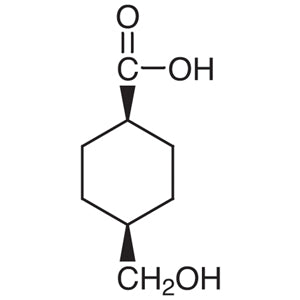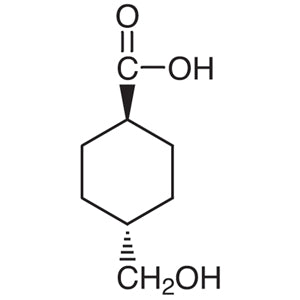
TCI H1243, with CAS number 66185-74-8, is trans-4-(Hydroxymethyl)cyclohexanecarboxylic Acid, a geometric isomer of a bifunctional cyclohexane compound classified among non-heterocyclic building blocks. In the trans isomer, the carboxylic acid group and the hydroxymethyl group occupy positions that allow both to adopt equatorial orientations simultaneously, producing a molecule that is relatively elongated and conformationally stable. In the laboratory, this compound serves as the scaffold of choice when researchers require a rigid linker whose distance between functional groups can be predicted with confidence.
The preference for the trans isomer arises from its high conformational stability and its more linear molecular shape compared with the cis isomer. This characteristic matters in both drug design and materials work, because molecular shape determines how well a compound occupies a protein binding pocket and how regularly polymer chains arrange themselves. The two functional groups differ in reactivity, which permits stepwise transformation: the carboxylic acid can be converted into an amide or an ester, while the primary alcohol is ready to be oxidised, tosylated, or coupled to another fragment. This flexibility allows a single starting material to support several different synthetic routes.
In Indonesian laboratories, this building block is typically used in university and institutional synthetic chemistry groups, in medicinal chemistry programmes exploring rigid spacer units, and in polymer and materials research where a defined, conformationally predictable linker is needed. It is commonly handled in small-scale bench synthesis, where the researcher installs one functional group at a time and then carries the intermediate forward through subsequent coupling or functionalisation steps.
Related TCI products
- TCI H1242 73094-35-6 cis-4-(Hydroxymethyl)cyclohexanecarboxylic Acid
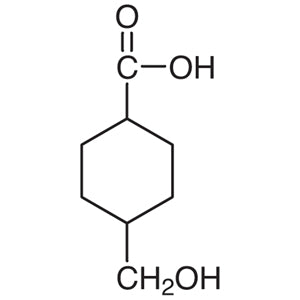
- TCI H1015 13380-84-2 4-(Hydroxymethyl)cyclohexanecarboxylic Acid (cis- and trans- mixture)
- TCI B3253 27687-14-5 trans-4-(tert-Butoxycarbonylaminomethyl)cyclohexanecarboxylic Acid
- TCI B3251 162046-58-4 4-(tert-Butoxycarbonylaminomethyl)cyclohexanecarboxylic Acid (cis- and trans- mixture)
- TCI B3250 53292-89-0 trans-4-(tert-Butoxycarbonylamino)cyclohexanecarboxylic Acid
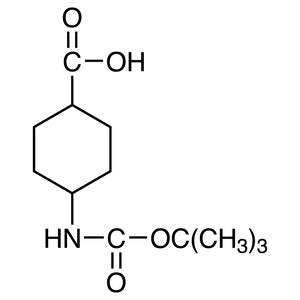
- TCI B3248 130309-46-5 4-(tert-Butoxycarbonylamino)cyclohexanecarboxylic Acid (cis- and trans- mixture)
- Medicinal chemistry scaffold design, where the linear trans geometry provides a predictable distance between substituents so candidate molecules fit protein binding pockets reliably.
- Rigid linker construction in multi-step synthesis, because the conformationally stable cyclohexane ring holds the two functional groups at a reproducible separation throughout subsequent reactions.
- Amide and ester library preparation, since the carboxylic acid group can be converted selectively into amides or esters while the alcohol remains untouched.
- Selective alcohol functionalisation studies, as the primary hydroxymethyl group is readily oxidised, tosylated, or coupled to another fragment for stepwise route development.
- Polymer and materials research, where the elongated trans shape promotes more regular chain arrangement than the corresponding cis isomer would allow in the same system.
| Brand | TCI |
|---|---|
| CAS number | 66185-74-8 |
| Molecular formula | — |
| Purity | — |
| Category | Chemistry > Building Blocks > Non-Heterocyclic Building Blocks |
| Pack sizes | available in standard TCI research-scale pack sizes; please confirm the pack size when ordering |
| Physical form | — |
| Storage | store in a cool, dry place in the tightly closed original container |
- Chemical name: trans-4-(Hydroxymethyl)cyclohexanecarboxylic Acid
Store the container tightly closed in a cool, dry, well-ventilated area, away from direct sunlight, moisture, and incompatible reagents such as strong oxidising agents and strong bases. The original supplier container is the most suitable primary packaging; if transfer is required, use a clean, dry, chemically resistant vessel with a secure closure and label it clearly with the compound name and CAS number. Handle the material in a fume hood, wearing safety goggles, a laboratory coat, and appropriate chemical-resistant gloves. Avoid raising dust, avoid inhalation and contact with skin or eyes, and wash hands thoroughly after handling. Keep the container sealed when not in use to prevent moisture uptake, and consult the manufacturer's safety data sheet before first use and before disposal.
—
Produk Terkait
-
cis-4-(Hydroxymethyl)cyclohexanecarboxylicAcid TCI H1242
Regular price From Rp 1.749.300,00Regular price -
4-(Hydroxymethyl)cyclohexanecarboxylicAcid(cis-andtrans-mixture) TCI H1015
Regular price Rp 4.347.000,00Regular price -
trans-4-(tert-Butoxycarbonylaminomethyl)cyclohexanecarboxylicAcid TCI B3253
Regular price From Rp 1.510.950,00Regular price -
4-(tert-Butoxycarbonylaminomethyl)cyclohexanecarboxylicAcid(cis-andtrans-mixture) TCI B3251
Regular price Rp 1.829.100,00Regular price -
trans-4-(tert-Butoxycarbonylamino)cyclohexanecarboxylicAcid TCI B3250
Regular price From Rp 3.578.400,00Regular price -
4-(tert-Butoxycarbonylamino)cyclohexanecarboxylicAcid(cis-andtrans-mixture) TCI B3248
Regular price From Rp 2.625.000,00Regular price -
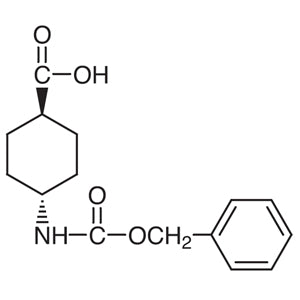
trans-4-(Carbobenzoxyamino)cyclohexanecarboxylicAcid TCI C2036
Regular price From Rp 1.538.250,00Regular price -
Diethyl2,2-Bis(hydroxymethyl)malonate TCI B1492
Regular price From Rp 3.021.900,00Regular price