

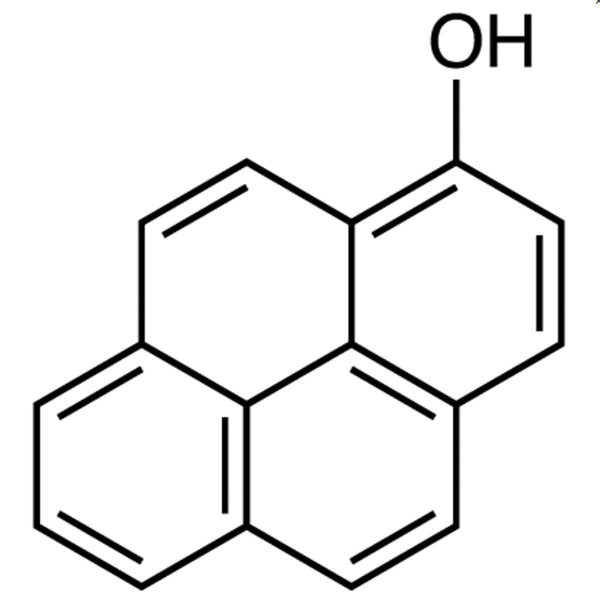
1-Hydroxypyrene is a hydroxylated derivative of pyrene, the tightly fused four-ring polycyclic aromatic hydrocarbon. The addition of a single hydroxyl group at the number one position converts that non-polar aromatic compound into a polycyclic phenol with polar character and new reactivity. In the laboratory the compound holds a dual role: it serves as a building block for the synthesis of fluorescent compounds, and it serves as a reference material in research on monitoring exposure to polycyclic aromatic hydrocarbons, because 1-hydroxypyrene is widely recognised as a biological marker of exposure to that class of compounds.
The property that gives this material its high value is its pyrene group, which fluoresces strongly, has a relatively long excited-state lifetime, and is sensitive to its immediate surroundings. These characteristics make the pyrene unit a classic fluorescence label, one able to report on micropolarity, matrix rigidity, and inter-molecular proximity through the formation of excimers. The hydroxyl group at position one supplies a practical chemical handle for etherification, esterification, or the coupling of the pyrene unit onto other molecules, polymers, and surfaces, so that the fluorescent behaviour can be transferred to those systems.
In Indonesian laboratories this material is used where a researcher needs a fluorescent reporter that can be attached chemically rather than merely mixed in, and where work is being done on polycyclic aromatic hydrocarbon exposure monitoring. It is drawn on by university chemistry and environmental research groups, materials and polymer laboratories preparing labelled systems, and analytical laboratories developing methods around the recognised exposure marker, in each case as a defined starting material of known identity.
Related TCI products
- Synthesis of fluorescent compounds — the hydroxyl handle at position one allows the strongly emitting pyrene unit to be built into larger target molecules through straightforward etherification or esterification chemistry.
- Reference material for exposure monitoring research — 1-hydroxypyrene is widely recognised as a biological marker of polycyclic aromatic hydrocarbon exposure, making a defined sample essential for method development work.
- Fluorescent labelling of polymers and surfaces — the phenolic group provides the coupling point needed to attach the pyrene reporter covalently onto polymer chains and prepared surfaces.
- Micropolarity and matrix rigidity probing — the pyrene unit responds to its immediate chemical environment, so a labelled system can report on local polarity and the stiffness of the surrounding matrix.
- Excimer-based proximity studies — because pyrene units form excimers when brought close together, this building block supports experiments that measure inter-molecular distance and association behaviour.
| Brand | TCI |
|---|---|
| CAS number | 5315-79-7 |
| Molecular formula | — |
| Purity | — |
| Category | Chemistry > Building Blocks > Non-Heterocyclic Building Blocks |
| Pack sizes | available in the standard catalogue pack sizes offered by TCI for this item |
| Physical form | — |
| Storage | follow the storage conditions stated on the manufacturer's label and safety data sheet |
- Catalogue code: H1435
Store this material in its original tightly closed container, kept in a cool, dry, and well-ventilated place away from heat sources and direct sunlight, and follow the storage conditions given on the manufacturer's label and safety data sheet. Amber glass or otherwise light-protected containers are appropriate for a fluorescent aromatic compound of this kind. Handle in a fume hood using gloves, safety glasses, and a laboratory coat, avoiding the generation of dust and any contact with skin, eyes, or clothing. Keep the container closed when not in use, label transferred portions clearly, and dispose of residues and contaminated materials as chemical waste in line with institutional procedures. Consult the manufacturer's safety data sheet before first use.
—
Produk Terkait
-
Ethyl2-Amino-4-hydroxypyrimidine-5-carboxylate TCI E1247
Regular price From Rp 1.035.300,00Regular price
