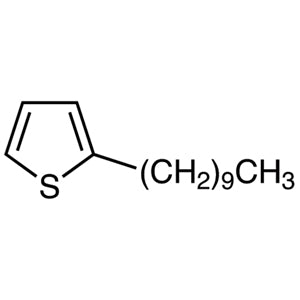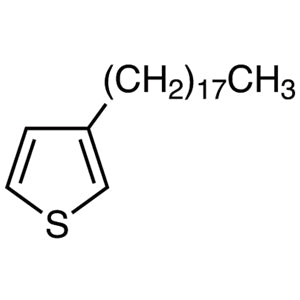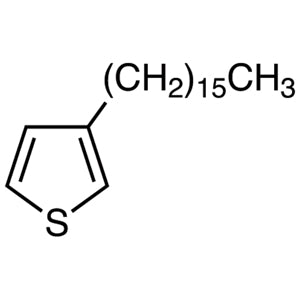
3-Hexadecylthiophene is a chemical compound widely used in laboratory settings for the synthesis of heterocyclic compounds. As a building block in organic chemistry, it plays a crucial role in creating complex molecular structures with unique reactivity and solubility properties. Its thiophene core, extended with a hexadecyl chain, makes it a versatile reagent in various synthetic pathways. This compound is essential for researchers aiming to develop new materials, pharmaceuticals, and functional chemicals. Its chemical structure allows for participation in substitution and cyclization reactions, making it a valuable tool in synthetic chemistry.
The compound’s high reactivity and solubility in organic solvents make it a preferred choice for laboratory applications. Its ability to dissolve in a range of organic solvents simplifies purification and isolation processes, enhancing the efficiency of chemical synthesis. Additionally, its stability under certain conditions ensures reliable performance in experimental setups. These properties make 3-Hexadecylthiophene a reliable and effective reagent for advanced chemical research. The compound’s unique structure also allows for the creation of diverse functional derivatives, expanding its utility across multiple scientific disciplines.
In Indonesian laboratories, 3-Hexadecylthiophene is commonly used in organic chemistry research and the synthesis of heterocyclic compounds. It is frequently found in projects related to drug development, polymer materials, and functional chemical compounds. Due to its high quality and consistent performance, it is a preferred material for researchers seeking to produce complex chemical structures with specific properties. Its availability and reliability make it an essential component in many scientific investigations conducted in Indonesia.
- Organic synthesis of heterocyclic compounds due to its reactive thiophene core and long hydrocarbon chain.
- Development of pharmaceuticals as a building block for creating complex molecular structures with therapeutic potential.
- Production of polymer materials through functionalization reactions that benefit from its solubility and reactivity.
- Research in functional chemistry for creating compounds with specific optical, electronic, or biological properties.
- Advanced chemical research requiring reliable and consistent reagents for synthetic pathway optimization.
| Brand | TCI |
|---|---|
| CAS number | 119269-24-8 |
| Molecular formula | — |
| Purity | — |
| Category | Chemistry > Building Blocks > Heterocyclic Building Blocks |
| Pack sizes | Available in various quantities as per standard laboratory supply |
| Physical form | Solid or liquid, depending on the specific product variant |
| Storage | Store in a cool, dry place away from direct sunlight and moisture |
3-Hexadecylthiophene should be stored in a cool, dry environment to maintain its chemical stability. It is recommended to keep the compound in a sealed container to prevent exposure to moisture and air, which may affect its reactivity. Suitable storage containers include glass or plastic bottles with airtight lids to ensure long-term preservation. In laboratory settings, it is important to handle the compound with care, using appropriate personal protective equipment such as gloves and safety goggles. The compound is generally stable under normal storage conditions but should be kept away from incompatible substances to avoid any potential chemical interactions. Proper labeling and storage practices help ensure the safety and effectiveness of the material in research applications.
—
Produk Terkait
-
2-Decylthiophene TCI D5240
Regular price From Rp 1.538.250,00Regular price -
3-Undecylthiophene TCI U0056
Regular price From Rp 1.644.300,00Regular price -
2-Dodecylthiophene TCI D4874
Regular price From Rp 1.405.950,00Regular price -
3-Dodecylthiophene TCI D2016
Regular price From Rp 610.050,00Regular price -
3-Tetradecylthiophene TCI T3104
Regular price From Rp 1.378.650,00Regular price -
3-Octadecylthiophene TCI O0245
Regular price From Rp 1.273.650,00Regular price -
2-Bromo-3-hexadecylthiophene TCI B5409
Regular price Rp 2.386.650,00Regular price -
2,5-Dibromo-3-hexadecylthiophene TCI D5242
Regular price From Rp 1.696.800,00Regular price