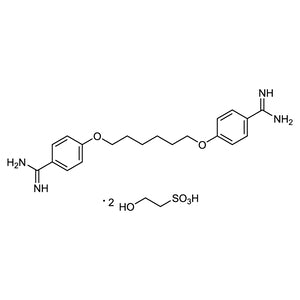
Hexamidine Diisethionate with CAS number 659-40-5 is the isethionate salt of hexamidine, an aromatic compound bearing amidine groups that belongs to the family of antimicrobial substances. Within the Life Science category, this compound is classified as a biochemical reagent in the antibiotics line and is widely used in microbiological research as well as in preservative studies. Its presence in the laboratory helps researchers examine inhibitory activity against microorganisms, evaluate preservation systems in formulations, and investigate the mode of action of cationic compounds on microbial cell membranes in a controlled and well-documented manner.
This compound is chosen because its diisethionate salt form offers considerably better solubility in aqueous media than the corresponding free base, making it straightforward to prepare as a stock solution for activity testing. The cationic character of the amidine groups allows strong interaction with the negatively charged surfaces of microbial cells, a property that underpins many studies of antimicrobial mechanisms. The solid salt form is also easier to weigh accurately and is generally more stable in storage than a liquid form, which supports reproducibility between experiments and makes the material practical for routine bench work.
In Indonesian laboratories, this reagent is typically handled in microbiology and formulation research settings where antimicrobial screening and preservative evaluation are part of the regular workload. Research groups at universities, government research institutes, and industrial quality laboratories use it when preparing test solutions for inhibition assays or when comparing preservation systems. Because it is supplied as a stable solid, it fits well into workflows where a single container serves multiple experiments over an extended period.
- Antimicrobial activity screening: the compound's well-defined salt form and good aqueous solubility allow preparation of accurate stock solutions for consistent inhibition testing against microbial cultures.
- Preservative system evaluation: researchers use it to study how antimicrobial agents behave within formulations, supporting controlled and documented assessment of preservation performance over the course of a study.
- Membrane interaction mechanism studies: the cationic amidine groups interact strongly with negatively charged microbial cell surfaces, making this material suitable for investigating how cationic compounds act on cell membranes.
- Microbiological research reference work: as a biochemical reagent in the antibiotics line, it serves as a defined comparison substance when characterising the inhibitory behaviour of microorganisms under laboratory conditions.
- Stock solution preparation for assay development: the solid salt is easy to weigh accurately and disperses readily in aqueous media, supporting reproducible dilution series across repeated experimental runs.
| Brand | TCI |
|---|---|
| CAS number | 659-40-5 |
| Molecular formula | — |
| Purity | — |
| Category | Life Science > Biochemicals and Reagents > Antibiotics |
| Pack sizes | available in the standard catalogue pack sizes offered by the manufacturer; please confirm the required size when ordering |
| Physical form | solid salt (diisethionate salt of hexamidine) |
| Storage | store in a closed container under the conditions stated on the manufacturer's label |
Store the container tightly closed in a cool, dry place away from direct sunlight and moisture, following the conditions indicated on the manufacturer's label. Original containers or chemically compatible closed vessels are suitable, and containers should be clearly labelled with the substance name and CAS number. Handle the solid in a well-ventilated area or fume hood to avoid generating and inhaling dust, and wear standard laboratory personal protective equipment including gloves, safety glasses, and a laboratory coat. Prepare aqueous stock solutions using clean glassware, keep them properly labelled, and avoid cross-contamination between weighing operations. Consult the manufacturer's safety data sheet before use, and dispose of residues and contaminated materials in accordance with applicable laboratory chemical waste procedures.
—
Produk Terkait
-
TCI B5774 5,10-Bis(4,4,5,5-tetramethyl-1,3,2-dioxaborolan-2-yl)naphtho[1,2-c:5,6-c']bis([1,2,5]oxadiazole)
Regular price Rp 10.255.350,00Regular price -
Dihydroiodide TCI B6569
Regular price From Rp 1.936.200,00Regular price -
Trifluoromethanesulfonate TCI B7003
Regular price From Rp 1.936.200,00Regular price
![5,10-Bis(4,4,5,5-tetramethyl-1,3,2-dioxaborolan-2-yl)naphtho[1,2-c:5,6-c']bis([1,2,5]oxadiazole) - TCI B5774 - AMI Scientific](http://amiscientific.com/cdn/shop/files/TCI2510B5774.jpg?v=1769180228&width=533)