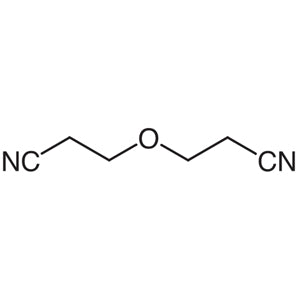
3,3'-Iminodipropionitrile is an aliphatic compound built around a secondary amine whose two arms each terminate in a nitrile group. This symmetrical arrangement makes it an efficient building block, because a single molecule supplies three reactive points at once: one amine nitrogen and two cyano groups that can be converted into carboxylic acids, amides, or primary amines. The compound is commonly produced through Michael addition, and in turn serves as an intermediate for constructing polyamines, polyamides, and aminocarboxylic acid derivatives in the organic synthesis laboratory.
The property that makes this material a preferred choice is the transformational flexibility of its nitrile groups. Hydrolysis yields beta-alanine acid derivatives, while hydrogenation converts the molecule into a branched triamine that is useful as an epoxy resin hardener, as a ligand, or as a monomer. Having two identical cyano arms on a single nitrogen centre means one reagent can open several synthetic routes without requiring a change of starting material, which is a practical advantage when a laboratory is exploring more than one derivative from a common scaffold.
Unlike most other products in this series, this compound is a liquid at room temperature, so it is packaged by volume and is more easily transferred with a pipette or a syringe. That handling profile suits Indonesian research and teaching laboratories where volumetric dispensing into small-scale reaction vessels is routine. It should be emphasised that this compound is widely known in the neuroscience literature as a neurotoxic substance in animal models, so its handling demands a high degree of caution at every stage of use.
Related TCI products
- Polyamine synthesis — catalytic hydrogenation of both cyano arms delivers a branched triamine in a single step from one readily dispensed liquid reagent.
- Polyamide intermediate preparation — the two nitrile groups can be carried forward toward amide functionality, giving a symmetrical scaffold for building polyamide chains in synthesis work.
- Aminocarboxylic acid derivative work — hydrolysis of the nitrile groups produces beta-alanine acid derivatives, making this compound a direct precursor route for that class of products.
- Epoxy resin hardener development — the branched triamine obtained after hydrogenation functions as a curing agent, so this nitrile serves as the upstream laboratory-scale starting material.
- Ligand and monomer preparation — the amine nitrogen plus the two convertible cyano arms give coordination chemists and polymer chemists three handles on a single small molecule.
| Brand | TCI |
|---|---|
| CAS number | 111-94-4 |
| Molecular formula | — |
| Purity | — |
| Category | Chemistry > Building Blocks > Non-Heterocyclic Building Blocks |
| Pack sizes | supplied by volume, in line with its liquid form |
| Physical form | liquid at room temperature |
| Storage | keep in the closed original container under the conditions stated on the manufacturer's label |
Store the container tightly closed in a cool, dry, well-ventilated area away from heat sources and incompatible materials, keeping the original manufacturer packaging wherever possible. As a liquid, it is best transferred with a pipette or syringe rather than poured, which reduces splashing and limits exposure during dispensing. Work inside a fume hood and wear chemically resistant gloves, safety goggles, and a laboratory coat. Because this compound is documented as a neurotoxic substance in animal models, treat every contact route as significant, avoid skin contact and inhalation of vapours, and consult the manufacturer's safety data sheet before use and disposal.
—
Produk Terkait
-
Propionitrile TCI P0514
Regular price From Rp 477.750,00Regular price -
3-(Methylamino)propionitrile TCI M2312
Regular price From Rp 1.988.700,00Regular price -
3,3'-Oxydipropionitrile TCI B0475
Regular price From Rp 2.227.050,00Regular price -
alpha,alpha,alpha',alpha'-Tetramethyl-1,3-benzenedipropionitrile TCI T3421
Regular price Rp 2.466.450,00Regular price -
3-Bromopropionitrile TCI B1762
Regular price Rp 2.121.000,00Regular price -
3-AminopropionitrileFumarate TCI A0796
Regular price From Rp 1.908.900,00Regular price -
3-Aminopropionitrile(stabilizedwithK2CO3) TCI A0408
Regular price Rp 2.332.050,00Regular price -
2-(3-Benzoylphenyl)propionitrile TCI B2939
Regular price From Rp 1.220.100,00Regular price