

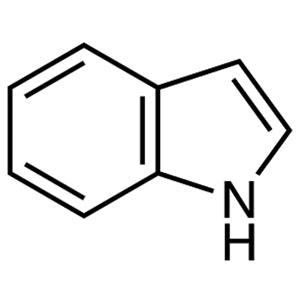
Indole is an organic chemical compound with a heterocyclic structure containing a single nitrogen atom. It plays a crucial role in laboratory settings as a fundamental building block for synthesizing complex molecules, particularly in the development of aromatic and heterocyclic compounds. Its unique structure allows it to participate in various chemical reactions, making it an essential tool for researchers in chemistry, pharmacy, and biotechnology. Indole is widely used for studying the reactivity of heterocyclic compounds and for creating new substances with potential medical or pharmaceutical applications.
Indole is valued for its high reactivity and stability, which enable it to engage in a range of chemical transformations. It is soluble in many organic solvents, facilitating its use in diverse experimental procedures. Its molecular structure supports reactions such as Diels-Alder, substitution, and electrophilic reactions, making it a versatile reagent. These properties make indole a preferred choice for synthetic chemists aiming to develop complex organic compounds and functional materials.
In Indonesian laboratories, indole is commonly used by chemists, pharmacists, and biotechnologists. It is integral to research on bioactive compounds and pharmaceutical development. Its availability and chemical properties make it a reliable and essential material for academic and industrial research in the region.
TCI brochures (PDF)
- Amino Acids and Peptide Synthesis Reagents 2025-08-14 · p. 38
Related TCI products
- TCI I0743 1196-70-9 Indole-6-carboxaldehyde
- TCI I0852 19005-93-7 Indole-2-carboxaldehyde
- TCI T4293 1,1,2-Trimethyl-1H-benzo[e]indole-7-sulfonic Acid Monohydrate
- TCI T3351 55577-25-8 2-(p-Tolyl)indole
- TCI T3119 881219-73-4 1,2,3-Trimethyl-3H-benzo[e]indole
- TCI T3116 2047-91-8 1,2,3,4-Tetrahydrocyclopenta[b]indole
- Synthesis of aromatic and heterocyclic compounds due to its stable molecular structure and reactivity.
- Development of pharmaceuticals and bioactive molecules because of its ability to participate in various chemical reactions.
- Research on heterocyclic reactivity for understanding chemical behavior in organic synthesis.
- Creation of functional materials through its involvement in Diels-Alder and electrophilic reactions.
- Testing of chemical solubility and reactivity in organic solvent-based experiments.
| Brand | TCI |
|---|---|
| CAS number | 120-72-9 |
| Molecular formula | — |
| Purity | — |
| Category | Chemistry > Building Blocks > Heterocyclic Building Blocks |
| Pack sizes | Available in various quantities as per standard laboratory supply |
| Physical form | Solid |
| Storage | Store in a cool, dry place away from light and moisture |
Indole should be stored in a cool, dry place, away from light and moisture to maintain its stability and prevent degradation. It is recommended to use airtight containers made of glass or plastic to avoid contamination. Due to its reactivity, it should be handled with care in a well-ventilated area. Proper personal protective equipment, such as gloves and safety goggles, should be worn when handling. It is important to keep it away from incompatible substances to ensure safe storage and usage in the laboratory environment.
—
Produk Terkait
-
Indole-6-carboxaldehyde TCI I0743
Regular price From Rp 2.359.350,00Regular price -
Indole-2-carboxaldehyde TCI I0852
Regular price From Rp 3.949.050,00Regular price -
AcidMonohydrate TCI T4293
Regular price From Rp 1.696.800,00Regular price -
2-(p-Tolyl)indole TCI T3351
Regular price From Rp 2.625.000,00Regular price -
1,2,3-Trimethyl-3H-benzo[e]indole TCI T3119
Regular price From Rp 1.035.300,00Regular price -
1,2,3,4-Tetrahydrocyclopenta[b]indole TCI T3116
Regular price Rp 1.115.100,00Regular price -
2,3,3-Trimethyl-3H-benzo[g]indole TCI T2601
Regular price Rp 4.452.000,00Regular price -
1-(Triisopropylsilyl)indole TCI T1822
Regular price Rp 5.460.000,00Regular price


![1,1,2-Trimethyl-1H-benzo[e]indole-7-sulfonic Acid Monohydrate - AMI Scientific](http://amiscientific.com/cdn/shop/files/TCI2510T4293.jpg?v=1767145027&width=533)

![881219-73-4 1,2,3-Trimethyl-3H-benzo[e]indole - AMI Scientific](http://amiscientific.com/cdn/shop/files/TCI2510T3119.jpg?v=1767143808&width=533)
![2047-91-8 1,2,3,4-Tetrahydrocyclopenta[b]indole - AMI Scientific](http://amiscientific.com/cdn/shop/files/TCI2510T3116.jpg?v=1767143800&width=533)
![74470-85-2 2,3,3-Trimethyl-3H-benzo[g]indole - AMI Scientific](http://amiscientific.com/cdn/shop/files/TCI2510T2601.jpg?v=1767143100&width=533)
