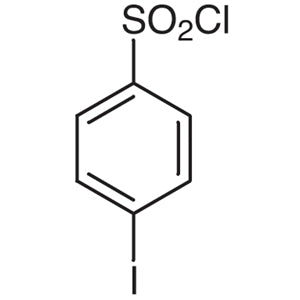
4-Iodobenzenesulfonyl Chloride from TCI is an aromatic sulfonylation reagent that carries an iodine atom at the position para to the sulfonyl chloride group. In the laboratory the material plays a dual role: it serves as a reagent for installing sulfonyl groups onto amines and alcohols, while at the same time acting as a building block that leaves behind a reactive iodine atom for the next stage of synthesis. That combination makes it highly valued in stepwise molecular design, because a single reagent can offer two opportunities for functionalisation without the inconvenience of installing additional protecting groups.
The property that determines its selection is the high reactivity of the sulfonyl chloride group toward nitrogen- and oxygen-based nucleophiles, producing sulfonamides and sulfonate esters that remain stable under common reaction conditions. The sulfonamide bond that forms resists hydrolysis, which is why it is widely used both as a protecting group for amines and as a pharmacophore. The same property, however, makes the material extremely sensitive to moisture; contact with water vapour hydrolyses it into the corresponding sulfonic acid and releases hydrogen chloride. Handling under dry conditions is therefore an absolute requirement.
In Indonesian laboratories this reagent is typically drawn on in synthetic organic chemistry groups, medicinal chemistry programmes and university research units where compound libraries are assembled step by step. Because the local climate is persistently humid, laboratories here pay particular attention to keeping the container closed and the work dry, and the reagent is normally dispensed quickly and returned to controlled storage rather than left open on the bench during a working session.
Related TCI products
- Sulfonamide preparation from primary and secondary amines, where the highly reactive sulfonyl chloride group couples cleanly with nitrogen nucleophiles to give bonds stable under common reaction conditions.
- Sulfonate ester formation from alcohols, exploiting the same reactivity toward oxygen-based nucleophiles to convert hydroxyl groups into products useful for subsequent transformation steps.
- Amine protection in multi-step synthesis, since the sulfonamide bond formed resists hydrolysis and therefore survives conditions that would remove more labile protecting groups.
- Stepwise molecular construction, because the para-iodine atom is retained after sulfonylation and remains available as a reactive handle for the following synthetic stage.
- Medicinal chemistry building-block work, where the sulfonamide unit functions as a pharmacophore while the iodine substituent allows further diversification of the scaffold without extra protecting-group manipulation.
| Brand | TCI |
|---|---|
| CAS number | 98-61-3 |
| Molecular formula | — |
| Purity | — |
| Category | Chemistry > Building Blocks > Non-Heterocyclic Building Blocks |
| Pack sizes | please refer to the catalogue listing for the pack sizes currently offered |
| Physical form | — |
| Storage | keep tightly closed under dry conditions; the material is moisture sensitive |
- Chemical class: aromatic sulfonyl chloride bearing a para-iodine substituent
Store the container tightly closed in a dry, well-ventilated place away from moisture, and keep it in its original tightly sealed container or another container that seals reliably against water vapour. Dispensing is best carried out promptly and under dry conditions, with the container reclosed immediately afterwards, since contact with atmospheric moisture hydrolyses the material to the sulfonic acid and releases hydrogen chloride. Handle in a fume hood using appropriate gloves, eye protection and a laboratory coat, keep the material away from water and incompatible nucleophilic substances, and follow the supplier safety data sheet and local laboratory rules for disposal of residues.
—
Produk Terkait
-
2-IodobenzenesulfonylChloride TCI I0811
Regular price From Rp 4.506.600,00Regular price -
2-IodobenzenesulfonicAcid TCI I0758
Regular price Rp 3.100.650,00Regular price -
Sodium2-Iodobenzenesulfonate TCI S0848
Regular price From Rp 3.100.650,00Regular price -
1-Benzyloxy-4-iodobenzene TCI B4692
Regular price From Rp 3.551.100,00Regular price -
1-Benzyloxy-3-iodobenzene TCI B4689
Regular price Rp 2.597.700,00Regular price -
2,5-Diiodobenzene-1,4-diol TCI D6109
Regular price Rp 4.056.150,00Regular price -
2,4-Dinitroiodobenzene TCI D1921
Regular price Rp 3.340.050,00Regular price -
2,4-Dimethoxyiodobenzene TCI D0636
Regular price Rp 4.743.900,00Regular price