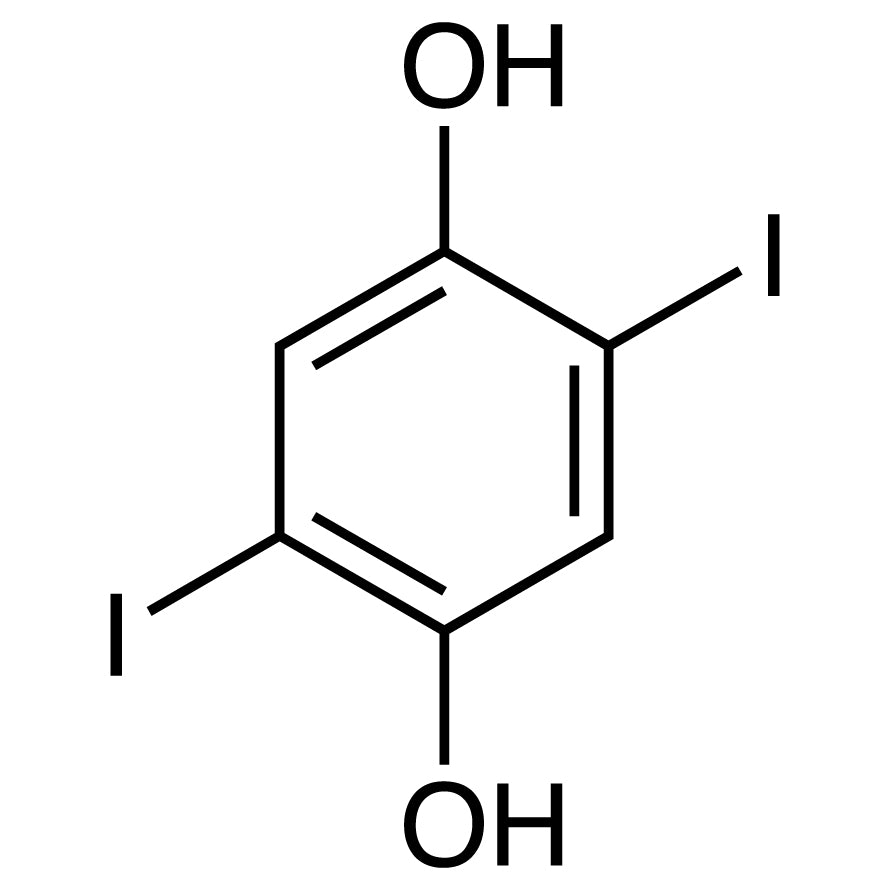
2,5-Diiodobenzene-1,4-diol is a chemical compound widely used in laboratory settings for its versatility in organic synthesis. This compound serves as a key building block in the creation of complex organic molecules, particularly those requiring iodine and hydroxyl group substitutions. Its aromatic structure, with two iodine atoms at positions 2 and 5 and two hydroxyl groups at positions 1 and 4, makes it a valuable reagent in various chemical reactions. The compound is commonly employed in halogenation and reduction reactions due to its reactivity and functional group compatibility.
The chemical properties of 2,5-Diiodobenzene-1,4-diol make it a preferred choice for researchers. Its stability under controlled conditions allows for predictable outcomes in synthetic processes, while its reactivity enables participation in a wide range of chemical transformations. The presence of both iodine and hydroxyl groups provides multiple functionalization opportunities, making it suitable for advanced organic synthesis. Additionally, its solubility in polar solvents enhances its utility in laboratory procedures. These characteristics make it an essential component in both academic and industrial research environments.
In Indonesian laboratories, 2,5-Diiodobenzene-1,4-diol is frequently used in research related to organic chemistry, pharmaceutical development, and material science. It is a staple in academic institutions and research centers where the synthesis of new compounds is a priority. Its role in drug discovery and the development of functional materials underscores its importance in scientific innovation within the region.
TCI brochures (PDF)
- Iodinated Phenol/Benzoic Acid/Benzaldehyde Building Blocks 2024-11-15 · p. 1
Related TCI products
- Organic synthesis applications benefit from its iodine and hydroxyl groups, enabling substitution reactions and functional group modifications.
- Pharmaceutical research utilizes the compound for the development of new drugs, leveraging its reactivity in complex molecule synthesis.
- Material science applications take advantage of its structural versatility for creating advanced polymers and functional materials.
- Academic research in chemistry relies on its use as a building block for teaching and experimental purposes.
- Industrial chemical processes incorporate it for the production of specialized compounds requiring precise functional group manipulation.
| Brand | TCI |
|---|---|
| CAS number | 13064-64-7 |
| Molecular formula | — |
| Purity | — |
| Category | Chemistry > Building Blocks > Non-Heterocyclic Building Blocks |
| Pack sizes | Available in various quantities as per standard laboratory supply |
| Physical form | Solid |
| Storage | Store in a cool, dry place away from light and moisture |
2,5-Diiodobenzene-1,4-diol should be stored in a cool, dry environment, away from direct sunlight and moisture. It is recommended to use airtight containers to prevent exposure to air and humidity, which may affect its stability. Due to its reactivity, it should be handled with appropriate personal protective equipment, including gloves and safety goggles. It is important to store it separately from incompatible substances such as strong oxidizers. In laboratory settings, it should be kept in a well-ventilated area to minimize potential hazards. Proper labeling and storage practices ensure safe handling and maintain the compound's effectiveness for research purposes.
—
Produk Terkait
-
1-Benzyloxy-4-iodobenzene TCI B4692
Regular price From Rp 3.551.100,00Regular price -
1-Benzyloxy-3-iodobenzene TCI B4689
Regular price Rp 2.597.700,00Regular price -
4-Hydroxy-3,5-diiodobenzaldehyde TCI H1539
Regular price From Rp 2.650.200,00Regular price -
2,4-Dimethoxyiodobenzene TCI D0636
Regular price Rp 4.743.900,00Regular price -
2-IodobenzenesulfonylChloride TCI I0811
Regular price From Rp 4.506.600,00Regular price -
Sodium2-Iodobenzenesulfonate TCI S0848
Regular price From Rp 3.100.650,00Regular price -
4-IodobenzenesulfonylChloride TCI I0051
Regular price From Rp 1.961.400,00Regular price -
3-Hydroxy-2,4,6-triiodobenzaldehyde TCI H1944
Regular price From Rp 2.889.600,00Regular price