

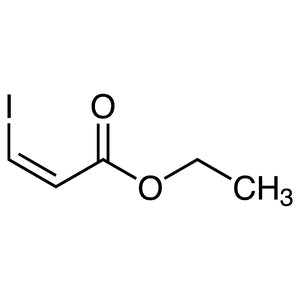
Ethyl cis-3-Iodoacrylate (stabilized with Copper chip), with CAS number 31930-36-6, is a chemical compound widely used as a building block in organic synthesis. It plays a crucial role in laboratory settings where the formation of carbon-carbon bonds or substitution reactions is required. This compound is particularly valuable for its reactivity, which makes it suitable for a variety of synthetic pathways. Its presence in chemical reactions allows for the development of complex molecular structures, making it a key reagent in advanced organic chemistry research.
The compound's reactivity is primarily attributed to the presence of the iodo group on the acrylate chain, which enhances its ability to participate in various chemical transformations. Stabilization with a copper chip helps control its reactivity, reducing the risk of unwanted side reactions and extending its shelf life. This controlled reactivity makes it a preferred choice for researchers who require precise control over chemical processes. The stabilization also ensures that the compound remains stable under normal laboratory conditions, enhancing its usability in a wide range of applications.
In Indonesian laboratories, Ethyl cis-3-Iodoacrylate is commonly used in organic chemistry research, particularly in academic and research institutions. It is frequently employed in projects related to the synthesis of new compounds, drug development, and studies on organic reactivity. Its versatility and stability make it an essential tool for chemists working on complex molecular structures and reaction mechanisms.
Related TCI products
- TCI P0676 25215-53-6 Monobutyl Phthalate Copper(II) Salt
- TCI I0912 53064-79-2 Iodomethyl Pivalate (stabilized with Copper chip)
- TCI B1905 3814-34-4 1-Bromo-2-ethylbutane (stabilized with Copper chip)
- TCI B1412 13294-71-8 2-Bromo-2-butene (stabilized with Copper chip)
- TCI B1289 3377-87-5 3-Bromohexane (contains 2-Bromohexane) (stabilized with Copper chip)
- TCI B1235 3377-86-4 2-Bromohexane (contains 3-Bromohexane) (stabilized with Copper chip)
- Organic synthesis applications benefit from Ethyl cis-3-Iodoacrylate due to its reactivity and ability to form carbon-carbon bonds, making it ideal for creating complex molecular structures.
- Drug development projects often utilize this compound because of its role in synthesizing compounds with antimitotic properties, which are crucial in pharmaceutical research.
- Research on organic reactivity frequently involves this compound as it provides insights into how different functional groups interact in chemical reactions.
- Academic institutions use it in teaching and research to demonstrate the principles of organic chemistry and synthetic pathways.
- Industrial chemical processes may incorporate this compound for the production of specialty chemicals requiring controlled reactivity and stability.
| Brand | TCI |
|---|---|
| CAS number | 31930-36-6 |
| Molecular formula | — |
| Purity | — |
| Category | Chemistry > Building Blocks > Non-Heterocyclic Building Blocks |
| Pack sizes | Available in standard laboratory quantities |
| Physical form | Liquid |
| Storage | Store in a cool, dry place away from light and moisture |
Ethyl cis-3-Iodoacrylate should be stored in a cool, dry place, away from direct light and moisture to maintain its stability and prevent degradation. It is recommended to use airtight containers made of glass or polyethylene to minimize exposure to air and moisture. Due to its reactivity, it should be handled in a well-ventilated area, and appropriate personal protective equipment such as gloves and goggles should be worn. Avoid contact with incompatible materials such as strong oxidizers or bases. The stabilized form with a copper chip helps reduce the risk of unintended reactions, but proper storage is still essential to ensure long-term usability and safety in the laboratory.
—
Produk Terkait
-
MonobutylPhthalateCopper(II)Salt TCI P0676
Regular price Rp 3.817.800,00Regular price -
IodomethylPivalate(stabilizedwithCopperchip) TCI I0912
Regular price Rp 2.279.550,00Regular price -
1-Bromo-2-ethylbutane(stabilizedwithCopperchip) TCI B1905
Regular price From Rp 1.035.300,00Regular price -
2-Bromo-2-butene(stabilizedwithCopperchip) TCI B1412
Regular price From Rp 1.724.100,00Regular price -
3-Bromohexane(contains2-Bromohexane)(stabilizedwithCopperchip) TCI B1289
Regular price Rp 7.023.450,00Regular price -
2-Bromohexane(contains3-Bromohexane)(stabilizedwithCopperchip) TCI B1235
Regular price Rp 3.763.200,00Regular price -
2-Iodobutane(stabilizedwithCopperchip) TCI B1093
Regular price Rp 980.700,00Regular price -
2-Iodo-2-methylpropane(stabilizedwithCopperchip) TCI B1072
Regular price Rp 2.332.050,00Regular price


